Tuesday, 26 July 2011

Smash the dragons!

Occasionally, life is awesome. And thus it was that the local 'independent' cinema put on a screening of The Battleship Potemkin (1925), a film I had previously only seen on DVD. It absolutely blew me away. If you see The Battleship Potemkin - and until you do, your life will be incomplete - you must see it in the cinema: the film needs the space the big screen affords to develop its full power.

It's worth recalling the extent to which the Russian Revolution, which director Sergei Eisenstein served as a Red Army soldier from 1918, inspired an incredible boom of the avant-garde in Russia: in music, visual arts and film, Russia was world-leading in the first half of the 1920s, until the ossification of Soviet public life stifled the arts.

The Battleship Potemkin was Sergei Eisenstein's second full-length feature, after 1924's Strike. At twenty-seven years Eisenstein was considered a prodigy when he filmed The Battleship Potemkin, the troubles with Soviet authorities that would cast a shadow over his masterpiece, October (1927), still ahead of him. Although the film's success at home was less than stellar, it fared better internationally.

Designed as the ultimate revolutionary propaganda film, The Battleship Potemkin is divided into five dramatically distinct parts. In 'Men and Maggots', sailors on the battleship Potemkin of the Black Sea Fleet become angered by the rotten, maggot-infested meat they are asked to eat during the first, failed Russian Revolution of 1905.
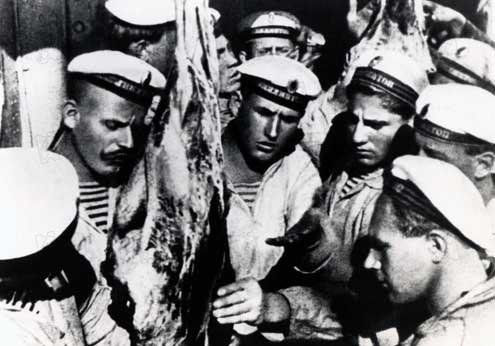
In 'Drama on the Deck', the conflict comes to a head as the officers' decision to shoot down those unwilling to eat is confronted by a mutiny led by Grigory Vakulinchuk (Aleksandr Antonov). After a fight, the mutinous sailors take over the ship.


After the fallen Vakulinchuk is mourned over by the people of nearby Odessa in 'A Dead Man Calls for Justice', the revolutionary population is massacred by Tsarist troops and Cossacks on 'The Odessa Steps'. Finally, the Potemkin must face a naval squadron sent to quash the mutiny.

The version I saw was restored by the Deutsche Kinemathek and claims to be as close to the original as possible, unlike previous versions compromised by Stalin-era re-editing. It is distinctive for its soundtrack, a re-recording of Edmund Meisel's original score, and for the colouring of the red flag the Potemkin flies after the successful mutiny. The brilliant red in a black-and-white film is quite striking and I am more than willing to accept this deviation from the original, since it seems very much in the spirit of Eisenstein. There, are, however, some errors in the subtitles: the call to 'smash the dragons!' is a point of particularly hilarity, although thankfully it does not impede efforts to disarm the dragoons.

Seeing The Battleship Potemkin on the big screen I was very much struck by the perfection of the compositions by cinematographer Eduard Tisse and Eisenstein himself. Image after image is perfectly created; this almost leads to a feeling of sensory overload as the modern viewer is too used to the narrative-centred, 'getting out of the actors' way' style of twenty-first-century direction.
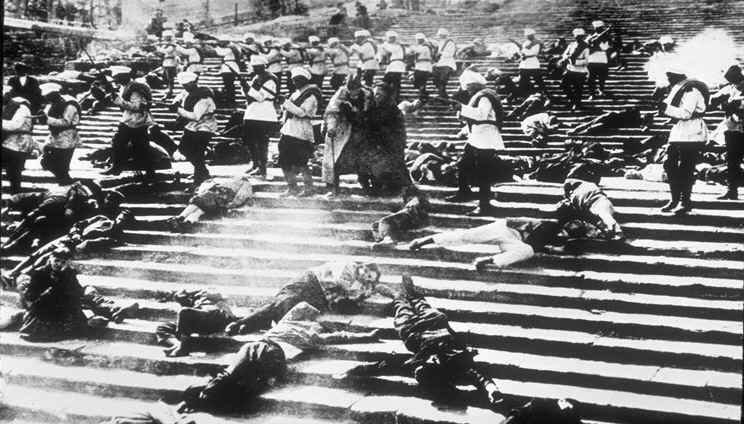

The Odessa steps sequence is the film's most famous by far. And it deserves to be: it's perfectly shot and shockingly violent by the standards of the times. But it shouldn't overshadow other scenes. The early confrontation between recalcitrant sailors and officers is particularly tense, as is the climactic showdown between Potemkin and the Tsarist squadron.

Eisenstein films are notable in eschewing the individualism that is endemic in western cinema. So it is with The Battleship Potemkin: although Vakulinchuk is the only named sailor, he is killed in the second of the film's five episodes and remains a cipher, no more than a spokesman for the revolutionary proletariat. No, the protagonist of The Battleship Potemkin is the collective of the mutinous sailors and, in chapters three and four, the revolting populace of Odessa. It is virtually only the villains who actually receive names.


Speaking of villains: as a work of Soviet propaganda, the film of course deals in broad stereotypes. The bad guys walk around in finery and sport monocles; one attempts to turn the people's assembly in Odessa into a pogrom and is beaten to death for his troubles by the people, who of course know their woes cannot be blamed on the Jews. But such a clear distinction between heroes and villains is not necessarily a bad thing; indeed The Battleship Potemkin absolutely could not work if the counter-revolutionaries were treated fairly.

Propaganda, then: but what propaganda! You don't need to be a dirty Red like me to enjoy this film (although it helps): Joseph Goebbels was apparently a jealous admirer of Eisenstein's craft. But you must  bring a willingness to accept collective protagonists, the flexibility to adjust to silent film, and sturdy footwear to prevent your socks from being blown off. What are you waiting for? To the cinema, post haste.

Monday, 25 July 2011

Someday this war's gonna end

Sometimes a film surprises you. I expected First Blood (1982) to be a big, dumb action film. I didn't know anything about it before: nothing more, in fact, than the cliché of Rambo in pop culture. Instead, First Blood turns out to be one of the finest thrillers I have ever seen. I expected big, shiny and shallow; I got small and gritty, with surprising depth.

In the winter of 1981, Vietrnam War veteran John Rambo (Sylvester Stallone, who also co-wrote the script) sets out to visit a friend from his unit in the town of Hope, Washington (portrayed by the town of Hope, British Columbia). Finding out his friend has died from the after-effects of Agent Orange exposure, Rambo sets out to leave town, but is harassed and eventually arrested for vagrancy by local sheriff Teasle (Brian Dennehy), who doesn't like Rambo's scruffy appearance.

In custody Rambo is abused both verbally and physically by police officers including Galt (Jack Starrett) and Mitch (a young David Caruso). When ill-treatment leads to flashbacks of torture in Vietnam, Rambo attacks the policemen and escapes into the mountains. He is pursued by Teasle and his posse, but fights them off, injuring several men and inadvertently killing Galt. Teasle calls in the National Guard and begins a large-scale hunt for Rambo in hostile mountain terrain, although he is warned by Rambo's former commander, Colonel Trautman (Richard Crenna), that Rambo may be too experienced in guerrilla warfare to be captured.

It's been said before, but it's worth stating that Stallone is some manner of genius. He can't always be accused of the best judgment: in a career that includes Rocky and First Blood, he also made Over the Top (the armwrestling film!) and the much-maligned Judge Dredd. His attempts to hide his short stature are legendary. But at his peak he had creativity and determination, and it's Stallone the actor that is First Blood's greatest strength. His John Rambo is a man who hides his war and post-war scars beneath a bland exterior, a drifter both literal and metaphorical in an America that appears to have turned its back on him. And Stallone absolutely nails his character's crucial scene, a monologue at the end that is both riveting and harrowing.

Its focus on the treatment of Vietnam War veterans ultimately makes First Blood into political cinema. This was a near-ubiquitous trope in the aftermath of Vietnamese victory: Taxi Driver (1976) and The Deer Hunter (1978) dealt with the mental scars war inflicts, while Bruce Springsteen's 'Born in the USA' (1984) lambasted the United States' failure to reintegrate their veterans into society ('Went to see my VA man / He said, "Son, don't you understand?"').

That an arrest over vagrancy turns into a deadly manhunt is symptomatic of a failure to make peace - not just between Vietnam and the American empire, but also between veterans and society at large (Rambo: 'Nothing is over! Nothing! You just don't turn it off! ... Back there I could fly a gunship, I could drive a tank, I was in charge of million dollar equipment, back here I can't even hold a job parking cars!') Rambo is a man perpetually at war, and - without giving away too much - the ending is perfect in recognising this as the film's central theme.

Next to all the implicit and explicit politics, however, First Blood is also a brilliant action thriller. For starters, at 97 minutes it is absolutely fleet, without an ounce of padding. The action is brilliantly choreographed and shot and surprisingly realistic, particularly in the early and middle part of the film (towards the end it's a different story). And, in another validation of the old rule whereby an action film's quality is inversely proportional to amount of bloodshed shown* there is only one certain death. In 2011 as in 1982, an entertaining but thought-provoking action film that packs a punch like this is a rarity.

*Let's call it Q = k 1/b, where Q = quality, k = a constant I have yet to discover, and b = bodies.

Wednesday, 20 July 2011

Things fall apart. And by things I mean robots.

I liked Transformers. That may not be cool in certain circles, but those circles fail to love robots the way they should. I'm a fan of both Battlestar Galactica and Terminator, and by simple logic bigger robots should be more fun. That didn't work out perfectly, but the mixture of mecha-a-mecha action and teenage shenanigans appealed to me so much that I happily reckon Transformers a guilty pleasure. On the other hand, Transformers: Revenge of the Fallen felt like someone reading the phone book to you while kicking your face in for three hours.

So now, two years and a big public fight between actress Megan Fox and director Michael Bay later, we have Transformers: Dark of the Moon. Glory in that title, earthlings! Dark of the Moon, well, it doesn't make sense at a basic level. They just picked random words out of a dictionary. And so the title breaks down the seeming fixedness of language itself, leaving us to navigate a sea of unstable meanings.

It's been argued that Revenge of the Fallen was the first poststructuralist blockbuster. The non-existence of plot, the disappearance of any structure connecting images, characters and events showed the loss of fixed relationships in postmodernity. If we consider RotF a deconstruction of the blockbuster, DotM marks a cautious attempt at reconstruction: it has a discernible plot, which it mostly follows for a significant part of the film's running time. Until, that is, it goes utterly insane. But more of that later.

Plot, then: Sam Witwicky (Shia LaBeouf) has graduated from university and been ditched by wrench wench Mikaela. Having taken up with new love interest Carly (Rosie Huntington-Whiteley), who works for wealthy, smarmy Dylan (Patrick Dempsey), Sam finds a job of uncertain description with psychotic Bruce Brazos (John Malkovich). Meanwhile, it is revealed that the real purpose of the 1969 Apollo 11 mission was to investigate the wreck of The Ark, a Cybertronian ship containing Sentinel Prime, the original leader of the Autobots. Sentinel, however, turns out to not share the other Autobots' views on coexistence with humanity, and soon the Autobots and their human allies must stop the Decepticons from taking over Earth and enslaving humanity with the aid of five pillars aboard The Ark.

Michael Bay is not a merciful man: subplots around Sam's boss, his parents, and Dylan are drowned like a sack of kittens. But at the centre we have a real plot about mankind's attempts to prevent total Decepticon domination. It's not the freshest or most sophisticated of plots: but it's there, it's quite gripping for a good portion of the running time, and I'd take that over the sub-Eisensteinian montages of RotF any day. What's more, the film is much less visually and sonically aggressive than its predecessor, which constituted an all-out assault on the audience.

But in the massive, extended climactic battle nothing makes sense anymore. This is a pity because a good part of that scene is, in fact, awesome. But alas, all Decepticons look the same to the untrained eye - a problem that has persistently plagued the series, although it seems to be worsening - and so I genuinely thought Megatron had perished about five times in the space of twenty minutes. Stated plot points are suddenly violated. And in the worst Michael Bay tradition, the editing and framing makes it impossible to establish who is where or what is happening at any moment, leaving the viewer with nothing but noises and colours and no framework to help interpret the experience.

In a sense, this is worse than it was in RotF because through the coherence of the film to this point, the audience has been lulled into a false sense of security. DotM suddenly pulls the rug out from under our feet, demolishing the universe of meaning wholesale and simulating the disorienting collapse of modernity into postmodernity. What's more, it is perhaps the most realistic war film ever: as in real combat, we have no idea at all what is happening. Cherished certainties of sequence and association dissolve into air.

Next to this ultra-hip poststructuralism, however, there's unfortunately some good old-fashioned misogyny. Bay never attempts to convince us Carly exists for any purpose other than fanservice. The mercenary way in which Megan Fox was replaced by Rosie Huntington-Whiteley certainly does not inspire confidence in the director's intention to treat her as an actual human being. In the film's worst scene, Patrick Dempsey praises a car's design and 'curves' while the camera lingers over Miss Huntington-Whiteley's body. By association with the automobile she becomes nothing more than an object to be possessed by men. (Incidentally, her car-related job is proof that the writers just went through the script replacing 'Mikaela' with 'Carly'.)

There we have it, then: another film from this most distinctive of directors. It does not go as far in questioning the nature of cinema itself as RotF did, but its reliance on coherent plotting makes for a rather more enjoyable time at the cinema. 'Better', I'm afraid, is not good; and while freedom is indeed the right of all sentient beings, I may be willing to make an exception for Michael Bay.

Monday, 18 July 2011

Die Wacht in Wapping

Der Abhörskandal um die News of the World ist nicht nur eine Blamage für eine Zeitung oder einen Konzern. Vielmehr zeigt er die Verstrickungen zwischen der Macht Murdochs, der Polizei und der Politik. Als solches handelt es sich um eine Krise für einen gewaltigen Komplex - eine Krise, die die Meinungshoheit der britischen Herrscher insgesamt bedrohen könnte.

Das ist das Ausmaß des Skandals. Kein Wunder, daß Murdochs Parteigenossen darum ständig versuchen, das Ganze kleinzureden. Mein Lieblingsfeind Jan Fleischhauer zum Beispiel sieht hier nur einen Konflikt zwischen Murdoch, dem Helden der konservativen Volksmeinung, und linken Eliten, die den armen Mann wegen seiner unliebsamen politischen Überzeugungen verfolgen.

Es ist typisch für Fleischhauer, erstens das Thema grob zu entstellen und zweitens allerortens die Verschwörung der "Linken" zu wittern - die zu definieren er übrigens nicht vermag. In dieses Schema muß alles passen, darum die Verzerrung. Es lohnt sich darum selten, sich an Herrn Fleischhauer abzuarbeiten.

Dennoch muß der Behauptung entschieden widersprochen werden, daß, "wer auf die bunten Blätter herabschaut [sic!], [...] in Wahrheit auch das Volk [verachtet], das diese Medien groß und mächtig macht". Erstens wird hier wieder der eigentliche Punkt verzerrt: es geht hier nicht um den Boulevard an sich, sondern um die Macht Murdochs in Großbritannien, der ein stetig wachsendes Regiment von Medien straff nach Parteilinie gegen Migranten, Schwule und Linke hetzen läßt. Damit wird echte politische Meinungsbildung natürlich erschwert.

Wer also ein sich aggressiv ausbreitendes Imperium als letzte Bastion der Volksmeinung verstanden sehen will - wer den Milliardär Murdoch und einen gelackten Schreiberling zum Helden des kleinen Mannes macht - , der verdreht klar die realen Machtverhältnisse. Das hat bei Fleischhauer Methode. Er stilisiert sich stets als publizistischen Guerillakämpfer, als letzten Konservativen, den die linke Hegemonie mundtot machen will. Ironisch ist dabei, daß diese Selbststilisierung zum Opfer eben das ist, was Fleischhauer angeblich an den Linken mißfällt.

Zuletzt obliegt es mir, Herrn Fleischhauers albernes Nichtargument über entrüstete Deutsche abzutun: 
Die meisten, die sich nun hierzulande über Murdoch und die Recherchepraktiken in dessen Reich erregen, haben zwar wohl noch nie eines seiner Produkte in der Hand gehalten, aber man kann sich ja auch fremdempören. Das ist sogar noch schöner, als wenn man selbst nah dran ist.
  Nun muß man Herrn Fleischhauer zugestehen, daß er tatsächlich auch schon in Übersee gearbeitet hat. Zur Zeit linst er aber auch nur über seinen deutschen Schreibtisch. Nun, ich lebe in England, bin darum nah dran und darf Herrn Fleischhauer versichern, daß ich Murdochs Produkte in Händen gehalten und mich auch darum mitempört habe. Als dürfe man sich als Ausländer nicht aufregen: was wird da aus aller Empörung über die Zustände beim Feind, von Iran bis Nordkorea? Die sollten Fleischhauer und seine Spießgesellen dann wohl auch zurückziehen und sich auf eigene Sauställe besinnen.

Fleischhauer glaubt, in Kafkascher Hatz von der Linken verfolgt zu werden. Seine Wahnvorstellungen seien ihm gegönnt. In Wirklichkeit aber ist es Murdoch, dem in Großbritannien ein mächtiges Sprachrohr gehört. Der Kanonendonner gegen die Feinde des Australiers kann hier Debatten schaffen und abwürgen - dazu müssen oft nicht einmal Lügen geschmiert werden, Verzerrung reicht. Wer offene demokratische Meinungsbildung will, kann den Niedergang des Wapping-Reiches kaum bedauern.

Thursday, 14 July 2011

Love is best

In one year they sent a million fighters forth
           South and North,
And they built their gods a brazen pillar high
           As the sky,
Yet reserved a thousand chariots in full force -
           Gold, of course.
Oh heart! oh blood that freezes, blood that burns!
           Earth's returns
For whole centuries of folly, noise and sin!
           Shut them in,
With their triumphs and their glories and the rest!
           Love is best.
-Robert Browning, 'Love Among the Ruins'

Sunday, 10 July 2011

The Great War: American Front (Southern Victory Series, Part Three)

North America in 1914
This is the third post in my series on Harry Turtledove's Timeline-191, following my introduction and my review of How Few Remain. Naturally, from now on all reviews will contain spoilers for the preceding books.

There's a strong argument that the First World War could easily have ended very differently. If the German High Command had not diverted forces eastwards that were later missed during the Battle of the Marne - if Italy or later the United States had remained neutral - if the German spring offensive of 1918 had succeeded... The consequences of Central Powers victory would have been momentous.

So it's no surprise that Turtledove's opening scenario would knock something as precarious in real life as the First World War off balance completely. As you'll remember, in Turtledove's timeline the Confederacy defeats the United States in 1862 and again in 1881 in a rematch over the Confederate purchase of Sonora and Chihuahua from Mexico. Fast forward to 1914, and relations between the two American powers are frosty as ever. The USA, who have maintained close relations with the German Empire since the 1880s, are part of the Central Powers, while the CSA join Britain, France and Russia in the Quadruple Entente. When war breaks out, both powers enter the fray, with the USA having to fight Canada and Britain in the north and the Confederates in the south.

As argued here, this scenario is quite problematic. Conducting an arms race against both Germany and the USA would have overstretched Britain impossibly, and it therefore seems likely Britain would have sought an accommodation with one of these powers. Historically, England decided to remain neutral towards the United States, while planning for a confrontation with Germany; there is no reason why this should be different in Turtledove's timeline.

Indeed, the cost of conducting a land war along a border of almost 4000 miles would have convinced any British policy-makers to maintain neutrality towards the United States at almost any cost. Not to mention that the CSA could provide no benefit to Britain in a European war unless the USA were neutral, freeing up CS resources - an unlikely scenario at best.

I disagree, however, with the notion that Britain would have allied herself with the USA against the CSA. It seems more likely to me that British diplomacy would have been aimed at stopping the war from spreading to North America entirely through neutrality towards the USA, which would have forced the CSA into neutrality, since they could never have fought the North by themselves. Like Britain, Germany would have no incentive to ally itself to the Confederate States.

In Turtledove's timeline, the most likely scenario therefore seems peace in North America, or else an opportunistic US-British alliance in which the US could have attacked the South with impunity. But of course, Turtledove is at this particular point not interested in historical plausibility: what he wants is a massive land war in North America, and his scenario gives it to him.

Like How Few Remain, The Great War: American Front is told through a number of characters. But this time there are rather more of them and they're entirely fictional. That's not without its problems, unfortunately, for Turtledove is on rails here: he feels the need to create allohistorical analogues for people and events that do not occur in his timeline. You get one guess, for example, to figure out who 'Irving Morrell' (say it out loud), US tactician making his name with innovative tactics of surprise and speed on the Alpine Rocky Mountains front, might be based on. Unfortunately this sort of thing abounds.

Generally the oppressed characters (women, blacks, and civilians living under military occupation) are far more interesting than the relatively tedious middle-class white men. That rule of thumb is not without its exceptions: Anne Colleton, as a Scarlett O'Hara expy, is possibly my least favourite character. The opposite goes for Flora Hamburger (gee, I wonder which real person's name Turtledove might be inspired by here), socialist agitator in New York, who I can really root for.

Unfortunately, American Front is also somewhat less well written than How Few Remain, to put it mildly. I present you with the very first paragraph of the book:
The leaves on the trees were beginning to go from green to red, as if swiped by a painter's brush. A lot of the grass near the banks of the Susquehanna, down by New Cumberland, had been painted red, too, red with blood.
Someone please make him stop. Clumsy exposition is another massive problem:
'General McClellan, whatever his virtues, is not a hasty man', Lee observed, smiling at Chilton's derisive use of the grandiloquent nickname the Northern papers had given the commander of the Army of the Potomac. 'Those people' - his own habitual name for the foe - 'were also perhaps ill-advised to accept battle in front of a river with only one bridge offering a line of retreat should their plans miscarry.'
This sort of unspeakably awful thing goes on for six hundred pages, I'm sorry to say. Turtledove was perhaps ill-advised to include in-text exposition rather than append some basic information and allow the reader to figure out a lot of facts, rather than constantly attempting to show how much research he's done. A sense of strangeness, rather than thudding exposition at every turn, would surely serve an alternate history novel well.

So, then: Harry Turtledove is a pretty bad writer. But I'm not ashamed to say I'm devouring this series all the same. It's far more plausible than is usually the case with alternate history, it's aware of social and political issues (especially blacks' struggles) to an uncommon extent, and it offers really fascinating breaks from our timeline and occasional wonderful touches (of which more next time). I do hope it picks up a bit, though.

In this series:
Setting the scene
How Few Remain
The Great War: Walk in Hell
The Great War: Breakthroughs 

Thursday, 7 July 2011

How Few Remain (Southern Victory Series, Part 2)


This post follows my introduction to the general setting of Harry Turtledove's alternate history timeline in which the Confederacy wins the American Civil War in 1862.

In the Anglosphere at least, Southern victory in the American Civil War is one of the most popular historical 'What ifs?', beaten out only by a certain other scenario which Godwin's law won't let me mention. So Turtledove had to choose an original approach if he wanted to make his mark. That he did it twice is to his credit.

In The Guns of the South (1992), time-travelling white supremacists armed a beleaguered Robert E. Lee with AK-47s for the 1964 campaign, leading to a Confederate victory. So when How Few Remain was published in 1997, Turtledove was at pains to point out that it was not a sequel to the earlier book, but rather the beginning of an entirely different timeline: one in which the Confederacy won 'through natural causes', as outlined in my earlier post.

How Few Remain picks up the story in 1881. The Union and the Confederacy remain rivals. The CSA have maintained strong ties with their allies Britain and France while also taking Cuba and Puerto Rico from the fading Spanish Empire. The USA, by contrast, have crushed the resistance of the remaining Indians but have not taken Alaska from the Russian Empire. But trouble starts a-brewin' when the CSA offer to buy the provinces of Sonora and Chihuahua from a perpetually broke Mexican Empire. (In Turtledove's timeline, French intervention in Mexico was successful, leaving a feeble Emperor Maximilian on the throne.)

You see, buying up Sonora and Chihuahua would give the Confederates access to the Gulf of California and raises the prospect of a Confederate transcontinental railroad. The USA, keen to (a) keep the Confederacy out of the Pacific and (b) give the 'Rebs' a good thrashing to make up for the War of Secession, soon declare war. Britain and France both join their Confederate allies. President James Longstreet, a prudent politician, even agrees to manumit the Confederacy's slaves in return for European support.

Like all the books in the Southern Victory series, How Few Remain is narrated in the third person through a number of point-of-view characters; but unlike later books, there are fewer of them, and they're all well-known historical characters. There's Abraham Lincoln, socialist orator and former president of the US; Thomas 'Stonewall' Jackson, general-in-chief of the Confederate States Army; Samuel Clemens, newspaper editor in San Francisco; Frederick Douglass, abolitionist, journalist, and orator; George Armstrong Custer, US cavalry colonel; Theodore Roosevelt, an independently wealthy landowner in Montana; Jeb Stuart, commander of the Confederate forces in the Trans-Mississippi; and Alfred von Schlieffen, the German Empire's military attaché to the United States.

These are really fascinating characters, and Turtledove does a really good job of showing how a different outcome in 1862 put them on alternate paths. As a socialist, I'm obviously rather pleased with Abraham Lincoln's adoption of Marx (but not poor, perpetually forgotten Engels, apparently). Because they're based on historical figures, Turtledove has little trouble creating rounded, compelling characters. And he finds their voice, too: I'm especially pleasantly surprised by his invocation of Sam Clemens's journalistic style.

Most characters here are the sort of people you can root for, too: that goes especially for Lincoln, Douglass and Clemens and not at all for Custer, who is stupid, vainglorious, arrogant and selfish, but quite fascinating all the same. The Ensemble Darkhorse is Alfred von Schlieffen, who's a genuinely likeable character despite coming up with the military plan that bears his name. Turtledove must be criticised, however, for his frequent and annoying use of Poirot Speak: foreign characters fall back on their native language for simple words, not coincidentally those the monoglot reader is most likely to know. This tends to render them a little ridiculous.

All in all, How Few Remain presents a thoroughly plausible alternate timeline with largely rounded and compelling characters, and with a warm humanity suffused throughout: Turtledove never cushions the systemic inhumanity of slavery. A good start, then: let’s see if he can keep it up in The Great War: American Front.

In this series:
Setting the scene
How Few Remain
The Great War: American Front
The Great War: Walk in Hell
The Great War: Breakthroughs