Thursday, 23 February 2012
'When the Guns Come Out' (Justified, Season 3, Episode 6)
'When the Guns Come Out' is a breather episode dealing with the aftermath of the fairly momentous happenings of 'The Devil You Know' and 'Thick as Mud'. But it's far from filler: the episode allows us to get to know our hero better, brings back some of the Justified's trademark humour, and pushes the plot forward in ways that will surely pay off down the line. It isn't particularly suspenseful, but I can deal with that.
But before we get to all that: Tim is back! I've complained repeatedly about Jacob Pitts being absent from Justified for much of this season, seeing it as a general problem the show has with ignoring some of its recurring characters to focus on colourful one-offs. And while Tim Gutterson is a one-scene wonder here, he popped in just to remind me why I kind of love his character: he's wry, pragmatic and not in awe of Raylan, to whom he may well feel superior. (And as a marshal, he probably is.)
In 'When the Guns Come Out', one of Boyd's travelling oxycontin clinics is hit by gunmen who kill two men and a working girl, but her colleague manages to survive unnoticed by the murderers. Boyd and Ava, realising that Quarles, the obvious suspect, is too smart to make such a move, suspect Ellstin Limehouse. Meanwhile, Raylan has to cope with Winona's departure at the end of 'Thick as Mud', and we see an angry, hurt man whose request for some time off is not initially granted by Art, who wants him to sort out the oxy situation in Harlan.
The oxy plot never gets too tense: there's no real sense of danger as Raylan faces down the gunmen, although the episode also features one of Justified's best action sequences, in which Raylan and a criminal wrestle in a moving trailer. Instead, the episode reveals character: Raylan, who channels his heartbreak into suspecting Winona of theft; Winona herself, who has accepted she cannot raise her child around Raylan's job; Boyd and Ava, calculating but perhaps overmatched; and Limehouse, who sees his caution - always being in the know, not openly waging war lest white people threaten his holler - threatened by a hotheaded subordinate. And then there's the hilarious final twist, one of the most fun moments on this show in quite some time. No complaints from me, no sir.
Monday, 20 February 2012
Hyborian twilight
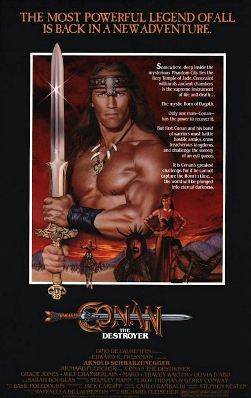
Like its predecessor, Conan the Destroyer didn't set cinema on fire. But in an industry of marginal profits, the film's considerable success at the box office made a third film set in the world of Robert E. Howard all but inevitable. That film, Conan the Conqueror - the long-promised story that shall also be told, of how Conan became a king in his own hand -, never left development hell; and for that we can thank the ignominious failure of the series spin-off Red Sonja.Red Sonja's production was rushed compared to the two-year gap between the Conan films. I've remarked on the breakneck pace the Italian film industry was capable of in its glory days, and if Richard Fleischer did not quite match Mario Bava's feat of releasing two of his films twelve days apart, it's still worth noting that Conan the Destroyer left cinemas in August 1984 and principal photography for Red Sonja took place that same November, for a summer 1985 release. That sort of pace may be common in low-budget horror, but it's quite something for sword and sorcery, which calls for massive sets, landscape photography and epic battles.
Those three months during the autumn of 1984, however, saw the release of The Terminator. That film's massive success - a worldwide gross of $78 million, comparable to the Conan films but nothing to sniff at considering it had only a third of the sword-and-sorcery films' budget - suggested to Schwarzenegger that he had a legitimate, loincloth-free career ahead of him. When Red Sonja bombed, taking in less than $7m on a $17.9m budget, he abandoned the barbarian genre and became the action/comedy star - and eventually the politician and philanderer - we know and possibly still love today.
When Red Sonja (Brigitte Nielsen) rejects the lesbian advances of the evil queen Gedren (Sandahl Bergman), Gedren has her family murdered while Sonja is raped by her soldiers and left for dead before being revived by a spirit voice. (It's never revealed who this spirit - who speaks to Sonja only twice in the course of the film, never in a plot-relevant function - is, which strikes me as one of the tell-tale signs of a script that was butchered and stitched together again by some literary Leatherface.)
Later, somewhere else, a group of priestesses tries to destroy a dangerous talisman, but they're attacked and killed by the goons of Gedren, who wants the power of the talisman for herself to rule the world. Sonja's sister Varna (Janet Agren) manages to flee, but is shot in the back before being rescued by random hero-lord 'Kalidor' (Arnold Schwarzenegger). It remains one of the film's mysteries why it was felt necessary to create a character who is clearly Conan with the serial numbers filed off: legal reasons, perhaps. Anyway, Kalidor messily kills several of Gedren's goons (Red Sonja cranks up the gore to Conan the Barbarian levels again, after the tamer Destroyer) and carries the dying Varna off to Sonja, who has been trained as a mighty warrior by a vaguely Oriental sword-master (Tad Horino).
When Sonja finds out what's going on, she decides to stop Gedren, initally leaving Kalidor who nonetheless, as Tim Brayton puts it, 'just pops in like a wacky neighbor on a sitcom' during the film's first half. She fights and kills the warlord Brytag (Pat Roach) for no discernible reason and encounters Tarn (Ernie Reyes Jr.) and Falkon (Paul Smith), a child prince and his manservant who have lost their kingdom to Gedren's newly powerful forces. Eventually, the four make it through the wilderness, encountering exactly no people, and square off against Gedren and her magic tricks.
Though undeniably very bad - if Schwarzenegger's jest about punishing his progeny by subjecting them to this film were true, it would constitute child abuse - Red Sonja is at least as 'good' as Conan the Destroyer, and feels a lot better by mercifully coming in under ninety minutes. Written by two Britons, Clive Exter (who later wrote no fewer than twenty-three episodes of Jeeves and Wooster, if you can believe it) and George MacDonald Fraser (who co-wrote Octopussy), Red Sonja's plot is as unsteady and aimless as that of the preceding films, but it's a whole lot less padded, avoiding the cosmic tedium of Destroyer's sleepy second half. The worst thing you can say about is that it introduces that shopworn trope, the Annoying Kid; but at least Tarn turns heroic fairly early on.
At the same time, the casting departments must have been mad as a hatter convention, for the sheer number of series veterans re-cast in totally different roles makes viewing a profoundly baffling experience. Besides Schwarzenegger - who, as the film's most bankable star, is billed above the then unknown Nielsen - there's Bergman, who played Conan's true, sadly nameless love in Barbarian, rendered less recognisable by a mask covering half her face, a fairly terrible black wig, and a deliciously hammy performance. The casting of Pat Roach, who played the illusionist Toth-Amon in Destroyer, as the villainous Brytag is less justifiable, especially since his cameo is mere padding. Danish bodybuilder Sven-Ole Thorsen, however, takes the cake, with his third character in as many films.
Schwarzenegger's performance is, well, vintage Arnie: no-one could make a line like 'She's dead. [Pause.] And the living have work to do' sound quite so earnest yet hilarious. But let's consider Brigitte Nielsen for a moment. Twenty-one years old, with no real acting experience, her uninflected, wooden performance is truly horrendous in exactly that oddly fitting Schwarzeneggerian mould, and they're perfectly matched on set. But where the Austrian reached superstardom, Nielsen briefly became Mrs Sylvester Stallone, met Ronald Reagan, appeared in Playboy a couple of times and has lived out the rest of her career on reality television. Just a few weeks ago, Nielsen won the German version of I'm a Celebrity... Get Me Out of Here!.
Richard Fleischer, returning to the director's chair after Conan the Destroyer, largely keeps it steady. At some point, though, he must have decided to prove that a leopard can change its spots and also why it shouldn't, by serving up a couple of absolutely nonsensical first-person shots during sword-fighting scenes. It's in the special effects department that Red Sonja is a real let-down, however. Whether it was time or money, the film resorts to mattes - gorgeously painted mattes, I grant - where John Milius in his Barbarian days would probably have built a full set. Contrast the visuals of Conan the Barbarian with the pretty but totally artificial look of Red Sonja:
The costumes and sets, alas, are the series' weakest by far, preposterous without once looking striking. In one battle scene - I'm not making this up, I swear - one mook wears blue jeans, which I'm fairly sure were not invented in the Hyborian Age. And speaking of battles, the swordfighting - choreographed by stunt coordinator Sergio Mioni, I presume - is noticeably worse than in either of the earlier films. Saddled with a leaden script, poor effects and an extraordinarily lazy Ennio Morricone score, Red Sonja cannot help being terrible; but while not as rousing as the first film, it is at least less infuriating than Conan the Destroyer.
In this series: Conan the Barbarian (1982) | Conan the Destroyer (1984) | Red Sonja (1985) | Conan the Barbarian (2011)
Thursday, 16 February 2012
John Piper is wrong about women
American pastor John Piper has come under criticism for saying that God gave Christianity a 'masculine feel'. Piper's assertions (which gender important virtues male, among other things) have been thoroughly refuted all over the blogosphere. In the slightly older video above, Piper discusses the question of domestic abuse (beginning with an ill-advised chuckle). He ends up suggesting that women should endure verbal abuse 'for a season' and endure 'being smacked' for one night, before taking the problem to the church.
These remarks are, of course, despicable. The fact that Piper seems to mean nothing by them makes it worse: his ignorance suggests that he lives in a subculture so male-centred that he is insulated from listening to women at all. Most of all, Piper seems to be totally unaware of the strong association between patriarchy and abuse. As Women's Aid put it:
Domestic violence against women by men is "caused"* by the misuse of power and control within a context of male privilege. Male privilege operates on an individual and societal level to maintain a situation of male dominance, where men have power over women and children. Perpetrators of domestic violence choose to behave abusively to get what they want and gain control. Their behaviour often originates from a sense of entitlement which is often supported by sexist, racist, homophobic and other discriminatory attitudes. In this way, domestic violence by men against women can be seen as a consequence of the inequalities between men and women, rooted in patriarchal traditions that encourage men to believe they are entitled to power and control over their partners.Violence is typically the assertion of male control, not the loss of it in a fit of rage. Male rule - for which 'godly male leadership' is but a euphemism; it's difficult to imagine what besides rule Piper means by 'leadership' in concrete situations - sets the context in which women suffer violence. The belief that Christianity is chiefly masculine relegates women to second-class status, appendages of their husbands whom they are obliged to obey. This puts women into the impossible situation of choosing between their own safety and well-being (by seeking help, which may involve leaving their husband) and obedience to Christ.
Short of situations in which we are ordered to disown Jesus, that dilemma is false. We follow a Lord who was and is eternally human, who mourns with those who mourn, who will not break a bruised reed or snuff out a smouldering wick. Never forget that He began his ministry like this (Luke 4:16-21):
He went to Nazareth, where he had been brought up, and on the Sabbath day he went into the synagogue, as was his custom. He stood up to read, and the scroll of the prophet Isaiah was handed to him. Unrolling it, he found the place where it is written:It's horrifying that End Violence Against Women, for example, need to advise visitors how to cover their tracks to prevent their abuser from finding out they're seeking help. So much for the 'Christian foundations' of 'western civilisation' supposedly under threat: Piper's assertion that 'the fullest flourishing of women and men takes place in churches and families that have this masculine feel' is comprehensively refuted by two thousand years of church history.
"The Spirit of the Lord is on me,
because he has anointed me
to proclaim good news to the poor.
He has sent me to proclaim freedom for the prisoners
and recovery of sight for the blind,
to set the oppressed free,
to proclaim the year of the Lord's favour."
Then he rolled up the scroll, gave it back to the attendant and sat down. The eyes of everyone in the synagogue were fastened on him. He began by saying to them, "Today this scripture is fulfilled in your hearing."
Of course, as Piper says, the church can play a part in tackling abuse by running women's shelters or by excommunicating known abusers. But in its present form the church is ill-equipped for these tasks. It cannot honestly claim innocence from abuse until it abandons male rule. You cannot both deplore violence and argue for the continuing existence of contexts in which violence occurs: something has to give. Because white rule was the root cause of lynchings, the answer could not be a more benevolent form of white rule; it was and is the abolition of white rule itself. Isn't it time we said the same of patriarchy?
*The inverted commas signify the FAQ's insistence that it is ultimately the abuser who is responsible for violence, and that social context does not abolish responsibility.
Labels:
Christianity,
evangelicalism,
gender,
Jesus,
Redemption Day
Wednesday, 15 February 2012
'Thick as Mud' (Justified, Season 3, Episode 5)
This week Justified gave us the long-awaited first confrontation between Robert Quarles and Boyd Crowder, and it was awesome. That alone would have made 'Thick as Mud' a good episode, but the A-plot - which focused on Dewey Crowe (the always-welcome Damon Herriman) being preyed on by ruthless organ harvesters - was pretty excellent too.
After the criminals who broke Dickie and Dewey out of prison in 'The Devil You Know' saw their plans fall apart, they decide to make some cash by organ-harvesting. Dewey wakes up with surgical scars on his abdomen and is told by Lance (Clayne Crawford) that his kidneys have been removed, but he can buy them back if he comes up with $20,000 in the next couple of hours. This leads to Dewey frantically robbing electrical retailers, convenience shops, and strip clubs until Raylan catches up with him.
Who couldn't adore Dewey Crowe? As Raylan says in 'The Devil You Know', Dewey 'wants you to know he's bad, but doesn't have it down yet'. His bumbling incompetence - getting old after three seasons, let's face it - is given a twist in 'Thick as Mud' as he's made genuinely violent and dangerous by his conviction that time is running out. Even so, his insistence that he's 'a desperate man' smacks of play-acting on a certain level, and the plotline's benign resolution (turns out Dewey still has his kidneys after all) takes us away from the potentially dark ending.
Meanwhile, Boyd traces Devil's betrayal back to Quarles and decides to send a message by brutalising the latter's henchman and taking a slice of his oxycontin business. His interest stirred, Quarles drops by Johnny's bar and makes Boyd a business offer, but is rebuffed when Boyd, initially courteous, calls him a 'carpetbagger'. It's a tense, funny and scary scene in which both actors are at their best. Neal McDonough in particular does some terrific work as he conveys Quarles's menace and outward courtesy when Boyd's insult sinks in.
Gio from Miami may not be the last outsider to find that he's underestimated Harlan. As Boyd tells Quarles, 'carpetbaggers in three-piece suits have been coming to Harlan for a long time. They have a habit of dying off like deer flies at the end of summer.' I don't know who will keep the upper hand in the confrontation between Detroit and Harlan, and for the first time, I think Quarles doesn't know either.
Tuesday, 14 February 2012
If your neighbour worships twenty gods: a note on biblical law and religious toleration
Christians are used to seeing secular society - whose institutions favour no particular faith - as a dire threat. To John Piper, for example, '[t]he modern secular world... tries to remove God from his all-creating, all- sustaining, all-defining, all-governing place [and] has no choice but to make itself god'. In other words, a secular society is blasphemous by definition. Against this conservative appraisal, I'll suggest secularism is most fruitfully understood not as a menace destroying western civilisation from within, but as a blessing longed for by those who did not enjoy it, made possible by Jesus' death on the cross.
At the same time, I'll argue that the liberal understanding of secularism is ahistorical and impossible to square with biblical evidence. Here, for example, is the excellent blogger Fred Clark, arguing against the US Catholic bishops' attempt to stop contraceptive services for women:
'It does me no injury,' Thomas Jefferson wrote, 'for my neighbour to say there are 20 gods or no God. It neither picks my pocket nor breaks my leg.' The advocates of burka-logic [sic] disagree. They insist that the very presence of such irreligious neighbors does them an injury - the injury of constraining their freedom to live unperturbed by the constant reminder of such blasphemies.This quintessentially liberal argument - my neighbour's religious predilections do me no harm, so I have no business constraining him - cannot survive an encounter with the God of the Old Testament. At Sinai God makes a covenant is with Israel as a community to ensure correct religious observance and moral behaviour in the land (Deuteronomy 1:1-14). The Mosaic Law does not offer any room for religious toleration. Indeed the Israelites are explicitly commanded to destroy all traces of Canaanite paganism if they wish to enjoy the land (Deuteronomy 12:1-4).
Contrary to Jefferson, under Old Testament law my neighbour's heterodox religious observance does pick my pocket and break my leg. The Religious Right's notion of 'individual responsibility' is quite absent in the Bible. God repeatedly threatens to punish people for sins they have not themselves committed, 'visiting the iniquity of the fathers on the children and the children's children, to the third and fourth generation' (Exodus 20:5, Exodus 34:7, Numbers 14:18, Deuteronomy 5:9, and many more). Positively, God considers whole communities more kindly on account of a few righteous people (Genesis 18:22-32, Romans 11:28).
The insistence that Israel is judged as a whole for the actions committed in its midst rather than as individuals is perhaps best encapsulated by Deuteronomy 21:1-9:
If in the land that the LORD your God is giving you to possess someone is found slain, lying in the open country, and it is not known who killed him, then your elders and your judges shall come out, and they shall measure the distance to the surrounding cities. And the elders of the city that is nearest to the slain man shall take a heifer that has never been worked and that has not pulled in a yoke. And the elders of that city shall bring the heifer down to a valley with running water, which is neither ploughed nor sown, and shall break the heifer's neck there in the valley. Then the priests, the sons of Levi, shall come forward... And all the elders of that city nearest to the slain man shall wash their hands over the heifer whose neck was broken in the valley, and they shall testify, 'Our hands did not shed this blood, nor did our eyes see it shed. Accept atonement, o LORD, for your people Israel, whom you have redeemed, and do not set the guilt of innocent blood in the midst of your people Israel, so that their blood guilt be atoned for.' So you shall purge the guilt of innocent blood from your midst, when you do what is right in the sight of the LORD.Here the murderer is unknown and unidentifiable, but the nearest settlement is required to offer a sacrifice in atonement for the sin committed lest it be visited upon their heads. The action, not the acting subject, is the primary term. Nor does the Bible consider the motives of offenders. Distinguishing murder from accidental killings, for example, is an innovation of the ninth century, when earnest scholars attempted to settle matters humanius (more humanely) than the often harsh Church Fathers. (So much, incidentally, for the notion that a concern for human welfare reveals a 'man-centred' world-view.)
We tend to take a modern legal understanding of individual responsibility for granted, but it can seriously distort our reading of the Bible. The concept of bloodguilt - that sin, if unatoned, will return to haunt even those who have not themselves committed it - is accepted by New Testament writers (Luke 11:50-51, Revelation 6:10). Augustine's notion that original sin is passed on through biological parenthood - logically consigning those who die in the womb to damnation - would also be impossible without bloodguilt.
But that isn't the whole story. In the New Testament, God's people are not told to enforce obedience among their nonbelieving neighbours. Indeed the New Testament is marked by disinterest in secular power at best, and outright hostility at worst (Revelation 17:1-6). The death of Jesus at the cross changes everything. From that point onwards, it is not biological descent from Abraham but faith that determines membership in the people of God (Romans 9:30). The ethno-religious boundaries of ancient Israel have been shattered. God's people are now of every nation and tongue, no longer identifiable with individual peoples or states.
Secularism - a society no longer compelled to enforce religious obedience among its subjects, on pain of judgment - is thus made possible by the death of Jesus. When an individual puts her faith in Christ she cannot become his without also becoming part of the people of God; God's covenant is made with his people as a whole. There is no salvation for the individual outside the collective salvation of God's people (which is why I continue to find Calvinism's emphasis on Christ's successful purchase of a definite people compelling). It is because of this ingrafting into the people of God that baptism - a public symbol of membership in God's family - is important. But it no longer coincides with membership in an earthly nation or obedience to a set of temporal laws.
If the potential for secularism was present from Jesus' death onwards, that potential had to remain unrealised in pre-modern societies, which functioned through personal relationships and localised hierarchies sealed and enforced through oaths. Public declarations of political and religious loyalty - which are quite superfluous in modern states - were vital to rulers who lacked the centralised bureaucracy necessary to enforce obedience among their subjects. (For example, a modern state knows who all its subjects are and where they live, something the ancients could not have imagined in their wildest dreams.)
Even the Roman state, often praised for its tolerance, could not solve the problem of religious diversity by becoming secular - atheist as a state - but only by being radically inclusivist, declaring all faiths valid and adding foreign deities to its pantheon. Still, it required that its subjects subordinate their loyalties to the imperial cult, and those who could not comply - Christians, most famously - had to suffer its wrath. Pre-modern societies that did not compel everyone's conversion (the political entities of the Islamic world, for example) nonetheless had to privilege one faith.
It was only with the vastly increased capacity of the state from the French Revolution onwards, and its sweeping aside of motley feudal ties and privileges, that overwhelmingly Christian societies could provide freedom of religion for their subjects without breaking down. Our nonconformist forebears - the very people from whom modern evangelicalism is descended - ardently campaigned and prayed for a secular state that would not exclude them on the basis of religion, and eventually obtained that sweet freedom.
Labels:
antiquity,
Christianity,
conservatism,
early modern age,
evangelicalism,
historical materialism,
Jesus,
liberalism,
the middle ages
'The Devil You Know' (Justified, Season 3, Episode 4)
Last week I demanded the death of a character. Well, turns out the writers and I thought alike, and the result is a fast-paced episode that sees the main players - who've so far only sized each other up - collide for the first time.
In 'The Devil You Know', a prison guard (Todd Stashwick) and medic (Clayne Crawford) arrange for the escape of Dickie Bennett and, coincidentally, everyone's favourite moronic petty criminal, Dewey Crowe (Damon Herriman), to get their hands on the Bennett family fortune. Their plan begins to unravel, however, when Ellstin Limehouse - who keeps Mags's money - proves to be less than forthcoming and Raylan Givens starts snooping around.
In the B-plot, Devil (Kevin Rankin), displeased with the slim takings from Boyd Crowder's fledgling criminal outfit, decides to betray his leader to Robert Quarles, the man from Detroit. His attempt to get Johnny Crowder (That Guy David Meunier) on his side and ambush Boyd, however, goes exactly as well as you might expect.
Let's give it up for some of the supporting characters on this show. Dewey and Devil, both alumni of Boyd's neo-Nazi commando days (and with the rune tattoos to prove it), didn't seem like they'd return after the pilot, but both have played recurring roles - Dewey as a bumbling would-be gangster, Devil as an initially fanatically loyal, then increasingly disgruntled henchman to Boyd. They've helped sell the notion that gun thugs may be second-tier players, but they're far from faceless goons, even though things don't always go their way (has any plan by Dewey Crowe ever worked out?). It's sad that Rankin's character doesn't make it out of 'The Devil You Know', but his final scene with Boyd is compelling through both actors' sympathetic but - in Walton Goggins's case - quite merciless performance.
In 'The Devil You Know', Dickie finds out that Limehouse is a less altruistic friend of the family than he expected: taking advantage of Dickie's straits as a fugitive, Limehouse gives him only a small share of Mags's money and keeps the rest for himself. The conflict between the powerful Limehouse and friendless, penniless Dickie, now back in jail, is surely one to watch out for. Meanwhile, the opening exchange by proxy between Quarles and Boyd reveals both men's cunning: Quarles's, in poking the hornets' nest at little risk to himself, and Boyd's, in showing Devil's total inability to pull the wool over his eyes.
If there's a drawback to the episode, it's that Raylan is increasingly becoming a spectator in his own show: he's tracking down Dickie, but arrives only after the action, and does not impact the Devil-Boyd saga. Other characters, too, are taking a prolonged back seat. Winona and Art are taking the episode off, as is the now almost totally absent Tim (Jacob Pitts still gets opening credits billing, though). Rachel, at least, goes out on a fact-finding mission to Limehouse with Raylan, even if she only gets the token black person role.
In any case, 'The Devil You Know' has sketched out what will surely be the season's main conflict: Quarles versus Boyd versus Raylan. It'll be interesting, even if the focus of the show seems to have shifted to the criminals for now.
Friday, 10 February 2012
Conan: the LARP years
Films don't have to be spectacular box office successes to inspire legions of knock-offs. Conan the Barbarian doubled its $20 million budget domestically, grossed almost $69 million worldwide and turned Dino de Laurentiis's flagging fortunes around for a few years, but it was by no means an international smash. What attracted the vultures, instead, was Conan's readily replicable formula: wizards, leather-clad strongmen, and fanservice in furs.
In the 1980s, Conan copies like The Beastmaster and the Ator films multiplied on both sides of the Atlantic. The great Italian rip-off machine, no stranger to casting bodybuilders in garish adventures since the 1950s, was particularly reinvigorated by the Styrian's signature role, but Conan's influence was widespread and long-lasting. From Hercules: The Legendary Journeys to - just maybe - The Lord of the Rings, John Milius's film changed history.
It was inevitable that there should be a sequel. 1984's Conan the Destroyer enjoyed healthy box office takings, a fact that directly led Schwarzenegger to team up with Dino de Laurentiis for the following year's ill-fated Red Sonja. It was, however, widely disliked upon release - and rightly so, for Conan the Destroyer is a very bad film. It feels in every way like a made-for-TV knock-off rather than a sequel to Conan the Barbarian.
An unspecified amount of time after the events of the first film, Conan (Arnold Schwarzenegger) and his new sidekick Malak (Tracey Walter) are ambushed by goons who try to capture them in nets. After some slaughter, Conan is approached by the enemies' leader, Queen Taramis of Shadizar (Sarah Douglas), with a proposition: he is to escort her niece, Princess Jehnna (Olivia d'Abo), on a mission to retrieve the horn of the sleeping god Dagoth. Learning that this will involve confronting the wizard Toth-Amon, Conan initially refuses: 'What good is a sword against sorcery?' (That's a question which I thought the ending of Conan the Barbarian answered sufficiently, but whatever.) He relents, however, when Taramis promises that she will resurrect Conan's dead love interest Valeria. (In one of the oddities of continuity, Valeria is never named in Conan the Barbarian but regularly name-checked in the sequel.)
Conan accepts, and sets off on his quest - without having sex with Taramis, which I suppose counts as character development - accompanied by Jehnna, Malak, and the captain of Taramis's guard, Bombaata (Wilt Chamberlain). On their way to the evil sorcerer's castle, they pick up the wizard Akiro (Mako) of the first film, as well as the warrior woman Zula (Grace Jones). The party thus complete, they confront the illusionist Toth-Amon, defeat him, and retrieve the jewel that will allow access to Dagoth's jewelled horn.
This is about forty minutes in, and there's enough material left for perhaps fifteen minutes. Bombaata's real task is to kill Conan and abduct Jehnna so she can be sacrificed to Dagoth, but instead of getting on with it the padding kicks in: now our heroes have to travel to a temple where Dagoth's horn is kept, and this gives the filmmakers time to put us through long, gruelling dialogue and 'comic relief' regarding Jehnna's crush on Conan. That slack second half is in precise contrast to Conan the Barbarian, which accomplished its bumbling early on and then gained steam.
Conan the Destroyer feels less like the 1982 film than its knock-offs because, of course, it was penned by knock-off writers. No, not screenwriter Stanley Mann of Damien: Omen II, Firestarter and little else, but the duo who developed the story, Roy Thomas and Gerry Conway, who'd previously churned out the animated sword-and-sandal picture Fire and Ice and, in Thomas's case, worked on the television series Thundarr the Barbarian. Their work is inferior to that of John Milius and Oliver Stone in the original film in every respect, but let's start with the villains. Conan the Barbarian had Thulsa Doom, a terrific baddie played to perfection by James Earl Jones. In Destroyer, our heroes are menaced by this guy:
He turns into this when he wants to be extra-terrifying:
Need I say more?
Did Thomas & Conway - or anyone else, for that matter - really leave Conan the Barbarian thinking, 'This was pretty cool, but I wish Conan talked more/had a bunch of sidekicks/made more jokes?' Dino de Laurentiis apparently thought the first film's box office take had been hurt by its R rating, and subsequently worked hard to make Destroyer PG-13 by removing the nudity and gore of the original, but that's not where the problem lies. That would be sticking Conan into a tedious, padded story with limited personal stakes (no real effort is made to convince us of Conan's desire to bring Valeria back), and the sidekicks.
Ah yes! For this film replaces the mostly silent trio of the original (Conan, Subotai, Valeria) with, well, a party. It really does feel like a particularly unimaginative role-playing campaign, although at least they don't all meet in an inn. There are scenes that feel particularly Dungeons & Dragons: the ape-man at Toth-Amon's castle, for example, who can only be defeated by smashing all the mirrors in the room.
Mako as the wizard Akiro is a welcome presence, as is Wilt Chamberlain's Bombaata. I'm on the fence about Grace Jones as Zula: she's awesome, but her archetype - the savage warrior woman - is pretty racist, especially when contrasted with the exceedingly Aryan princess Jehnna. Malak, however, is perhaps the most wretched comic relief character before Jar Jar Binks. Tracey Walter, who's since carved out a very respectable career on television, is visibly miserable and unconvinced by the role. No-one could blame him: it isn't easy for actors to find work. Blame, instead, falls once more to Thomas & Conway, who should have remembered that comic relief is generally intended to be funny (hence 'comic').
Undone by an awful, meandering script, Conan the Destroyer holds up pretty well in other departments. Richard Fleischer, director of The Vikings and other sword-and-sandal pictures of the 1950s and 1960s, does his best to make the film no more boring than it has to be, and he's helped by the director of photography, fellow Vikings alumnus Jack Cardiff (who also shot the 1951 Bogart-Hepburn classic The African Queen). There is, in fact, a whiff of a last hurrah for the old guard surrounding Conan the Destroyer: the sword-and-sandal film of a previous generation going down in a blaze of sleepy non-glory. But in any case, they go down with some honestly pretty pictures:
Conan the Destroyer's budget was less than Barbarian's, and it seems more than once that being unable to afford something like the first film's majestic Mountain of Power they settled for a bunch of people bumbling around cheap-looking sets. But again, it's the fault of the writers who decreed that there must be crystal castles and temples covered in runes. In truth, Pier Luigi Basile's production design is good, great in the case of Queen Taramis's impressive throne room; and the same goes for the costumes, although there are some unconvincing wigs.
The single most disappointing aspect of the whole affair is that composer Basil Poledouris apparently zoned out. Poledouris's score for Conan the Barbarian has become a classic in its own right, but his work on the sequel is just tired. When he isn't plagiarising himself - the music from Barbarian's human soup scene is recycled for Destroyer's offering to Dagoth - it's just decidedly less exciting. Where Barbarian's music screamed epic!, the Destroyer score mutters, 'I was made for Saturday afternoon reruns'.
It's as if they went out of their way to remind the audience that Barbarian was a better film. When Malak says, and I'm quoting from memory here, 'LOOK, CONAN, IT'S A CAMEL, JUST LIKE THE ONE YOU PUNCHED IN THE FACE IN CONAN THE BARBARIAN' it would just be a clunky continuity nod - were it not for the fact that, being kicked off by a character not present in the original film, the scene suggests Conan boasts of his ignoble history of animal abuse to his companions.
If ever the title of a film improved upon Conan the Barbarian, surely it was Conan the Destroyer; but alas, reality proves otherwise. Not only does the promised destruction fail to ensue, we still don't learn how Conan became a king by his own hand, let alone what manner of crown he wore upon a troubled brow. The film's thorough failure is perhaps best summed up when Queen Taramis says,'What is there, Conan? Think!', and her suggestion does not strike us as self-evidently ridiculous. As for Thomas & Conway: fine writers you are - go back to juggling apples.
In this series: Conan the Barbarian (1982) | Conan the Destroyer (1984) | Red Sonja (1985) | Conan the Barbarian (2011)
In the 1980s, Conan copies like The Beastmaster and the Ator films multiplied on both sides of the Atlantic. The great Italian rip-off machine, no stranger to casting bodybuilders in garish adventures since the 1950s, was particularly reinvigorated by the Styrian's signature role, but Conan's influence was widespread and long-lasting. From Hercules: The Legendary Journeys to - just maybe - The Lord of the Rings, John Milius's film changed history.
It was inevitable that there should be a sequel. 1984's Conan the Destroyer enjoyed healthy box office takings, a fact that directly led Schwarzenegger to team up with Dino de Laurentiis for the following year's ill-fated Red Sonja. It was, however, widely disliked upon release - and rightly so, for Conan the Destroyer is a very bad film. It feels in every way like a made-for-TV knock-off rather than a sequel to Conan the Barbarian.
An unspecified amount of time after the events of the first film, Conan (Arnold Schwarzenegger) and his new sidekick Malak (Tracey Walter) are ambushed by goons who try to capture them in nets. After some slaughter, Conan is approached by the enemies' leader, Queen Taramis of Shadizar (Sarah Douglas), with a proposition: he is to escort her niece, Princess Jehnna (Olivia d'Abo), on a mission to retrieve the horn of the sleeping god Dagoth. Learning that this will involve confronting the wizard Toth-Amon, Conan initially refuses: 'What good is a sword against sorcery?' (That's a question which I thought the ending of Conan the Barbarian answered sufficiently, but whatever.) He relents, however, when Taramis promises that she will resurrect Conan's dead love interest Valeria. (In one of the oddities of continuity, Valeria is never named in Conan the Barbarian but regularly name-checked in the sequel.)
Conan accepts, and sets off on his quest - without having sex with Taramis, which I suppose counts as character development - accompanied by Jehnna, Malak, and the captain of Taramis's guard, Bombaata (Wilt Chamberlain). On their way to the evil sorcerer's castle, they pick up the wizard Akiro (Mako) of the first film, as well as the warrior woman Zula (Grace Jones). The party thus complete, they confront the illusionist Toth-Amon, defeat him, and retrieve the jewel that will allow access to Dagoth's jewelled horn.
This is about forty minutes in, and there's enough material left for perhaps fifteen minutes. Bombaata's real task is to kill Conan and abduct Jehnna so she can be sacrificed to Dagoth, but instead of getting on with it the padding kicks in: now our heroes have to travel to a temple where Dagoth's horn is kept, and this gives the filmmakers time to put us through long, gruelling dialogue and 'comic relief' regarding Jehnna's crush on Conan. That slack second half is in precise contrast to Conan the Barbarian, which accomplished its bumbling early on and then gained steam.
Conan the Destroyer feels less like the 1982 film than its knock-offs because, of course, it was penned by knock-off writers. No, not screenwriter Stanley Mann of Damien: Omen II, Firestarter and little else, but the duo who developed the story, Roy Thomas and Gerry Conway, who'd previously churned out the animated sword-and-sandal picture Fire and Ice and, in Thomas's case, worked on the television series Thundarr the Barbarian. Their work is inferior to that of John Milius and Oliver Stone in the original film in every respect, but let's start with the villains. Conan the Barbarian had Thulsa Doom, a terrific baddie played to perfection by James Earl Jones. In Destroyer, our heroes are menaced by this guy:
He turns into this when he wants to be extra-terrifying:
Need I say more?
Did Thomas & Conway - or anyone else, for that matter - really leave Conan the Barbarian thinking, 'This was pretty cool, but I wish Conan talked more/had a bunch of sidekicks/made more jokes?' Dino de Laurentiis apparently thought the first film's box office take had been hurt by its R rating, and subsequently worked hard to make Destroyer PG-13 by removing the nudity and gore of the original, but that's not where the problem lies. That would be sticking Conan into a tedious, padded story with limited personal stakes (no real effort is made to convince us of Conan's desire to bring Valeria back), and the sidekicks.
Ah yes! For this film replaces the mostly silent trio of the original (Conan, Subotai, Valeria) with, well, a party. It really does feel like a particularly unimaginative role-playing campaign, although at least they don't all meet in an inn. There are scenes that feel particularly Dungeons & Dragons: the ape-man at Toth-Amon's castle, for example, who can only be defeated by smashing all the mirrors in the room.
Mako as the wizard Akiro is a welcome presence, as is Wilt Chamberlain's Bombaata. I'm on the fence about Grace Jones as Zula: she's awesome, but her archetype - the savage warrior woman - is pretty racist, especially when contrasted with the exceedingly Aryan princess Jehnna. Malak, however, is perhaps the most wretched comic relief character before Jar Jar Binks. Tracey Walter, who's since carved out a very respectable career on television, is visibly miserable and unconvinced by the role. No-one could blame him: it isn't easy for actors to find work. Blame, instead, falls once more to Thomas & Conway, who should have remembered that comic relief is generally intended to be funny (hence 'comic').
Undone by an awful, meandering script, Conan the Destroyer holds up pretty well in other departments. Richard Fleischer, director of The Vikings and other sword-and-sandal pictures of the 1950s and 1960s, does his best to make the film no more boring than it has to be, and he's helped by the director of photography, fellow Vikings alumnus Jack Cardiff (who also shot the 1951 Bogart-Hepburn classic The African Queen). There is, in fact, a whiff of a last hurrah for the old guard surrounding Conan the Destroyer: the sword-and-sandal film of a previous generation going down in a blaze of sleepy non-glory. But in any case, they go down with some honestly pretty pictures:
Conan the Destroyer's budget was less than Barbarian's, and it seems more than once that being unable to afford something like the first film's majestic Mountain of Power they settled for a bunch of people bumbling around cheap-looking sets. But again, it's the fault of the writers who decreed that there must be crystal castles and temples covered in runes. In truth, Pier Luigi Basile's production design is good, great in the case of Queen Taramis's impressive throne room; and the same goes for the costumes, although there are some unconvincing wigs.
The single most disappointing aspect of the whole affair is that composer Basil Poledouris apparently zoned out. Poledouris's score for Conan the Barbarian has become a classic in its own right, but his work on the sequel is just tired. When he isn't plagiarising himself - the music from Barbarian's human soup scene is recycled for Destroyer's offering to Dagoth - it's just decidedly less exciting. Where Barbarian's music screamed epic!, the Destroyer score mutters, 'I was made for Saturday afternoon reruns'.
It's as if they went out of their way to remind the audience that Barbarian was a better film. When Malak says, and I'm quoting from memory here, 'LOOK, CONAN, IT'S A CAMEL, JUST LIKE THE ONE YOU PUNCHED IN THE FACE IN CONAN THE BARBARIAN' it would just be a clunky continuity nod - were it not for the fact that, being kicked off by a character not present in the original film, the scene suggests Conan boasts of his ignoble history of animal abuse to his companions.
If ever the title of a film improved upon Conan the Barbarian, surely it was Conan the Destroyer; but alas, reality proves otherwise. Not only does the promised destruction fail to ensue, we still don't learn how Conan became a king by his own hand, let alone what manner of crown he wore upon a troubled brow. The film's thorough failure is perhaps best summed up when Queen Taramis says,'What is there, Conan? Think!', and her suggestion does not strike us as self-evidently ridiculous. As for Thomas & Conway: fine writers you are - go back to juggling apples.
In this series: Conan the Barbarian (1982) | Conan the Destroyer (1984) | Red Sonja (1985) | Conan the Barbarian (2011)
Tuesday, 7 February 2012
Let me tell you of the days of high adventure
Thirty years on, 1982 self-evidently appears as a peak of genre cinema. What other year, after all, saw a slate that included the likes of Star Trek II: The Wrath of Khan, Tron, Blade Runner, First Blood and The Thing? As in any age, few of these masterpieces were recognised as such at the time: not every film could rake in the cash and critical accolades like E.T.: The Extraterrestrial.
None of those films would affect the world quite the way a certain sword-and-sorcery picture would, though. Conan the Barbarian put an Austrian bodybuilder on the road to running the world's eighth largest economy and being the only voice of reason in the Republican Party, and it did so by putting him into a leather loincloth. It's not just Schwarzenegger that got a career boost out of Conan, though; for while it's an exaggeration to say the film put Oliver Stone on the map, there might well have been no Platoon without it.
In the interests of full disclosure I must admit that Conan the Barbarian is one of my favourite films in the world, its heady mix of great and bafflingly awful unmatched in cinema otherwise. What other film aspires to such lofty excellence in some aspects while plumbing the depths of incompetence in others? It was for this reason that I found the 2011 remake so dispiriting. It was just bad, but in none of the gonzo inspired ways of its hallowed predecessor.
Conan (Arnold Schwarzenegger as an adult, Jorge Sanz as a boy) is raised by a tribe of Cimmerians who worship Crom, the god of steel. One day, his village is overrun by the forces of sinister warlord Thulsa Doom (James Earl Jones), who murder his parents (William Smith and Nadiuska, an Italian softcore actress). The tribe's children are put to slave labour pushing a giant wheel in the middle of nowhere. Over time the other children die from starvation and hard labour, and Conan alone grows into ridiculously muscular adulthood.
Eventually, he is trained to fight as a gladiator and becomes a champion in the arena. After being set free by his owner, Conan begins to search for Thulsa Doom. He's pointed in the right direction by a witch (Cassandra Gaviola) who subsequently transforms into a monster and attacks him during sex. Conan teams up with the thief Subotai (Gerry Lopez) and the warrior woman Valeria (Sandahl Bergman), and they're hired by King Osric (Max von Sydow) to retrieve his daughter, who has fallen in with a doomsday cult led by Doom.
The first half of the script is littered with plot holes and baffling non-sequiturs. Why did Thulsa Doom attack Conan's village? What purpose does the massy wheel of toil serve? Why was Conan freed? What's up with the witch? In several instances the voiceover narrator openly confesses his ignorance ('Who knows what they came for?'). Before growing tauter in the second half - when Conan and his crew infiltrate Thulsa Doom's cult at his Mountain of Power -, the story consists of no more than a succession of bizarre and hilarious incidents (Conan finds a sword after stumbling and falling into a cave! Conan punches a camel! Conan exclaims 'Crom!' at random intervals for no discernible reason!)
There's just a lot of weirdness in Conan the Barbarian, things that are not so much bad as totally puzzling. It's compulsively watchable in a so-bad-it's-good way. Take the odd scene in which Conan and Subotai earnestly discuss fictional theology by a campfire, or the mere fact that our hero does not speak at all until twenty-four minutes into the film. Perhaps the intention is to avoid drawing undue attention to Schwarzenegger's thick Teutonic accent, but it doesn't work too well. This, for example, is how Conan and Valeria first meet, while breaking into one of Doom's temples:
James Earl Jones seems to be in a different film altogether. His portrayal of a warlord turned charismatic cult leader is absolutely compelling, and the scene in which he demonstrates to Conan that 'flesh' (owning hearts and minds) is more powerful than steel is easily the film's best in an unironic way. Jones's amazing performance leads us straight into the plus column, and to the film's most important asset: it looks great.
Yes, Conan the Barbarian had one heck of a budget, and director John Milius splashes every last penny on the screen. The production design is lush, with pretty great costumes - even though Doom's Viking henchmen look oddly like early-eighties metal musicians, with Thorgrim in particular a dead ringer for Iron Maiden's Dave Murray. Duke Callaghan's landscape photography is terrific and atmospheric: heroic is the word I'm looking for, and the same goes for Basil Poledouris's rousing score.
That, then, is the enigma of Conan the Barbarian: it is one part so-bad-it's-good, a laughably acted random events plot; and a second part - the thrilling fight scenes, the production values, the music, James Earl Jones - genuinely great. These halves cannot be separated: they exist together in every scene of the film, and in John Milius's earnest vision they belong together. Conan's idea of a good time is 'to crush your enemies, see them driven before you, and to hear the lamentation of their women', and that is what Milius genuinely believed. If that ideology is wrongheaded, even contemptible, it nonetheless led to a maddening, baffling, and oddly endearing film.
In this series: Conan the Barbarian (1982) | Conan the Destroyer (1984) | Red Sonja (1985) | Conan the Barbarian (2011)
None of those films would affect the world quite the way a certain sword-and-sorcery picture would, though. Conan the Barbarian put an Austrian bodybuilder on the road to running the world's eighth largest economy and being the only voice of reason in the Republican Party, and it did so by putting him into a leather loincloth. It's not just Schwarzenegger that got a career boost out of Conan, though; for while it's an exaggeration to say the film put Oliver Stone on the map, there might well have been no Platoon without it.
In the interests of full disclosure I must admit that Conan the Barbarian is one of my favourite films in the world, its heady mix of great and bafflingly awful unmatched in cinema otherwise. What other film aspires to such lofty excellence in some aspects while plumbing the depths of incompetence in others? It was for this reason that I found the 2011 remake so dispiriting. It was just bad, but in none of the gonzo inspired ways of its hallowed predecessor.
Conan (Arnold Schwarzenegger as an adult, Jorge Sanz as a boy) is raised by a tribe of Cimmerians who worship Crom, the god of steel. One day, his village is overrun by the forces of sinister warlord Thulsa Doom (James Earl Jones), who murder his parents (William Smith and Nadiuska, an Italian softcore actress). The tribe's children are put to slave labour pushing a giant wheel in the middle of nowhere. Over time the other children die from starvation and hard labour, and Conan alone grows into ridiculously muscular adulthood.
Eventually, he is trained to fight as a gladiator and becomes a champion in the arena. After being set free by his owner, Conan begins to search for Thulsa Doom. He's pointed in the right direction by a witch (Cassandra Gaviola) who subsequently transforms into a monster and attacks him during sex. Conan teams up with the thief Subotai (Gerry Lopez) and the warrior woman Valeria (Sandahl Bergman), and they're hired by King Osric (Max von Sydow) to retrieve his daughter, who has fallen in with a doomsday cult led by Doom.
The first half of the script is littered with plot holes and baffling non-sequiturs. Why did Thulsa Doom attack Conan's village? What purpose does the massy wheel of toil serve? Why was Conan freed? What's up with the witch? In several instances the voiceover narrator openly confesses his ignorance ('Who knows what they came for?'). Before growing tauter in the second half - when Conan and his crew infiltrate Thulsa Doom's cult at his Mountain of Power -, the story consists of no more than a succession of bizarre and hilarious incidents (Conan finds a sword after stumbling and falling into a cave! Conan punches a camel! Conan exclaims 'Crom!' at random intervals for no discernible reason!)
There's just a lot of weirdness in Conan the Barbarian, things that are not so much bad as totally puzzling. It's compulsively watchable in a so-bad-it's-good way. Take the odd scene in which Conan and Subotai earnestly discuss fictional theology by a campfire, or the mere fact that our hero does not speak at all until twenty-four minutes into the film. Perhaps the intention is to avoid drawing undue attention to Schwarzenegger's thick Teutonic accent, but it doesn't work too well. This, for example, is how Conan and Valeria first meet, while breaking into one of Doom's temples:
CONAN: You are not a guard.This is how Conan meets his one true love (although, tellingly, Valeria isn't named until the credits). More or less all human interactions are howlingly incompetent. Schwarzenegger is perfectly cast in his total inability to act, giving us the sort of convincing performance as a barbarian Jason Momoa never could. He does get a couple of good lines: 'What do you see?', he is asked while peering into a fountain disguised as a priest, and he replies, 'Er... infinity'. Max von Sydow also makes the most of his cameo by chewing on the terrific line 'What daring! What outrageousness! What insolence! What arrogance!... I salute you.'
VALERIA: Neither are you. [...] Do you know what horrors lie beyond that wall?
CONAN: No.
James Earl Jones seems to be in a different film altogether. His portrayal of a warlord turned charismatic cult leader is absolutely compelling, and the scene in which he demonstrates to Conan that 'flesh' (owning hearts and minds) is more powerful than steel is easily the film's best in an unironic way. Jones's amazing performance leads us straight into the plus column, and to the film's most important asset: it looks great.
Yes, Conan the Barbarian had one heck of a budget, and director John Milius splashes every last penny on the screen. The production design is lush, with pretty great costumes - even though Doom's Viking henchmen look oddly like early-eighties metal musicians, with Thorgrim in particular a dead ringer for Iron Maiden's Dave Murray. Duke Callaghan's landscape photography is terrific and atmospheric: heroic is the word I'm looking for, and the same goes for Basil Poledouris's rousing score.
That, then, is the enigma of Conan the Barbarian: it is one part so-bad-it's-good, a laughably acted random events plot; and a second part - the thrilling fight scenes, the production values, the music, James Earl Jones - genuinely great. These halves cannot be separated: they exist together in every scene of the film, and in John Milius's earnest vision they belong together. Conan's idea of a good time is 'to crush your enemies, see them driven before you, and to hear the lamentation of their women', and that is what Milius genuinely believed. If that ideology is wrongheaded, even contemptible, it nonetheless led to a maddening, baffling, and oddly endearing film.
In this series: Conan the Barbarian (1982) | Conan the Destroyer (1984) | Red Sonja (1985) | Conan the Barbarian (2011)
Listening to black metal in the dark
I've been listening to Watain recently. My journey into black metal had previously kept me on the melodic, viking metal end of the subgenre's spectrum (Falkenbach, Forefather). I knew Swedish bands were generally more melodic and polished than the Norwegian scene, so I decided to ease into a harsher, more chaotic style than I was used to with Lawless Darkness. To my considerable surprise, I loved it.
In Metal: A Headbanger's Journey, Sam Dunn calls black metal 'raw, yet also epic and atmospheric'. Virtually all Hessians - outside grindcore, anyway - are drawn to the epic nature of metal, the liberation from the strictures of radio-friendly three-and-a-half minute songs musicians enjoy. A ten-minute metal composition twists and turns, it repeats itself, changes, evolves and comes full circle. The strength of Iron Maiden's albums since Brave New World, for example, is precisely that willingness to explore, to create vast soundscapes.
Extreme metal is set apart by extreme vocal and instrumental distortion. In effect, the musical landscapes metal creates become uncomfortable, alien. The music is many things, but never pleasant. A track like 'Wolves Curse' or the titular 'Lawless Darkness' creates a vast, hostile and alien wasteland musically; and the lyrics are an important part of that, as in 'Death's Cold Dark':
To dare what's lit sole by the friar's lanternNo, I don't know what that means either. But that's unsurprising: this is surrealism, and the parallels to psychedelia like Pink Floyd's A Saucerful of Secrets are worth noting. It's a dark version of apocalyptic literature like the Book of Revelation or - probably more accurately - the apocryphal Apocalypse of Peter. Watain fancy themselves satanists, but Lawless Darkness doesn't exactly overflow with blasphemy. Instead, the lyrics' obsession with imaginary geography indicates the fascination with exploring strange landscapes that characterises so much metal, and if that exploration is harsh - there's a lot of shred guitar and blast beats - it's so much the more fascinating for it.
Through labyrinths so desolate and dark
to travel far in solitude and silence
'cross thornclad deserts vast
To witness the erection of a temple
At the place where order dies and chaos unfold
Its tower shall lean out over the precipice
O the wonders those that mount it shall behold
For there the waves of Absu smash the rocks of definition
And feast upon them with erosive force
Yes there the ancient giants of primordial waters
Are hunting in the twilight near the shores
Monday, 6 February 2012
Viva Bava, Part 6: In space, no-one can hear you make mediocre films
In the early sixties, American International Pictures made a ton of money by distributing Mario Bava's films stateside. They'd usually retitle and edit the original film, removing gore, re-arranging the segments of Black Sabbath and so on. For that reason we Bava aficionados prefer the Italian release versions, but let's give credit where credit is due: without AIP, Bava could never have built a fanbase in America.
Despite having passed on Blood and Black Lace, AIP still wanted to distribute Bava's films, and they decided to get closer to the source. Thus it was that the maestro's next feature was financed jointly by AIP and Francoist Spain's Castilla Cooperativa Cinematográfica, and for the first time a Bava film was released almost simultaneously in Italy and the US (in September and October 1965, respectively).
I'd dearly love to blame AIP, who released the film as a double bill with Die, Monster, Die!, for the all-out badness of Planet of the Vampires (Terrore nello spazio), but I can't. Yes, the film's English screenplay, penned by Ib Melchior and AIP producer Louis M. Heyward, is dire almost beyond belief, but it's a translation of an Italian script Bava himself cowrote. Sure, AIP gave the Italian just $100,000 to work with, but low budgets were never a problem for Bava before (see Black Sunday). And the all-round bad acting? Well, working with an international cast who didn't understand each other, Bava must take at least part of the blame for not getting better performances.
Two interplanetary spaceships, the Argos and the Galliott, approach the unexplored planet of Aura when they suddenly find themselves subjected to an enormous gravitational force. The ships lose contact, and the Argos' crew begin attacking each other under the influence of an unexplained force. Captain Mark Markary (Barry Sullivan) manages to contain his raging crew and land the Argos on Aura's barren, fog-covered surface.
Our plucky heroes go on an expedition to the Galliott, which has crashed not too far from the Argos, but find all her crew dead and conclude they killed each other in the same fit of madness. After burying the victims, however, crew member Tiona (Evi Marandi) believes she's seen the dead walking while standing watch. Eventually, they realise the planet is inhabited by a non-corporeal race who are possessing the dead humans for their own nefarious purposes.
You may have noticed the above summary doesn't include any vampires. The Aurans certainly don't count: they inhabit dead bodies, sure, but they don't drink blood, and no-one ever suggests taking a stake to them. It's much more Invasion of the Body Snatchers than Dracula, but hey, AIP had previously marketed more than one Bava film about vampires, so they must have decided that marketing the picture as 'vampires... in space!' was a great idea. (Commercially, it worked out.) Thankfully, I don't have to blame Bava for this too: the Italian title just means, more vaguely but also more accurately, 'terror in space'.
Logic isn't the script's strong suit. Well, that's putting it mildly: nothing in Planet of the Vampires makes a lick of sense. Instead of coherence, Bava and/or Melchior decide to load up the script with incessant technobabble - especially sad given the cheapness of the sets. The less said about the thespians the better: the cast of Planet of the Vampires are, despite the extenuating circumstances listed above, an exceedingly sorry lot, with Ángel Aranda plumbing the depths of unconvincing acting.
But it's still a Mario Bava film and therefore looks gorgeous. There's an absolutely terrific giallotastic pan and zoom over a roomful of corpses, for example. (Notice that our space explorers' symbol seems to be struck-out double lightning bolts, as if fighting fascism was their primary concern.)
As always in Bava's films, the lighting is vibrant to the point of garishness. The director used vast amounts of fog to obscure the cheapness of the papier-maché rocks of Aura, but at least he shot said fog and rocks exceedingly well, emphasising otherworldly reds, blues and gaudy greens:
Its visual beauty can't save Planet of the Vampires from succumbing to utter tedium. It takes a stronger reviewer than me to behold the boring, confusing story and woeful acting and not throw up one's hands, saying, 'I don't care'. The film lives on mainly thanks to critics' claim that it inspired Alien, despite Ridley Scott's insistence he hadn't seen Planet of the Vampires before making his masterpiece. If we must compare the two, it is sadly entirely to the detriment of the earlier film. It's no surprise that Bava never dabbled in science fiction again.
Despite having passed on Blood and Black Lace, AIP still wanted to distribute Bava's films, and they decided to get closer to the source. Thus it was that the maestro's next feature was financed jointly by AIP and Francoist Spain's Castilla Cooperativa Cinematográfica, and for the first time a Bava film was released almost simultaneously in Italy and the US (in September and October 1965, respectively).
I'd dearly love to blame AIP, who released the film as a double bill with Die, Monster, Die!, for the all-out badness of Planet of the Vampires (Terrore nello spazio), but I can't. Yes, the film's English screenplay, penned by Ib Melchior and AIP producer Louis M. Heyward, is dire almost beyond belief, but it's a translation of an Italian script Bava himself cowrote. Sure, AIP gave the Italian just $100,000 to work with, but low budgets were never a problem for Bava before (see Black Sunday). And the all-round bad acting? Well, working with an international cast who didn't understand each other, Bava must take at least part of the blame for not getting better performances.
Two interplanetary spaceships, the Argos and the Galliott, approach the unexplored planet of Aura when they suddenly find themselves subjected to an enormous gravitational force. The ships lose contact, and the Argos' crew begin attacking each other under the influence of an unexplained force. Captain Mark Markary (Barry Sullivan) manages to contain his raging crew and land the Argos on Aura's barren, fog-covered surface.
Our plucky heroes go on an expedition to the Galliott, which has crashed not too far from the Argos, but find all her crew dead and conclude they killed each other in the same fit of madness. After burying the victims, however, crew member Tiona (Evi Marandi) believes she's seen the dead walking while standing watch. Eventually, they realise the planet is inhabited by a non-corporeal race who are possessing the dead humans for their own nefarious purposes.
You may have noticed the above summary doesn't include any vampires. The Aurans certainly don't count: they inhabit dead bodies, sure, but they don't drink blood, and no-one ever suggests taking a stake to them. It's much more Invasion of the Body Snatchers than Dracula, but hey, AIP had previously marketed more than one Bava film about vampires, so they must have decided that marketing the picture as 'vampires... in space!' was a great idea. (Commercially, it worked out.) Thankfully, I don't have to blame Bava for this too: the Italian title just means, more vaguely but also more accurately, 'terror in space'.
Logic isn't the script's strong suit. Well, that's putting it mildly: nothing in Planet of the Vampires makes a lick of sense. Instead of coherence, Bava and/or Melchior decide to load up the script with incessant technobabble - especially sad given the cheapness of the sets. The less said about the thespians the better: the cast of Planet of the Vampires are, despite the extenuating circumstances listed above, an exceedingly sorry lot, with Ángel Aranda plumbing the depths of unconvincing acting.
But it's still a Mario Bava film and therefore looks gorgeous. There's an absolutely terrific giallotastic pan and zoom over a roomful of corpses, for example. (Notice that our space explorers' symbol seems to be struck-out double lightning bolts, as if fighting fascism was their primary concern.)
As always in Bava's films, the lighting is vibrant to the point of garishness. The director used vast amounts of fog to obscure the cheapness of the papier-maché rocks of Aura, but at least he shot said fog and rocks exceedingly well, emphasising otherworldly reds, blues and gaudy greens:
Its visual beauty can't save Planet of the Vampires from succumbing to utter tedium. It takes a stronger reviewer than me to behold the boring, confusing story and woeful acting and not throw up one's hands, saying, 'I don't care'. The film lives on mainly thanks to critics' claim that it inspired Alien, despite Ridley Scott's insistence he hadn't seen Planet of the Vampires before making his masterpiece. If we must compare the two, it is sadly entirely to the detriment of the earlier film. It's no surprise that Bava never dabbled in science fiction again.
Labels:
horror,
Italian horror,
science fiction
Sunday, 5 February 2012
'Harlan Roulette' (Justified, Season 3, Episode 3)
Three weeks in may be too early to judge Justified's third season, but I think we can already say the show feels vastly different than it did last year. In Season Two, everything came back to the Bennetts: Mags had a finger in every pie, and none of the central conflicts could be solved without unravelling her empire. By contrast, the new season lacks that central antagonist so far. It's multipolar and complex, and therein lie both its strengths and weaknesses.
'Harlan Roulette' sees Raylan attempt to catch fugitive Wade Messer (James LeGros), but in the process he comes upon Messer's employer, pawnshop owner Glen Fogle (Pruitt Taylor Vince), who pays addicts in oxycontin. Fogle murders J.T. (Mike Foy) in a tense and harrowing scene, inducing the man to play 'Harlan Roulette' in return for a bottle of pills. Fogle is eventually told to kill Raylan Givens by kingpin Quarles (Neal McDonough), leading to one of the Mexican stand-offs Justified continues to do well.
In the B-plot, Boyd Crowder's attempt to split Mags Bennett's money with Ellstin Limehouse (Mykelti Williamson) is frustrated by Limehouse's intransigence. To combat grumblings among his men, who haven't been paid, Boyd decides to take back a bar lost by his cousin Johnny (David Meunier).
So we've got four principal actors - Boyd, Limehouse, Quarles, Raylan - trying to control Harlan, each with their respective associates; and there's still Dickie Bennett, who may yet be able to reclaim a part of Mags's empire. 'Harlan Roulette' is another episode in a war of position, as Limehouse rebuffs Boyd's advances, the latter gains an asset, and Quarles and Raylan meet for the first time. Justified is still re-arranging the pieces, and it isn't boring by any means
But I think the stakes need to be raised. Let's be frank: the show should kill off a character. Right now the obvious candidate is Dickie: although Jeremy Davies's performance is terrific, the character's arc seems complete (unlike the still enigmatic Limehouse and Quarles). Moreover, his death would put Limehouse and Boyd at each other's throats, leaving Raylan to deal with an escalating struggle over territory and assets. I'm willing to see what the writers have in store for us, though.
If the current complexity of the show is a problem, that's in no small part because so many characters now share screentime. Winona makes a token appearance in this episode; Rachel, Tim and Art are entirely absent after being relatively prominent the previous week. Instead of fixing flaws like ill-defined supporting characters, the writers seem instead to have chosen to forget about them. I hope that'll be reversed.
Even though 'Harlan Roulette' leaves me a little uncertain, the episode has its share of terrific lines (Limehouse: 'You see, Wynn, that's why it's called organised crime!'). Although Raylan has been a little prickly of late, 'Harlan Roulette' is another great episode for an increasingly ruthless Boyd. The enigma of the character (white supremacist, born-again Christian, traitor against his father...) is brought out in a late scene when Devil (Kevin Rankin) wonders 'which Boyd Crowder I'm being asked to follow'. I'm not sure of the answer, but Walton Goggins's performance keeps me fascinated by the character.
Friday, 3 February 2012
Metal on metal
I can't pinpoint the exact moment I became a metalhead, but as for so many young men of my generation my gateway drug was Linkin Park.
Within the metal scene this is not considered a cool thing to say, to put it mildly. These days I merrily dismiss nu metal as nothing more than gentrified grunge mixed with hip hop, a bunch of whingeing poseurs ripping off Rage Against the Machine with none of the revolutionary politics or musicianship.
But those of us in our mid-twenties now headbanging to blast beats? We liked Linkin Park. We liked Korn. Some of us, God help us, listened to Limp Bizkit. On this now famous graph, we all started on the far left. When I was fourteen, nu metal was the heaviest, angriest music I'd ever listened to.
Of course, that's because I didn't yet know the real thing. I came across 'The Wicker Man' by Iron Maiden by sheer chance, picked up The Number of the Beast and Brave New World, and the rest is history. Maiden opened the floodgates: from there, I discovered Rammstein, In Extremo, Metallica, Slayer, Avenged Sevenfold (another old shame) and eventually Black Sabbath, Sabaton, Manowar, Helloween, Finntroll, Arkona, Forefather, Falkenbach, Nachtmahr, Saxon, Nachtmystium...
The point is that I can't possibly approach Metal: A Headbanger's Journey neutrally. Thankfully, director Sam Dunn doesn't just recognise that: he comes from the same place. Dunn got into metal with Metallica, Maiden and Slayer in the eighties, and has been a metalhead ever since. His film is thus openly, enthusiastically partisan: just like the genre, it wears its heart on its sleeve in a big, proud and sometimes embarrassing way.
Dunn travels the world to speak to metal musicians and producers as well as attending Wacken in northern Germany, the world's largest metal festival. The interviews are almost entirely delightful. Dunn himself - an immensely likeable, gentle man who nonetheless likes some of the heaviest music on this middle-earth - has a lot to do with that: he's a sympathetic but smart interviewer, always giving his subjects room to breathe, never cutting them off or leading them.
Anyone still clinging to the aggressive, even brutish image associated with metal will be flummoxed by the sheer friendliness of the musicians - from Tony Iommi to Alice Cooper - that Dunn talks to. The tiny, wonderful Ronnie James Dio (of Black Sabbath, Rainbow, and Dio) and Iron Maiden's warm, articulate frontman Bruce Dickinson stand out, but for my money Rob Zombie is especially baffling. Here's someone who's directed some of the nastiest horror films in existence, and he seems like a great chap to have a pint with. (The gentlemen of Slipknot, who put forth intelligent, well-argued viewpoints while wearing horror masks, are another highlight.)
There are two interviews which are not what you'd call successful in ordinary terms, and both are with black metal musicians. First, Dunn tries to talk to Mayhem at Wacken, and only succeeds in provoking Necrobutcher to a profanity-laden drunken tirade against... something, while Blasphemer just sits there peacefully. The second odd encounter takes place in Norway, where Dunn speaks to Gaahl, then vocalist for black metal band Gorgoroth. The interview is worth watching:
Whether Gaahl's technically accomplished performance in this scene is effective depends on whether you find the ideology of Norwegian black metal compelling. I for one haven't laughed so hard in a long time, and Alice Cooper gently pokes fun at the Norwegian bands' constant attempts to be more evil than everyone else in their rather serious devil-worship. (Gorgoroth split up at least in part because of theological differences between Gaahl and Infernus, the latter insisting Satan is a real, divine being, not a symbol of the self.) But there is a more serious point, evident when Dunn asks about church burnings. Says Gaahl:
Dunn rightly insists that outside the Norwegian scene, metal musicians have used satanic imagery primarily because it is transgressive and shocking, not because of any actual belief in the occult. (In Dunn's new television series Metal Evolution, Geezer Butler and Bill Ward are wonderfully frank about the use of occult symbols as a marketing ploy.) But I already knew that, and hence I was much more fascinated by Dunn's exploration of gender in metal.
Dunn observes that musicians and fans have historically been overwhelmingly male, but he doesn't stop there. As Dee Snider of Twisted Sister says, metal has tended to be both grotesquely macho and intensely homoerotic. (In all-male environments homophobia, machismo and anti-effeminacy often go hand in hand with all-out homoeroticism: watched 300 lately?) Rob Halford's leather outfits - generally preferred by metalheads to seemingly effeminate glam garb - originated in gay culture. Metal, Snider points out, creates a space in which men can still be men, by having another guy shake his nether regions at them.
But to say that metal is male is to ignore the women who've made their way into the culture over the years. Pamela Des Barres, 'the world's most famous groupie', rejects the claim that she was 'powerless' and 'objectified' because 'they're exactly where they want to be' - which may be true but nonetheless shows us the face of patriarchy. (Imagine the groupie gender-flipped.) Perhaps more positively, Dunn interviews Doro Pesch as well as members of Girlschool and Kittie on the pressures they've faced to be 'more feminine' and emphasise their looks.
Angela Gossow of Arch Enemy states that her tough stage persona as a death metal vocalist is important to her and has inspired young women. This is great, but I think Dunn is being a little too pat here, moving on to the next subject while leaving us with the impression that the gender divide has broken down. He observes that ultra-masculinity is associated with freedom, which should be the start of a debate - why is freedom gendered male? - rather than its end. As I see it, gender archetypes in the metal scene are still strong, with women encouraged to like symphonic metal and similar genres considered 'softer', while extreme metal is still overwhelmingly male. There's progress yet to be made, people.
A lot of time is devoted to the mainstream media's maligning of metal, the attempt during the eighties to brand the style as satanic and likely to inspire teens to foul deeds. While the footage of Dee Snider's testimony before congress is quite wonderful - and it's worth recalling a Gothic cathedral contains more images of demons, death & doom than any Cannibal Corpse cover - , my issue with this stretch of the film is that Dunn doesn't acknowledge that institutional attempts to suppress metal effectively ended in the early nineties. But the notion that metal is marginalised outsider music is hugely important to fans' and musicians' self-image: metal's counterculturality is constantly (re-)constructed, and those mechanisms would be deserving of their own documentary.
Dunn concludes that metal 'confronts what we'd rather ignore; it celebrates what we often deny; it indulges in what we fear most'. I think he's right. Metal shares that with horror (a reason, no doubt, why Rob Zombie is drawn to both genres). It deals with the ugly and abject, often transgressing boundaries and inverting established values: reckless abandon over the careful composure that would help our CV, aggression in a society that has monopolised violence. There is thus a countercultural core to metal: it is the Jungian shadow of a carefully maintained status quo, the garish reflection of societal aggression.
Within the metal scene this is not considered a cool thing to say, to put it mildly. These days I merrily dismiss nu metal as nothing more than gentrified grunge mixed with hip hop, a bunch of whingeing poseurs ripping off Rage Against the Machine with none of the revolutionary politics or musicianship.
But those of us in our mid-twenties now headbanging to blast beats? We liked Linkin Park. We liked Korn. Some of us, God help us, listened to Limp Bizkit. On this now famous graph, we all started on the far left. When I was fourteen, nu metal was the heaviest, angriest music I'd ever listened to.
Of course, that's because I didn't yet know the real thing. I came across 'The Wicker Man' by Iron Maiden by sheer chance, picked up The Number of the Beast and Brave New World, and the rest is history. Maiden opened the floodgates: from there, I discovered Rammstein, In Extremo, Metallica, Slayer, Avenged Sevenfold (another old shame) and eventually Black Sabbath, Sabaton, Manowar, Helloween, Finntroll, Arkona, Forefather, Falkenbach, Nachtmahr, Saxon, Nachtmystium...
The point is that I can't possibly approach Metal: A Headbanger's Journey neutrally. Thankfully, director Sam Dunn doesn't just recognise that: he comes from the same place. Dunn got into metal with Metallica, Maiden and Slayer in the eighties, and has been a metalhead ever since. His film is thus openly, enthusiastically partisan: just like the genre, it wears its heart on its sleeve in a big, proud and sometimes embarrassing way.
Dunn travels the world to speak to metal musicians and producers as well as attending Wacken in northern Germany, the world's largest metal festival. The interviews are almost entirely delightful. Dunn himself - an immensely likeable, gentle man who nonetheless likes some of the heaviest music on this middle-earth - has a lot to do with that: he's a sympathetic but smart interviewer, always giving his subjects room to breathe, never cutting them off or leading them.
Anyone still clinging to the aggressive, even brutish image associated with metal will be flummoxed by the sheer friendliness of the musicians - from Tony Iommi to Alice Cooper - that Dunn talks to. The tiny, wonderful Ronnie James Dio (of Black Sabbath, Rainbow, and Dio) and Iron Maiden's warm, articulate frontman Bruce Dickinson stand out, but for my money Rob Zombie is especially baffling. Here's someone who's directed some of the nastiest horror films in existence, and he seems like a great chap to have a pint with. (The gentlemen of Slipknot, who put forth intelligent, well-argued viewpoints while wearing horror masks, are another highlight.)
There are two interviews which are not what you'd call successful in ordinary terms, and both are with black metal musicians. First, Dunn tries to talk to Mayhem at Wacken, and only succeeds in provoking Necrobutcher to a profanity-laden drunken tirade against... something, while Blasphemer just sits there peacefully. The second odd encounter takes place in Norway, where Dunn speaks to Gaahl, then vocalist for black metal band Gorgoroth. The interview is worth watching:
DUNN: What is the primary ideology or primary ideas that fuel Gorgoroth's music?This is theatre. Gaahl is controlling the scene by the setting, his Pinteresque pauses and laconic answers. He's presenting Dunn with the most evil man in Norway. (Wish to hear Gaahl discuss fashion and art? Here you go, provided you read German.) What I can't figure out is whether it's a serious performance - a genuine attempt to impress the ideology of black metal on Dunn - or whether he's pulling the film crew's leg, contemptuous of the media's feeble attempts to comprehend the scene from the outside and thinking he might as well have some fun.
(Pause.)
GAAHL: Satan. (takes sip of wine)
(Pause.)
DUNN: What does Satan embody, what does he represent?
(Pause.)
GAAHL: Freedom.
Whether Gaahl's technically accomplished performance in this scene is effective depends on whether you find the ideology of Norwegian black metal compelling. I for one haven't laughed so hard in a long time, and Alice Cooper gently pokes fun at the Norwegian bands' constant attempts to be more evil than everyone else in their rather serious devil-worship. (Gorgoroth split up at least in part because of theological differences between Gaahl and Infernus, the latter insisting Satan is a real, divine being, not a symbol of the self.) But there is a more serious point, evident when Dunn asks about church burnings. Says Gaahl:
Church burnings and all these things are, of course, a thing that I support one hundred per cent. It's something that should have been done much more and will be done much more in the future. We have to remove every trace [of] what Christianity and the semitic roots have to offer this world. [...] Satanism is freedom for the individual to grow and to become the superman. Every man who is born to be king becomes king. Every man who is born to be a slave doesn't know Satan.As Rolf Rasmussen, an assistant Lutheran minister at a church attacked by people associated with the black metal scene in the early nineties, points out, this is an uncomfortably elitist proposition. Though Gaahl is no fascist, the extreme individualism, worship of strength and associated contempt for other human beings associated with the scene help explain why there is a vocal neo-Nazi substratum in black metal.
Dunn observes that musicians and fans have historically been overwhelmingly male, but he doesn't stop there. As Dee Snider of Twisted Sister says, metal has tended to be both grotesquely macho and intensely homoerotic. (In all-male environments homophobia, machismo and anti-effeminacy often go hand in hand with all-out homoeroticism: watched 300 lately?) Rob Halford's leather outfits - generally preferred by metalheads to seemingly effeminate glam garb - originated in gay culture. Metal, Snider points out, creates a space in which men can still be men, by having another guy shake his nether regions at them.
But to say that metal is male is to ignore the women who've made their way into the culture over the years. Pamela Des Barres, 'the world's most famous groupie', rejects the claim that she was 'powerless' and 'objectified' because 'they're exactly where they want to be' - which may be true but nonetheless shows us the face of patriarchy. (Imagine the groupie gender-flipped.) Perhaps more positively, Dunn interviews Doro Pesch as well as members of Girlschool and Kittie on the pressures they've faced to be 'more feminine' and emphasise their looks.
Angela Gossow of Arch Enemy states that her tough stage persona as a death metal vocalist is important to her and has inspired young women. This is great, but I think Dunn is being a little too pat here, moving on to the next subject while leaving us with the impression that the gender divide has broken down. He observes that ultra-masculinity is associated with freedom, which should be the start of a debate - why is freedom gendered male? - rather than its end. As I see it, gender archetypes in the metal scene are still strong, with women encouraged to like symphonic metal and similar genres considered 'softer', while extreme metal is still overwhelmingly male. There's progress yet to be made, people.
A lot of time is devoted to the mainstream media's maligning of metal, the attempt during the eighties to brand the style as satanic and likely to inspire teens to foul deeds. While the footage of Dee Snider's testimony before congress is quite wonderful - and it's worth recalling a Gothic cathedral contains more images of demons, death & doom than any Cannibal Corpse cover - , my issue with this stretch of the film is that Dunn doesn't acknowledge that institutional attempts to suppress metal effectively ended in the early nineties. But the notion that metal is marginalised outsider music is hugely important to fans' and musicians' self-image: metal's counterculturality is constantly (re-)constructed, and those mechanisms would be deserving of their own documentary.
Dunn concludes that metal 'confronts what we'd rather ignore; it celebrates what we often deny; it indulges in what we fear most'. I think he's right. Metal shares that with horror (a reason, no doubt, why Rob Zombie is drawn to both genres). It deals with the ugly and abject, often transgressing boundaries and inverting established values: reckless abandon over the careful composure that would help our CV, aggression in a society that has monopolised violence. There is thus a countercultural core to metal: it is the Jungian shadow of a carefully maintained status quo, the garish reflection of societal aggression.
Labels:
documentary,
gender,
metal,
satanic panic
Subscribe to:
Posts (Atom)