Showing posts with label Latin America. Show all posts

Sunday, 30 December 2012

One by one, our old friends are gone

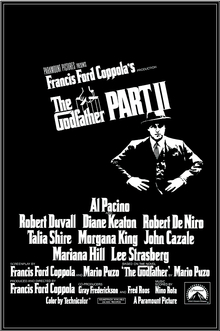
Despite a three-star Roger Ebert review that has angered fanboys for four decades, The Godfather Part II is, if anything, even more critically acclaimed than its predecessor. But among audiences, Coppola's sequel has never been able to catch up with the then highest grossing film of all time. Virtually all the franchise's famous lines and characters are from the first installment. A large segment of the moviegoing public, convinced it's all about Vito Corleone, is unable to strike up a connection to the Marlon Brando-less sequels.

But that's hardly the result of the first-year university student's favourite bugbear, the stupidity of the common man. It's all in the material. The Godfather Part II is brilliant, but it's much harder to like than its predecessor. Detached and critical where the first film is engrossing, Part II functions as a deconstruction of The Godfather's oft-criticised glamorisation of the Cosa Nostra. In Al Pacino's cold, calculating Michael Corleone it has a protagonist only in the technical sense: it's virtually impossible to root for him.

In 1901, Antonio Andolini is murdered by the Mafia don of Corleone, Sicily. His funeral procession is disturbed by shotgun blasts that signal the murder of Andolini's oldest son, Paolo, who had gone to seek revenge. Heartbroken, Paolo's mother (Maria Carta) goes to see Don Ciccio (Giuseppe Sillato) to plead for the life of her only remaining son, nine-year-old Vito (Oreste Baldini), but the don refuses. Vito's mother is killed, but Vito manages to flee Sicily and make it to the United States. There, an immigration official mistakenly writes down his name as Vito Corleone.

At Lake Tahoe in 1958, the Corleone family and their many friends celebrate the first communion of Don Michael's son Anthony Corleone. There's trouble in the family, though. Michael's sister Connie (Talia Shire), still wounded by the murder of her husband in Part I, is neglecting her children and cavorting with a man the family disapproves of. Fredo (John Cazale) is unhappy in his marriage, Tom Hagen (Robert Duvall) is increasingly shut out by Michael, Nevadan senator Geary (G.D. Spradlin) is causing trouble for the casino business, and New York caporegime Frank Pentangeli (Michael V. Gazzo) is dissatisfied with Michael's refusal to let him strike at his rivals. When Michael and his family barely survive a hit that same night, it's hardly a surprise.

The rest of the film is about Michael's attempt to uncover and defeat the conspiracy against him. Somehow involved is the reptilian Hyman Roth (Lee Strasberg). An elderly Jewish gangster living in Miami, Roth has organised a coalition of American business interests to carve up the Cuban economy with the full cooperation of Fulgencio Batista's government. While publicly declaring his intention to turn over his business to Michael after his death, Roth is angered by Michael's reticence in providing an agreed cash investment. After the little matter of the Cuban Revolution foils Roth's plans, the relationship of the two men turns openly hostile.

Vito's mother mourns her oldest son while Vito watches from background right.


Meanwhile, the film flashes back to a younger Vito Corleone (Robert De Niro) struggling to make a living in Manhattan's Little Italy in the 1910s and 1920s. After acquiring a rug that really ties the room together as a thanks from petty criminal Clemenza (Bruno Kirby), Vito begins to supplement his income with theft and burglary. Inevitably this puts him on a collision course with Fanucci (Gastone Moschin), the local Black Hand don who extorts protection money from businesses. After dispatching Fanucci, Vito expands his operations and sets up an olive oil import business as a legitimate front.

The period segments cover perhaps a quarter of the film's running time (at three hours and twenty-two minutes, the film is almost half an hour longer than its already hefty predecessor). I was at first annoyed by the soft focus and sepia tone returning cinematographer Gordon Willis chooses to mark these scenes: they seemed entirely too pleasant-looking, underplaying the squalor of New York's immigrant areas in the first quarter of the century. Then it clicked. Like the declarative title ins that explain who and what we're seeing in the beginning of the film, the look of the period scenes stresses the artificiality of what is shown and highlights the process of myth-making, particularly as they are constantly contrasted with the grubby present-day scenes.

The Godfather Part II doesn't mimic its predecessor's expert use of the three-act structure, opting for a more level narrative and the back-and-forth between present and period scenes instead. But many of the beats fall into the same place and fulfil equivalent functions, and they're all much nastier. The opening celebration is hollow and conflict-laden. Where Woltz was turned into a vassal of the Corleones after finding a horse head in his bed, Geary wakes up in a brothel next to a dead woman. ('This girl has no family. Nobody knows that she worked here. It'll be as though she never existed,' Tom Hagen assures him.) At the end of the film, those paying for their defiance of Michael Corleone with their lives are not real threats like Don Barzini and his allies, but defeated and isolated people on the run. ('I don't feel I have to wipe everybody out,' Michael explains. 'Just my enemies, that's all.')

'Don't worry about anything, Frankie Five-Angels.'

In its structure, then, the film undermines the sympathies Part I encouraged in the audience. The Godfather Part II thus becomes a critique of its own predecessor, indeed a self-critique by Francis Ford Coppola, who was bothered by accusations of glorifying organised crime with his sympathetic portrayal of the Corleone family. In a series of committee hearings, Michael is questioned by senators (portrayed by the likes of Roger Corman and Richard Matheson). It is, I believe, the first time in the series terms like 'Mafia' and 'Cosa Nostra' are spoken without the halo of 'honour', 'respect' and the rest of the claptrap that these films' criminals invoke to convince themselves they're more than gun thugs who got rich.

If it's a far more searing indictment of organised crime, though, The Godfather Part II also blurs the line between the strong-arm tactics of legal and illegal enterprise more thoroughly than its predecessor. 'This kind of government knows how to help business, to encourage it,' Roth says in praise of the Batista dictatorship.'We have now what we have always needed: real partnership with a government.' The film's most overt satire comes in a boardroom meeting that brings together the Cuban president, gangsters, representatives from American corporations, and a solid gold telephone. Crime and law enforcement are more thoroughly entwined, too: where Sonny Corleone spat at the FBI, in the sequel policemen are brought drinks by Michael Corleone's waiters.

The film's greater maturity is seen in markedly more subdued acting, with the exception of Gazzo's histrionic Pentangeli. De Niro, hardly recognisable to those used his last two decades of self-parody, is a revelation. Pacino's Michael continues becoming colder, ever less capable of ordinary human affection. 'All our people are businessmen', he knows: 'Their loyalty is based on that.' Yet he continues turning away people who care about him - Tom, Kay, Connie - in favour of those businessmen. In The Godfather Part II, his evolution from idealistic war hero to unscrupulous gangster is completed in a sequence that exceeds the heights reached by the already terrific ending of The Godfather. It's a sad and lonely place, and it's where the character's arc finds its logical conclusion. Accountants thought otherwise, though...

In this series: The Godfather (1972) | The Godfather Part II (1974) | The Godfather Part III (1990)

Sunday, 16 December 2012

Once upon a time in a barely disguised allegory

The Zapata western - a burgeoning subgenre of spaghetti westerns set during the Mexican Revolution - was always overtly didactic. Exploring US imperialism, revolutionary politics, militarism and violence with a furrowed brow, these films were far more obviously about the tense political situation in Italy than the only implicitly critical escapism proffered by the industry at large. I don't suppose the phrases 'carefully constructed Marxist critique' and 'box office gold' go hand in hand these days, but you must remember it was the sixties.

1968's Il mercenario (titled The Mercenary during its North American run, but since then known as A Professional Gun in the English-speaking world) was one of the most commercially successful examples of the form, but it wasn't particularly well respected among the more serious minds in Zapata western circles, for reasons we shall attend to presently. The film did, however, reunite director Sergio Corbucci and star Franco Nero, the team behind 1966's smash hit Django.

Sergei Kowalski (Nero, barely recognisable from his star-making role thanks to some magnificent facial hair) is a Polish gunslinger who is hired by Mexican mining barons to transport a load of silver to the United States, protecting it from the rebels roaming the area. Arriving at the mine, Kowalski finds the place in the hands of revolutionaries led by Paco Román (Tony Musante).

When the army attacks, Kowalski lets Paco pay him handsomely to fight them off with the machine gun he carries around ('Two hundred [dollars], you bastard - here, I hope you spend it on doctors!', Paco curses). The next day, Kowalski is accosted by Curly (Jack Palance), a villainous American trying to get his hands on the silver, but he is rescued by Paco's men. Curly swears revenge for the death of his men (one of whom, it is implied, was his lover), but is stripped naked and forced to walk back to civilisation by the rebels. Thereafter, Paco hires Kowalski as military advisor for the revolutionary war.

At a purely narrative level the film feels rote and uninspired. What isn't boilerplate is awkwardly shoved in: the character of Columba (Giovanna Ralli), for example, serves little purpose except as plot device and eye candy. And the film suffers from a series of false endings, stopping and starting repeatedly in its last fifteen minutes before coming to a close with a message that doesn't really respond to the arc of the character it's imparted to.

That mess is particularly odd considering the film seems to announce bold intentions early on. The credits are superimposed on photographs from the Mexican Revolution, drenched in red in the style of the previous year's Bonnie and Clyde, set to an insistent Ennio Morricone piece as if some sort of serious social critique was the aim. And it just carries right on, with a scene in which the miners are served scraps while the bosses feast right from the 'men and maggots' chapter of The Battleship Potemkin. And then there's the above image of company gun thugs hanged in front of a mural praising the revolution.

Nor would it be fair to accuse Corbucci of frivolity, and that makes it even stranger: that same year, after all, saw the release of The Great Silence, a film so grim and nihilistic it pushed the spaghetti western into and out the other side of parody. In other words, Corbucci's first entry into an ordinarily serious subgenre was pretty silly - no film in which one of the parties enters the climactic gunfight wearing a clown costume can claim to be all that straight-faced - while the 'standard' spaghetti western, which left more leeway for and would eventually descend into lightheartedness, was where he chose to place the darkest of his works.

Even though it does not deliver on the promise of its beginning - or, judging from the sort of person Corbucci was, possibly deliberately baits the audience - Il mercenario is far from a waste. Nero's self-amused bastard is as fantastic as ever, and he absolutely rocks the scenes in which he grants himself special treatment just to anger Paco (a device that would be reused by Eastwood in High Plains Drifter). Corbucci's style is nothing to sniff at, either: besides signature moves, the showiest bit of direction is a 360-degree tracking shot of Curly riding in a circle while a man is beaten offscreen. It's not great Corbucci, but is it ever interesting.

Saturday, 9 June 2012

South American graffiti, Part 1: Santa Cruz de la Sierra

Graffiti are a dazzlingly diverse means of political expression. From quick scrawls to elaborate murals, they're as suited to coarsely denouncing your opponents as they are to immortalising transcendent ideals. In short, I love 'em, and so I pretty much adored South America during my recent travels. A vibrant culture of guerrilla art combined with authorities that are rather slow to paint over graffiti makes the continent a Mecca for my kind.

In the next couple of posts, I'll show you some highlights of political graffiti, focusing on Bolivia but also including Chile and Paraguay. First up: the eastern Bolivian metropolis of Santa Cruz de la Sierra.

Invoking the name of the Falange Socialista Boliviana (FSB), the now defunct Franquist-inspired Bolivian fascist party of yesteryear, right-wing youths in Santa Cruz demand federalism (i.e. autonomy for the eastern departments).


'Loving in freedom and being happy': graffito defending the equality of LGBTQ people. Stencilled graffiti like this are common.

'The struggle belongs to the people, not to the parties! TIPNIS resist!' In support of TIPNIS, the protected indigenous territory through which the government is trying to build a road (turning its own base against it in the process).

Capitalism destroys flora, fauna and human life. 'We the poor have rights.'

Left-wing graffito ('socialism or death') painted over and given the coup de grace by fascist stencil graffiti.

'Narcostate.'

'Long live communism.'

Monday, 25 April 2011

La Revolución, exploitation style

By way of an introduction: Machete is awesome, of course. I mean, look at the poster. Or at the announcement, in the movie itself, that 'Machete will return in Machete Kills and Machete Kills Again'. Or the fact that Machete is not a nickname, but the protagonist's birth name. If you type 'Machete' that many times, it stops looking like a word. In any case: Machete is awesome, by which I mean to convey that I more or less squealed with giddy delight throughout the film.

Machete Cortez (Danny Trejo) is a former Mexican Federale ('CIA, FBI, DEA, all rolled up into one mean fucking burrito', according to one character) who has fallen foul of drug lord Rogelio Torrez (Steven Seagal). Now Machete works as a day labourer in Texas - until, that is, he is hired by Michael Booth (Jeff Fahey) to assassinate far-right anti-immigration senator John McLaughlin (Robert De Niro). But he's double-crossed: one of Booth's gunmen wounds McLaughlin in the leg and shoots Machete to guarantee the senator's re-election. Now Machete must take revenge and uncover a conspiracy involving a racist vigilante organisation headed by Von Jackson (Don Johnson) - a task in which he's aided by honest immigration cop Sartana Rivera (Jessica Alba), his brother, a priest (Cheech Marin) and a network helping illegal immigrants run by Luz (Michelle Rodriguez).

Ultimately the film comes down to a showdown between the vigilantes and Mexican immigrants. It's awesome, but it's also the one part of the film that director Robert Rodríguez treats without any irony. 'La revolución', as Luz calls it early in the film, is of course a fantasy - the marginalised and maligned immigrant working class rising up to overthrow the oppressive order, symbolised by racist paramilitaries. But it's an immensely gratifying and empowering fantasy, in tune with Frantz Fanon's assertion that the colonial subject's desire is not for equality but for the defeat and death of the coloniser. That Rodríguez takes such a clear stance is not self-evident in a B-movie; but at a time when immigrants are under fire (sometimes literally) both in the US and in Europe it's something to cheer every leftist's heart.

That, then, is politically pleasing to me; but what about other aspects of the film? Does Machete reinforce patriarchy, for example? For Machete most certainly does 'get the women', as the trailer promises - seven by my count, excluding his wife who is murdered roughly three minutes into the film. That the male gaze predominates in Machete I cannot deny. But I'd like to protest that the topic is treated ironically: with respect to sixty-six-year-old Mr Trejo, it is not quite plausible that Machete is irresistible to every woman in sight, and Robert Rodríguez makes not the slighest attempt to make it plausible. It's merely another homage to the conventions of 1970s exploitation films, in which heroes would womanise like nobody's business.

It's all a delight: the performances from an all-star cast (Rose McGowan was left on the cutting room floor) are over the top in just the right way. The villains stand out, from Jeff Fahey's magnificently purry drug dealer to Don Johnson as a murderous redneck ('There's nothing I'd like better than to see that Mexican dance the bolero at the end of a rope'). I don't need to mention that Michelle Rodríguez is bad-ass as usual (nay, more so than usual), and even Jessica Alba manages not to grate. Lindsay Lohan, as a 'nun with a gun', has a small but functional part. Of course, Machete is intensely violent. If you're squeamish about the severing of limbs, I recommend you do not see this. Nonetheless, if you have seen something utterly vicious like last year's Piranha, rest assured Machete is less depraved than that. Meaning it is still quite depraved. Be that as it may, Machete is ultimately a full-throttle thrill-ride, bloody and sexy and hilarious. A guilty pleasure, of course - but oh, how very pleasurable.

In this series: Grindhouse (2007) | Machete (2010) | Hobo with a Shotgun (2011)

Saturday, 20 March 2010

Individualism must disappear (Steven Soderbergh, 'Che')

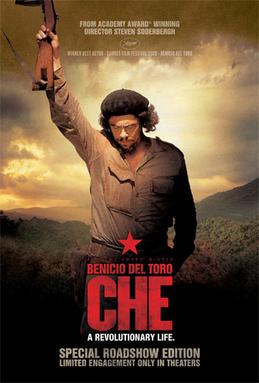
Che's very title is a lie. It's a lie because Steven Soderbergh's 2008 two-part opus is not a biopic. Because, despite the advertising campaign's desperate attempt to convince us of the contrary, Soderbergh has not the slightest interest in showing us 'the man behind the myth'. James Verniere is right in calling Che a feature-length version of the famous portrait, but wrong in considering that a flaw.

Che: Part One (also known as The Argentine) opens with Che Guevara giving a radio interview in New York. The scene is shot in grainy black and white, with extreme close-ups of Che, and it immediately contrasts with the next scene that takes us back to Mexico City in 1955, and into colour and medium shots. This progression through opposites is preserved throughout The Argentine as Soderbergh switches between black-and-white scenes of Che's visit to the United States in 1964 and an account of the Cuban Revolutionary War from the beginning to the victory; the film ends with the victorious revolutionary troops on their way to Havana after the decisive battle of Santa Clara. By contrast, Che: Part Two (Guerrilla) is structured as a single relentless slog from Guevara's arrival in Bolivia in late 1966 to his capture and execution by the military eleven months later. It's a difficult experience to sit through as the situation of the guerrillas goes from bad to worse to catastrophic, with no relief in sight.

Watching Che is in many ways a jarring experience to us consumers of Hollywood films. The biographical picture in our depoliticised culture bestows on its hero a simple, everyday motivation: William Wallace in Braveheart fights the English because they murdered his wife, Johnny Cash in Walk the Line becomes a tortured musician because of his abusive father and dead brother. Both films personalise a process that is in reality larger than the individual, but which, the filmmakers assume, the audience won't understand or care about: thirteenth-century politics in the former, early rock'n'roll in the latter case – thus draining whatever subversive content the material may have had. (As Slavoj Žižek remarks of Warren Beatty's Reds, '[e]ven the October Revolution is OK, according to Hollywood, if it serves the reconstitution of a couple'.) Hollywood attempts, foolishly, to isolate the individual as archetype from his socio-political context. In Che Steven Soderbergh resolutely refuses to do this, and the extent of his commitment becomes clear when you consider that other Che film, Walter Salles's The Motorcycle Diaries (2004). That's a good movie, but a firmly conventional one: impetuous young man sets out on road trip across South America and on his journey encounters oppressed people that make him re-think his priorities.

Che is not about a person at all. Each part opens with a map – Cuba in the first, South America in the second film – that brings home the point that what we are about to see is not about Ernesto Guevara, but about his revolutions and why one succeeded while the other failed. Soderbergh frankly admits that he had no interest in Che's personal life, and neither film tells you anything at all about the time before the Sierra Maestra. Soderbergh drives the point home by filming virtually everything in medium shot, with the very notable exception of the black-and-white 1964 scenes of Part One. Benicio del Toro's performance is a wonder to behold not because he allows us deep insights into his psyche, but precisely because it is so detached and deliberately underplayed. 'Individualism must disappear', Guevara insisted, and in Soderbergh's opus it does as Che the person disappears into his struggle.

Hollywood loves a linear narrative: it's the cinematic expression of the bourgeois idea of progress. Che, by contrast, is structured dialectically. Part One and Part Two are opposites in almost every respect. They aren't even in the same aspect ratio: The Argentine is shot in 2.35:1, while Guerrilla is presented in more cramped 1.85:1, as befits the second film's almost claustrophobic feel. Further, The Argentine employs a vibrant colour scheme rich in greens and browns, while Guerrilla is extremely desaturated, using feeble greens and blues and pale light for a sickly and depressed look.

Soderbergh insists on showing us Che not as an individual, but as a revolutionary, and a revolution is always achieved by a collective. We are not invited to ask 'Who was this man?', but 'How did he try to bring about revolution?'. This uncompromisingly political and procedural stance that led some critics to call Che curiously impersonal and dramatically unsatisfying. On the contrary: in removing the man from the revolutionary, in rejecting the accumulated clichés of the Hollywood biopic, Soderbergh has made the best possible film about a man who chose to dedicate his life to the revolution – more than that: to embody it.