Showing posts with label higher education. Show all posts

Wednesday, 30 November 2011

#Nov30 in Nottingham


Today was an important day for the fightback against 'austerity', with two million public sector workers out on strike all over the country. It was a lovely late autumn day, cold but clear and sunny. We got up at an ungodly hour, by student standards, to support our lecturers on the picket lines around University Park Campus.

We put up posters, held placards and posted pickets on all nearby paths. Picketing an open campus is a little tricky: many of the cars going past you will be private sector contractors, who are not on strike, and students may be going in for more than one reason. Still, we encouraged all who came to turn back, go to the pub etc.: some did and were cheered for it. We got quite a lot of declarations of solidarity from passers-by, but really the old principle that you never cross a picket line needs to be reinstated. (I hope this will happen as the struggle against the government broadens and continues.)

There were tight-lipped managers in Jaguars, too, and scabs who would try to avoid looking you in the eye as they drove past. (We generally didn't denounce them as vigorously as I've seen happen at the 2009 Royal Mail strikes, for example.) Shortly after 10am, we packed up and walked to Forest Recreation Ground, where the trade union march was gathering.

It was a terrific march, certainly the largest I've been on in Nottingham. There were people from more unions I've ever seen outside the TUC March for the Alternative, including unions not commonly associated with protest and industrial action, like the Royal College of Nursing. The local Labour Party branches were there, too, reminding us that Labour is not just the spinelessness of an Ed Miliband. As in March, there were people from all sections of society, including many with children. We marched down Mansfield Road, through the city centre and Market Square (past the occupiers, with whom there was much fraternising) before gathering in Wellington Circus.

The atmosphere was amazing. No march I've been on has ever experienced quite so much support from the general public, I think: drivers honked and raised their fists, people young and old clapped and shouted. I don't want to exaggerate this, but polling data suggests the government has pretty much lost the argument on job losses and cuts to services. The Tories and their LibDem running dogs mishandled the conflict from the start, managing to create a broad front between smaller, more militant and larger, more conciliatory unions. The challenge to the anti-cuts movement is to maintain and expand the front that's been created, and keep pressing the most reactionary government since Caligula until victory.

Sunday, 21 August 2011

I want to say one word to you. Just one word. Plastics.

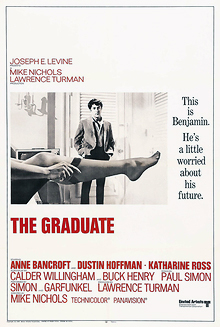
The Graduate is a fine example of an almost extinct subgenre: the funny comedy. Once, you see, funny comedies were fairly common, but in recent years they've been crowded out by scatological and infantile varieties, as well as alleged comedies that contain no jokes (Definitely, Maybe). But first things first.

Benjamin Braddock (Dustin Hoffman, aged thirty in a comical case of Dawson Casting), has recently graduated from university and returned home to his affluent parents and their dreary friends, who are inexplicably enamoured with him (and want to recruit him for tedious careers). Plagued by ennui he begins an affair with Mrs Robinson (Anne Bancroft), the wife of his father's business partner. Things take a dramatic turn, however, when Benjamin is forced by his parents to date the Robinsons' daughter, Elaine (Katharine Ross), and ends up falling for her, much to Mrs Robinson's chagrin.

Let's get this out of the way first: no, The Graduate is not a universal tale of young people's disaffection. Benjamin, unlike most twentysomethings, is filthy rich and, even near the end of the post-war era of prosperity, spoilt for choice among high-flying careers. (As Roger Ebert remarked, 'I wonder how long it took him to get into plastics'.) It's a story of the horror of a life of luxury mapped out for you from birth: a dystopia, I suspect, that many would gladly trade for their less glamorous lives.

So yes, it's a self-indulgent story of privilege. What's more, it is curiously free of any of the struggles of the 1960s: no race conflict, no Vietnam War, no drugs, no real rebellion, in fact, at all: just a curious sense of being adrift. Perhaps the sanitised world the Braddocks inhabit was shielded from these tremors; perhaps that's not what Mike Nichols was interested in.

Ah yes, director Mike Nichols! For I referred to the fact that The Graduate is a funny comedy, and the inspired direction has a lot to do with that. The most famous image from the film is, of course, that of Mrs Robinson putting on her stockings while seducing Benjamin, embodying their lazy objectification of each other; another well-known sequence, Benjamin driving across the San Francisco Bay Bridge, was later to be lovingly ripped off by Cruel Intentions. The editing absolutely needs to be mentioned: my favourite moment is a cut from the protagonist lunging forwards in the swimming pool to a scene I dare not spoil.

All this with a whip-smart comedy script, full of hilarious lines ('Are you here for an affair?' can hardly be bettered, and the subsequent scene of Benjamin being accidentally introduced to various strangers is  priceless), although the later turn into drama is not handled as well as it might have been. While The Graduate is clearly a product of its age, it remains mercifully free of the mustiness that can afflict some pre-1970 films.

That leaves us with the performances. To be frank, neither Hoffman nor Ross are exactly brilliant; both struggle with underwritten characters, and Hoffman shows few signs of the actor we know & love. But Bancroft shines as Mrs Robinson, dominating every scene she's in, although the script serves her ill during the third act. Not a timeless masterpiece, perhaps, but an excellent comedy well worth treasuring in our depraved age.

Friday, 6 May 2011

Bull of the University of Nottingham, Against Rod Thornton

As you've no doubt heard, our university has suspended Rod Thornton, a lecturer in the School of Politics, for writing an article that ruthlessly exposes the university's lies and bullying during and after the 'Nottingham Two' affair in 2008. When the Guardian and the BBC ran the story, the university released a statement claiming Rod Thornton 'defamed' his colleagues with 'baseless accusations'.

I'm sure you're thinking what I'm thinking: lame. That's the best they could come up with? 'Defaming'? Clearly the art of vigorous denouncement without engaging in debate has suffered since the good old days. They need help. So here's a suggestion of how the university ought to have attempted to suppress legitimate whistleblowing - with apologies to Pope Gregory XI:

Bull of the University of Nottingham, Against Rod Thornton
The University, servus servorum sapientiae, to her beloved children the students of the University, in the diocese of Russell, grace and benediction.
We are compelled to wonder and grieve that you, who, in consideration of the favours and privileges conceded to your student body by the University, and on account of your familiarity with the Code of Discipline, in whose sea you navigate, by the gift of knowledge, with auspicious oar, you, who ought to be, as it were, warriors and champions of the orthodox faith, without which there is no economic growth, - that you through a certain sloth and neglect allow tares to spring up amidst the pure wheat in the fields of your glorious University aforesaid; and what is still more pernicious, even continue to grow to maturity. And you are quite careless, as has been lately reported to us, as to the extirpation of these tares; with no little clouding of a bright name, danger to your careers, contempt of the laws of this land, and injury to the faith above mentioned. And what pains us the more, is that this increase of the tares aforesaid is known in London before the remedy of extirpation has been applied in the School of Politics where they sprang up. By the insinuation of many, if they are indeed worthy of belief, deploring it deeply, it has come to our ears that Rod Thornton, Lecturer of the School of Politics, at the University of Nottingham, Expert in Terrorism (would that he were not also Master of Errors), has fallen into such a detestable madness that he does not hesitate to dogmatise and publicly preach, or rather vomit forth from the recesses of his breast, certain propositions and conclusions which are erroneous and false. He has cast himself also into the depravity of preaching heretical dogmas which strive to subvert and weaken the state of the whole University and even secular polity, some of which doctrines, in changed terms, it is true, seem to express the perverse opinions and unlearned learning of Rizwaan Sabir of cursed memory, and of Hicham Yezza, whose book is extant, rejected and cursed by our predecessor, Sir Colin Campbell, of happy memory. This he has done at the University of Nottingham, lately glorious in its power and in the abundance of its resources, but more glorious still in the glistening piety of its faith, and in the distinction of its sacred learning; producing also many men illustrious for their exact knowledge of the Code of Discipline, mature in the gravity of their character, conspicuous in devotion, defenders of the Management Board. He has polluted certain of the faithful by sprinkling them with these doctrines, and led them away from the right paths of the aforesaid faith to the brink of perdition.
Wherefore, since we are not willing, nay, indeed, ought not to be willing, that so deadly a pestilence should continue to exist with our connivance, a pestilence which, if it is not opposed in its beginnings, and torn out by the roots in its entirety, will be reached too late by medicines when it has infected very many with its contagion; we command you with strict admonition, in virtue of your sacred obedience, and under penalty of the deprivation of all the favours, indulgences, and privileges granted to you  by the said University, for the future not to permit to be asserted or proposed to any extent whatever, the opinions, conclusions, and propositions which are in variance with good morals and faith, even when those proposing strive to defend them under a certain fanciful wresting of words or of terms. Moreover, you are on our authority to suspend the said Rod, or cause him to be suspended. Besides, if there should be, which God forbid, among you opponents stained with these errors, and if they should obstinately persist in them, proceed vigorously and earnestly to a similar removal of them, and otherwise as shall seem good to you. Be vigilant to repair your negligence which you have hitherto shown in the premises, and so obtain our gratitude and favour, besides the honor and reward of the Management Board's recompense.

Better, eh? They really ought to get some papal scribes to smarten up their public relations effort. But seriously: the circumstances surrounding all this (for which please read Rod Thornton's paper, 112 pages long though it may be) stink to high heaven. It is unfortunate that our university, which prides itself on its allegedly open, democratic culture, should seek to attack its own students and lecturers and attempt to suppress dissent. We have a management culture that rewards loyalty and punishes heresy, one that disdains to follow its own procedures - it was a moment of grim amusement for me when Rod Thornton in his paper became the third person I know of to independently call the university 'Kafkaesque' in print. We can't let them get away with it.

Sunday, 30 January 2011

Aaron Porter's contortions

So, Aaron Porter – remember him? – warned ahead of yesterday’s student and trade union demonstrations in Manchester and London that ‘[s]tudent infighting harms our cause’ and that the correct strategy is ‘peaceful protests and engaging with politicians – not the violent tactics of a hard-left minority’. That Porter would decry ‘infighting’ in an article that is nothing but is ironic, or would be if he still commanded even a sliver of student support. Generally there is no reason to listen to, much less discuss, Porter’s pathetic mewling as he battles Nick Clegg for the prize of Least Relevant Person in Britain Today. But he uses a number of fairly insidious rhetorical sleights of hand, and those are worth taking apart.

First, Porter’s trying to reassert his leadership over the student movement. He wants to explode the notion that the NUS have been inactive, and he cites what he’s been up to. But of course the issue isn’t that the NUS are doing nothing; it’s that their actions are mostly symbolic and irrelevant. Does anyone remember their glow-stick vigil on 9 December, poorly attended mostly by, one imagines, people who couldn’t find the real protest that was taking place on Parliament Square where thousands were kettled by police for hours?

Now the man is trying to claim the Manchester demonstration while disowning the parallel London protest for being neither ‘supported by students’ unions’ nor having ‘adequate arrangements… for the safety of those involved’. This would be the Manchester demo where Porter had to be escorted by police to escape the wrath of students (so his safety was clearly adequately provided for – go NUS!) and the ‘largely peaceful’ London protest. In reality, of course, Porter is fighting a public relations campaign to persuade the public at large that he is still in charge; students know that he lost leadership of the movement the movement he supported the police and the media against protesters on 10 November.

That, then, is just nonsense. But Porter also claims that those who are in favour of direct action are a ‘hard-left minority’. There’s something really quite pathetic about the man who pledged his support for the UCL and other occupations (after the fact, of course) to now turn on those students and rhetorically marginalise them. First, Porter insists that those in support of and involved in direct action represent a minority of students. Although in my experience they greatly outnumber those who actively support the NUS, in absolute terms Porter’s point is irrefutably true – the majority of students are not well informed or involved. But it does not follow that they are therefore impostors and Porter himself the true embodiment of the will of the student body.

As Rosa Luxemburg wrote, the superstitious belief that ‘in order to carry anything, you must first have a majority’ is a product of ‘parliamentary cretinism’. ‘The same, they [the cretins] say, applies to revolution: first let’s become a “majority”. The true dialectic of revolutions, however, stands this wisdom of parliamentary moles on its head: not through a majority, but through revolutionary tactics to a majority – that’s the way the road runs.’ (The Russian Revolution, Ch. 1.) Substitute ‘struggle’ for ‘revolution’ and Luxemburg is clearly right even today.

Without the direct action of tax protests, would corporate tax avoidance have become an issue in the public consciousness? Without direct action at Millbank, on Parliament Square etc., would the student movement have been paid more than cursory attention in the mainstream press? Hardly. Determined minorities can create majorities, and there is nothing undemocratic about that. Opinions are not pre-existing notions stuck in someone’s head; they are created, shaped and reshaped by real events. Direct action is necessary, not in violation of but to create majorities.

Second, Porter claims that because most students’ unions are not opposed to him, the ‘radicals’ are a minority ‘pushed by outside forces on the hard-left of the political spectrum’. It’s not new for Porter to claim that mysterious ‘outside forces’ are the source of his troubles, but the main argument is more interesting. It’s intended to convince not students but readers of the Guardian who may not be aware that one of the major grievances of the ‘radicals’ is that they feel students’ unions as a whole with some laudable exceptions are unrepresentative, opportunistic and conservative.

The reasons why SU sabbatical officers are so often among the most reactionary of the student body are manifold and not relevant here, but it’s important that Porter seeks to hide the struggle between student activists and structurally conservative SUs. As these have often failed to support or sabotaged even the mildest action, real opposition to fees and cuts has in many places been forced to act outside the SU. Thus Porter’s argument is entirely circular: ‘the people who support me support me; therefore the complainers are wrong. QED.’ At many universities student activism is being driven by extra-SU forces, with the SU either totally isolated or being dragged along while bleating feebly about ‘moderation’ and ‘responsibility’. (And oh, see Porter’s insistence that the NUS must ‘play the hand we are dealt’, i.e. capitulate, a lapse into the futile ‘moderate’ NUS policy of the last decade-and-a-half that saw no real NUS opposition to the introduction, trebling, and now trebling again of tuition fees.)

So, let’s just stop listening to this man. But let’s have a debate about the NUS: can it be reformed or should it be ignored and bypassed? Ultimately I tend to the view, adapted from Lenin, that the students must be sought and engaged wherever they are to be found and that to this end working within as well as outside the NUS is important, if only to definitively break down its reactionary structures and revolutionise it to become a genuine fighting organisation for students’ interests. Either way, direct action is the way forward as students seek to unite with the wider working masses in our fight against this government.