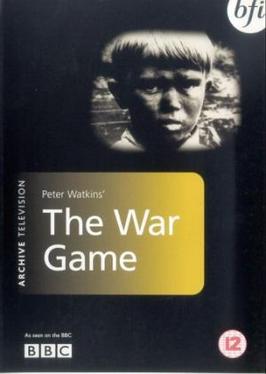
The story behind Peter Watkins's 1965 docu-drama The War Game is gnarled and contentious. Funded by £10,000 from a reluctant BBC at a time of power struggle inside the Corporation, the final 48-minute film made higher-ups profoundly uncomfortable. After privately screening The War Game for representatives of several government departments (including the Ministry of Defence, the Home Office and the Post Office), the BBC decided not to broadcast the film.*
The resulting imbroglio is detailed in Watkins's account, which makes fascinating reading for anyone interested in the raison d'état of the rump British Empire in the sixties. The BBC tried to shake off accusations of political censorship by screening the film to select elite audiences - specifically excluding film critics -, but scrupulously avoided showing it to a wider public. As Watkins stresses, the print media overwhelmingly backed the BBC's line (some choice quotes there).
The film's rehabilitation began when a limited theatrical run resulted in The War Game winning Best Documentary Feature during the 1966 Academy Awards. The BBC, which had previously claimed that it was only Watkins's artistic failings that had led them to suppress the film - as we all know, the Corporation cares deeply about our delicate artistic sensibilities, which is why Top Gear exists - finally broadcast The War Game in 1985, as part of the forty-year anniversary coverage of the bombing of Hiroshima. For his part, Watkins has continued as a stridently left-wing and anti-war documentary filmmaker, falling foul of censorship as often as he's won awards.
The War Game falls into three kinds of footage, mixed within the film. First, there are short interviews with a random sample of passers-by ('Do you know what Strontium-90 is, and what it does?') which reveal the British public as woefully underinformed on the horrors of nuclear war. Interspersed, there are monologues based on real recorded statements by authority figures in government, military and church, which tend towards the utterly insane presented with a certain cheer ('The Aztecs on their feast days would sacrifice 20,000 men to their gods in the belief that this would keep the universe on its proper course. We feel superior to them.')
The meat of the film and the source of most controversy, though, is a merciless recreation of the horrors of a Soviet nuclear strike on Kent, presented in the style of a documentary. A Chinese ground invasion of South Vietnam leads to the US authorising the use of tactical nuclear weapons - first in Indochina, then, as tensions escalate between the blocs, in Germany. This is followed by Soviet massive retaliation on targets in western Europe, including the UK. Apart from the millions killed instantaneously, much of British society collapses in the following months as radiation disease, starvation and post-traumatic stress overwhelm a totally inadequate civil defence system.
Filming around Tonsbridge, Gravesend, Chatham and Dover, Watkins uses almost entirely non-professional actors (ironically considering the director's left-wing stance, this caused him some trouble with actors' unions). He achieves a sense of extraordinary immediacy by using a lot of shaky handheld camerawork (old hat in 2012, revolutionary then), realistically imperfect dialogue, and seemingly unscripted moments. Among a talented crew, Lilian Munro's make-up work stands out for its unflinching recreation of injuries (severe burns, poisoning), skin covered in soot, and other misery.
All of which sounds a bit technical, so let me be clear, in the manner of the Prime Minister: The War Game is among the most horrifying films I've ever seen. I don't say that lightly or frivolously. In the many, many hours I've misspent watching exploitation films, only The Texas Chain Saw Massacre and Cannibal Holocaust have sickened me to my very soul to the same extent as The War Game. That's not because it's particularly explicit (much of the film works by suggestion), but because what is portrayed is just so much more gut-churningly awful than what even the most depraved horror directors tend to dream up: newly blind children covering their faces after the brightness of a thousand suns has burnt their retinas, people dying from carbon monoxide poisoning, others beaten to death by starving mobs.
In all that, Watkins is keen to stress that what he's portraying is not speculative but merely a dramatisation of existing scientific predictions. 'It's been estimated that...', begins sentence after sentence of horrifying statistics that imbue the film with a sense of inexorability. Reviewers were of course right to call The War Game totally one-sided: but who could imagine a 'balanced' film on this subject? A documentary that detailed the horrors of atomic fallout before enumerating the many wonderful upsides of nuclear weapons would surely be more repulsive than The War Game, not less.
There is, then, a disgusting hypocrisy in the official response to The War Game. According to the defence and media establishment, planning the murder of millions upon millions of civilians is quite all right just so long as one uses the correct euphemisms; the moral transgression apparently lies in spelling out the reality. As Orwell said, the genocidal reality of modern power 'can indeed be defended,
but only by arguments which are too brutal for most people to face, and which
do not square with the professed aims of the political parties'. Hence the need for obfuscating language and misinformation - which, as Watkins points out, is precisely likely to increase casualties in the eventuality of war.
A mere calm listing of the inevitable horrors of all-out atomic war would refute any case for nuclear weapons, but that's not all Watkins does. By focusing on the darker aspects of Allied conduct in the Second World War, he critiques the justifying ideologies of British power. Again and again, the narrator stresses that the scenario is merely an extrapolation of what happened to Hamburg, Darmstadt, Dresden, Hiroshima and Nagasaki: and who dropped those bombs? When the firestorm created by a one-megaton bomb destroys Rochester, 'the oxygen is being consumed in every cellar and every ground floor room'. Which is how 42,000 civilians died during Operation Gomorrah, after Bomber Command developed the proper scientific combination of incendiary and explosive bombs to create a firestorm. After the initial Soviet attack, Watkins describes British bombers on their way to retaliation. 'Their target: people like this.'
It's really no surprise, then, that The War Game was thought excessively subversive, and its suppression on explicitly political grounds defended in the press. '[T]he only possible effect of showing it to the British public at large would be ... to raise more unilateral disarmament recruits', the Evening News insisted.** The entirely correct accusation against Watkins was thus one succinctly expressed in the hideous German word Wehrkraftzersetzung, literally 'sapping of defensive strength': the danger of showing the film would be to incline the British people against any possibility of a war they'd been systematically misinformed about.
All of which might be interesting historically, but unfortunately the BBC is still at it. Acting as the mouthpiece of the government in the run-up to the conquest of Iraq, refusing to broadcast humanitarian appeals when the aggressor happens to be a is a British ally, shutting down commentators who wouldn't fall in line during the riots: more than ever, the BBC has a reputation for being regime media - structurally, not just incidentally. All the more reason to hold up The War Game as the little docu-drama all the Corporation's horses and all the Corporation's men couldn't bury.
*The BBC officially denies this screening ever happened.
**According to Watkins's website.
Showing posts with label after the end. Show all posts
Wednesday, 16 January 2013
Saturday, 29 September 2012
Gaze into the fist of Dredd
Dredd is the best comic book adaptation of the year. Where The Avengers was a crowd-pleasing something-for-everyone effort and The Dark Knight Rises fumbled its lofty ambitions, Dredd goes its own hyper-authoritarian, gore-soaked way. It's a film that doesn't beg the audience to love it. So far it's grossed just over $19 million worldwide, a pittance next to fellow post-apocalyptic actioner Resident Evil: Retribution's $139 million. That isn't surprising since much of the filmgoing public still associates Judge Dredd with the reviled Sylvester Stallone adaptation, but it's depressing nonetheless.
In the future, war has reduced most of the US to an irradiated wasteland. In Mega-City One, 800 million survivors are crammed into a single urban sprawl stretching from New England to Washington, D.C. As scarcity and the collapse of previous governments have caused a massive crime wave, the city is ruled in an authoritarian fashion and policed by Judges, lawmen entitled to use lethal force and act as judge, jury and executioner.
Judge Dredd (Karl Urban) is assigned a recruit, Cassandra Anderson (Olivia Thirlby). Anderson has failed her exams, but she may be valuable to the Hall of Justice for another reason: as a mutant, she has psychic powers.When the two investigate a seemingly routine triple homicide in a two-hundred-storey apartment block called Peach Trees, they stumble upon the empire of drug kingpin Ma-Ma (Lena Headey). After Ma-Ma shuts down the building to prevent their escape, the Judges must battle their way to the top against hundreds of gangbangers and desperate armed residents.
That's pretty much it. Where lesser comic book films stretch their material to pseudo-epic scope whether it fits the source material or not, there's a lot to be admired in Dredd's single-minded commitment to straightforwardness. Screenwriter Alex Garland (Sunshine) trims all the fat off the story for a lean ninenty-five minute running time. His script does not aspire to do more than chronicle a day's work for Dredd, the equivalent of a four-issue arc in the early 2000AD days, and that simplicity is the film's great strength.
Not that it lacks for strengths. Dredd is a masterclass in distilling the spirit of the comic book without taking on many of its details. The broad characters, physically deformed mutants, robots, laser guns, supernatural creatures and alien planets of the comic books are replaced by a deliberately basic, gritty future world. Technology barely exceeds present-day levels. Ordinary cars and weapons are used by everyone but the better-equipped Judges (and in the course of the film, even Anderson begins carrying an MP-5). The Judges' armour is far simpler and more practical-looking than its comic-book incarnation.
As for the character's heart and soul, Dredd does not attempt to sugarcoat the grimness of the source material. The comic books often overplayed their insanely dark future world for comic effect, but this was lost on quite a few readers. ('To my surprise, and even alarm', Pat Mills muses, 'a psycho character with no feelings would regularly win out any day over a hero who had some humanity or vulnerability.') By contrast, Dredd plays the Dirty-Harry-up-to-eleven concept straight, for a film that pleases everyone's inner authoritarian but troubles the soul. (That is, if satire is not as intrinsic to the concept as I think it is.)
The film is bolstered by three strong central performances. Urban, not allowed to take off his helmet, works his mouth and chin for all they're worth and affects a vocal chord-shredding growl. It sounds silly, but it works. Headey makes the most of the opportunity to exchange her restrained evil of Game of Thrones for unhinged villainy. Thirlby, meanwhile, shoulders the task of audience surrogate and standard 'newbie with a steep learning curve' character, communicating both doubt and increasingly strength effectively.
It's a jolly handsome film that should be seen in 3D. Slo-mo, Ma-Ma's drug that slows time down for the user, is exploited for numerous gorgeous shots of water droplets, explosions - and viciousness. Dredd's many gunfights delight in slow-motion shots of faces torn apart by bullets and other forms of unsavoury violence. Like its titular character, Dredd is single-minded, brutal, and singularly compelling.
In the future, war has reduced most of the US to an irradiated wasteland. In Mega-City One, 800 million survivors are crammed into a single urban sprawl stretching from New England to Washington, D.C. As scarcity and the collapse of previous governments have caused a massive crime wave, the city is ruled in an authoritarian fashion and policed by Judges, lawmen entitled to use lethal force and act as judge, jury and executioner.
Judge Dredd (Karl Urban) is assigned a recruit, Cassandra Anderson (Olivia Thirlby). Anderson has failed her exams, but she may be valuable to the Hall of Justice for another reason: as a mutant, she has psychic powers.When the two investigate a seemingly routine triple homicide in a two-hundred-storey apartment block called Peach Trees, they stumble upon the empire of drug kingpin Ma-Ma (Lena Headey). After Ma-Ma shuts down the building to prevent their escape, the Judges must battle their way to the top against hundreds of gangbangers and desperate armed residents.
That's pretty much it. Where lesser comic book films stretch their material to pseudo-epic scope whether it fits the source material or not, there's a lot to be admired in Dredd's single-minded commitment to straightforwardness. Screenwriter Alex Garland (Sunshine) trims all the fat off the story for a lean ninenty-five minute running time. His script does not aspire to do more than chronicle a day's work for Dredd, the equivalent of a four-issue arc in the early 2000AD days, and that simplicity is the film's great strength.
Not that it lacks for strengths. Dredd is a masterclass in distilling the spirit of the comic book without taking on many of its details. The broad characters, physically deformed mutants, robots, laser guns, supernatural creatures and alien planets of the comic books are replaced by a deliberately basic, gritty future world. Technology barely exceeds present-day levels. Ordinary cars and weapons are used by everyone but the better-equipped Judges (and in the course of the film, even Anderson begins carrying an MP-5). The Judges' armour is far simpler and more practical-looking than its comic-book incarnation.
As for the character's heart and soul, Dredd does not attempt to sugarcoat the grimness of the source material. The comic books often overplayed their insanely dark future world for comic effect, but this was lost on quite a few readers. ('To my surprise, and even alarm', Pat Mills muses, 'a psycho character with no feelings would regularly win out any day over a hero who had some humanity or vulnerability.') By contrast, Dredd plays the Dirty-Harry-up-to-eleven concept straight, for a film that pleases everyone's inner authoritarian but troubles the soul. (That is, if satire is not as intrinsic to the concept as I think it is.)
The film is bolstered by three strong central performances. Urban, not allowed to take off his helmet, works his mouth and chin for all they're worth and affects a vocal chord-shredding growl. It sounds silly, but it works. Headey makes the most of the opportunity to exchange her restrained evil of Game of Thrones for unhinged villainy. Thirlby, meanwhile, shoulders the task of audience surrogate and standard 'newbie with a steep learning curve' character, communicating both doubt and increasingly strength effectively.
It's a jolly handsome film that should be seen in 3D. Slo-mo, Ma-Ma's drug that slows time down for the user, is exploited for numerous gorgeous shots of water droplets, explosions - and viciousness. Dredd's many gunfights delight in slow-motion shots of faces torn apart by bullets and other forms of unsavoury violence. Like its titular character, Dredd is single-minded, brutal, and singularly compelling.
Labels:
action,
after the end,
comic books,
exploitation,
science fiction
Thursday, 13 September 2012
Product Recall
Total Recall is one of those remakes that just are. There was no real reason to dust off Paul Verhoeven's 1990 semi-classic. And yet we have a new Total Recall, apparently inspired by little more than a dim realisation there was money to be made. In that sense the new film, which has proved something of a box office bomb in North America - taking $57.6m to date on a budget of $125m - deserves its fate.
Beyond the fact of its mercenary nature, though, the new Total Recall is about as good as could be expected: uninspired, to be sure, but made with solid craftsmanship. That's thanks mostly to the production design of long-time Roland Emmerich collaborator and Underworld franchise veteran Patrick Tatopoulos, who knows to steal from the best. Its terrific used-future look gives Total Recall the spice the film's bland direction, acting and plotting lack.
Towards the end of the twenty-first century, an opening infodump informs us (I'd say that's a particularly modern sin, but I do believe Escape from New York commits the same transgression, with as little justification), the earth has become largely uninhabitable with the exception of two regions: the United Federation of Britain (UFB), comprising north-western Europe, and Australia, now known as the Colony. In a society where his compatriots are treated as second-class human beings, Colony citizen Douglas Quaid (Colin Farrell) undertakes a daily commute to his assembly-line job by using 'The Fall', a lift that goes straight through the earth's core.
Plagued by dissatisfaction with his life as well as recurrent nightmares, Quaid goes to Rekall, a company that specialises in implanting real-seeming memories. Just as he's being strapped to the chair, though, the place is raided by special forces; Quaid, suddenly using combat skills he never knew he had, makes short work of the intruders. Gradually realising his memory of being an operative of the resistance led by Matthias (Bill Nighy) was wiped, Quaid flees from UFB goons led by his wife, Lori (Kate Beckinsale).
This Total Recall's plot is no more ludicrous than the Verhoeven film's: and yet nonsense set on Mars somehow seems more believable than same happening right here on earth. That said, the transition from space to a terrestrial setting is generally handled well and gives Tatopoulos room to shine. He does so by more or less plagiarising the look of Blade Runner: dark megacities, Oriental cultural artifacts, and a heck of a lot of rain. The sight of English landmarks in a futuristic setting is thoroughly satisfying even as the technology level is disappointing for a film set a century in the future. Unfortunately Total Recall suffers from that bane of recent films, not-quite-there CGI. At times Wiseman's film reaches the plastic unreality of Sucker Punch.
The story beats are more or less the same, excepting an expanded role for Lori, whose presence throughout the film is surely explained more by the fact that Beckinsale is married to the director than by any narrative reason. If anything, Total Recall is hurt by this move, since Beckinsale's character is given no narrative arc whatsoever, leaving the actress stranded with little to do but snarl wickedly and be badass. Which she does with panache, of course. Jessica Biel is saddled with an equally slight character, while Farrell gives the film's most effective performance. His Quaid is far more relatable than Schwarzenegger's ludicrous superman, which is nothing but good in a film in which an ordinary man is thrust into events he cannot understand.
What remains is a sense of weirdness as a slick twenty-first century sci-fi aesthetic delivered by generically beautiful people is grafted onto the gnarled skeleton of a Paul Verhoeven film. Say what you will about Verhoeven, but he was no hack; even in failure his brand of satire, exploitation and gore between the silly and the disturbing was distinctively his own. The result is a film whose 1980s blockbuster subconscious keeps disrupting its modern garb.
Beyond the fact of its mercenary nature, though, the new Total Recall is about as good as could be expected: uninspired, to be sure, but made with solid craftsmanship. That's thanks mostly to the production design of long-time Roland Emmerich collaborator and Underworld franchise veteran Patrick Tatopoulos, who knows to steal from the best. Its terrific used-future look gives Total Recall the spice the film's bland direction, acting and plotting lack.
Towards the end of the twenty-first century, an opening infodump informs us (I'd say that's a particularly modern sin, but I do believe Escape from New York commits the same transgression, with as little justification), the earth has become largely uninhabitable with the exception of two regions: the United Federation of Britain (UFB), comprising north-western Europe, and Australia, now known as the Colony. In a society where his compatriots are treated as second-class human beings, Colony citizen Douglas Quaid (Colin Farrell) undertakes a daily commute to his assembly-line job by using 'The Fall', a lift that goes straight through the earth's core.
Plagued by dissatisfaction with his life as well as recurrent nightmares, Quaid goes to Rekall, a company that specialises in implanting real-seeming memories. Just as he's being strapped to the chair, though, the place is raided by special forces; Quaid, suddenly using combat skills he never knew he had, makes short work of the intruders. Gradually realising his memory of being an operative of the resistance led by Matthias (Bill Nighy) was wiped, Quaid flees from UFB goons led by his wife, Lori (Kate Beckinsale).
This Total Recall's plot is no more ludicrous than the Verhoeven film's: and yet nonsense set on Mars somehow seems more believable than same happening right here on earth. That said, the transition from space to a terrestrial setting is generally handled well and gives Tatopoulos room to shine. He does so by more or less plagiarising the look of Blade Runner: dark megacities, Oriental cultural artifacts, and a heck of a lot of rain. The sight of English landmarks in a futuristic setting is thoroughly satisfying even as the technology level is disappointing for a film set a century in the future. Unfortunately Total Recall suffers from that bane of recent films, not-quite-there CGI. At times Wiseman's film reaches the plastic unreality of Sucker Punch.
The story beats are more or less the same, excepting an expanded role for Lori, whose presence throughout the film is surely explained more by the fact that Beckinsale is married to the director than by any narrative reason. If anything, Total Recall is hurt by this move, since Beckinsale's character is given no narrative arc whatsoever, leaving the actress stranded with little to do but snarl wickedly and be badass. Which she does with panache, of course. Jessica Biel is saddled with an equally slight character, while Farrell gives the film's most effective performance. His Quaid is far more relatable than Schwarzenegger's ludicrous superman, which is nothing but good in a film in which an ordinary man is thrust into events he cannot understand.
What remains is a sense of weirdness as a slick twenty-first century sci-fi aesthetic delivered by generically beautiful people is grafted onto the gnarled skeleton of a Paul Verhoeven film. Say what you will about Verhoeven, but he was no hack; even in failure his brand of satire, exploitation and gore between the silly and the disturbing was distinctively his own. The result is a film whose 1980s blockbuster subconscious keeps disrupting its modern garb.
Labels:
action,
after the end,
cyberpunk,
remake,
science fiction
Tuesday, 31 January 2012
The short end of the stake
Okay, so that's not true, or at least an unfair generalisation: while certain narratives and cinematic languages occupy a hegemonic position, alternative ways of doing cinema make it through all the time. They're marginalised, but they're there. That first paragraph, though, is precisely the sort of response Stake Land - a film of whose existence I would never have learnt were it not for idly clicking on cross-references at 2 a.m. - induces in the viewer.
Because you see, Stake Land is pretty great, an indie-horror film with guts and ideas and gorgeous cinematography; but after making the rounds at festivals in 2010 and receiving a limited release in a couple of countries, the film managed to scrape up a grand total of $18,469 domestically ($33,245 internationally). And I should mention Stake Land's director Jim Mickle was in a relatively privileged position: he managed to get a budget of $4 million, which is by no means bad when a lot of talented filmmakers can't get the funding to make feature-length films at all - or, you know, anything.
(Sure, these films often manage to cover their costs because fans seek them out on home video, and that's great. But it limits their audience to those who already know what they're looking for: the horror ghetto, a particularly insular and unfairly maligned community. The point is that you and I never get a chance to go to the cinema and say, 'What shall we watch? Hey, Stake Land sounds kind of cool, let's check it out!')
Anyway, Stake Land takes place in a world in which a mass outbreak of vampirism has turned most people into either blood-drinking night-dwellers or non-walking corpses. As the film begins, the family of Martin (Connor Paolo) are preparing to flee to a less densely populated area. They're slaughtered by a sudden vampire attack, but Martin is saved by Mister (Nick Damici), a gruff, taciturn vampire hunter. (Why yes, it did remind me of Wesley's brief stint as a 'rogue demon hunter' on Angel, but that's all the Buffyverse references we'll make here.) The two strike up an unlikely friendship as they travel north towards Canada, now referred to as 'New Eden', where legend has it no vampires exist.
Along the way they have to navigate the dangerous physical and political landscape of North America. While national governments have to all intents and purposes collapsed, many towns still hold out, armed to the teeth and suspicious of strangers. Global catastrophe has also allowed fiefdoms to be carved out by demagogues like Jebedia Loven (Michael Cerveris), whose Brotherhood believes that vampires are a punishment sent by God, and also, it seems, that one should be awful to everyone for no reason. (Post-doomsday cults are always called the Brotherhood. Remember that the next time you're in the wasteland stuck for something to do, and decide to start your own new religious movement. Also, child brides. Gotta have those.) For company and protection, Martin and Mister are eventually joined by a Catholic nun (Kelly McGillis), a pregnant singer (Danielle Harris), and an ex-marine (Sean Nelson).
The film's strongest element are the astonishing visuals. It's easy to compare Stake Land to Zombieland, another film about a ragtag bunch of strangers on a roadtrip through a post-apolyptic America swarming with hungry ex-people. But the films couldn't be more different. It's not just that Zombieland is a comedy. While not ugly, Z-Land is ultimately filmed in a fairly straightforward point-and-shoot way. Mickle and cinematographer Ryan Samul, by contrast, deliver one carefully composed image of striking gorgeousness after another:
Stake Land's vampires are magnificently ugly beasts. Largely unintelligent - they hunt in packs, but are incapable of speech and easy to trap - they most closely resemble the nosferatu of Vampire: The Masquerade, or indeed their silent-film progenitor. Brutal killing machines, they share none of the deceptive simulation of human beings that usually makes vampire fascinating.
Well, there's a reason for that. The script, written by the director and co-star Nick Damici, is a bit undecided on what it wants to be, but either way isn't really interested in vampires. They exist primarily as a backdrop to explore how society would respond to near-total collapse of its structures, and what that tells us about human beings. It's ultimately hopeful: yes, some people do become homicidal fanatics, but most learn to take a pure joy in each other amid the utter horror that is Vampireland. (Proceeding purely from theme rather than what its monster is called, that makes Stake Land a zombie film, but let's not quibble.)
The simple plot - moving north, avoiding trouble - allows the filmmakers to take us through a variety of post-apocalyptic communities, showing new societies arising in the wake of disaster. Hence, I think, the beauty. As a wacky mixture of Zombieland and Badlands with a dash of Into the Wild, Stake Land is fundamentally introspective, even contemplative; and since Martin's voiceover narration is mostly used for exposition, the visuals have to do the heavy lifting. And that they do. The outdoors photography of the wilderness in the later part of the film is especially memorable.
Stake Land is unfortunately let down by a weak villain. I don't think that's Michael Cerveris's fault: with a script so eager to sell us on evil fundamentalists, he can't really do much. I'm always perplexed by the portrayal of fundamentalist Christians in films. See, I disagree with the loony fringe of my faith when I meet them, but it seems like Hollywood screenwriters have never met a Christian, fundamentalist or otherwise, and just sort of assume they must be mad and eat babies. So again, I could be offended by the way Mickle and Damici caricature Christianity, but really the Brotherhood does not resemble anything existing in the real world - and there's no reason it should: a catastrophe of the scale portrayed here would certainly change the contours of mainstream Christianity and spawn a plethora of cults.
Connor Paolo turns in a sensitive performance in a thankless role: as the audience substitute, his job is mostly to observe and react to Damici. Shorter than Taylor Momsen - who's three years his junior- during their Gossip Girl days, he looks too slight and adolescent to break into leading-man roles anytime soon, but he's a talented actor. Damici - a poor man's Josh Brolin by looks - is pretty much pure awesome, while Danielle Harris is left a bit stranded (she was originally to be Damici's love interest, but her youthful appearance scuppered that storyline).
With beautiful cinematography, engaging characters and a streak of humour (says one character of a vampire who regularly forages near her house: 'It's Walter again. I went to high school with him, and I haven't been able to get a clean shot. He's such an asshole.'), Stake Land is definitely worth your while. It's by no means purely original, but as a synthesis of concepts it brilliantly breaks some of the patterns we're used to in vampire films. It's ironic that there should be a real renaissance of creativity in the genre at the same time as Twilight is raking in the cash, but c'est la vie.
Labels:
after the end,
horror,
survival,
the North,
vampires
Subscribe to:
Posts (Atom)


