Showing posts with label socialism. Show all posts

Saturday, 9 June 2012

South American graffiti, Part 1: Santa Cruz de la Sierra

Graffiti are a dazzlingly diverse means of political expression. From quick scrawls to elaborate murals, they're as suited to coarsely denouncing your opponents as they are to immortalising transcendent ideals. In short, I love 'em, and so I pretty much adored South America during my recent travels. A vibrant culture of guerrilla art combined with authorities that are rather slow to paint over graffiti makes the continent a Mecca for my kind.

In the next couple of posts, I'll show you some highlights of political graffiti, focusing on Bolivia but also including Chile and Paraguay. First up: the eastern Bolivian metropolis of Santa Cruz de la Sierra.

Invoking the name of the Falange Socialista Boliviana (FSB), the now defunct Franquist-inspired Bolivian fascist party of yesteryear, right-wing youths in Santa Cruz demand federalism (i.e. autonomy for the eastern departments).


'Loving in freedom and being happy': graffito defending the equality of LGBTQ people. Stencilled graffiti like this are common.

'The struggle belongs to the people, not to the parties! TIPNIS resist!' In support of TIPNIS, the protected indigenous territory through which the government is trying to build a road (turning its own base against it in the process).

Capitalism destroys flora, fauna and human life. 'We the poor have rights.'

Left-wing graffito ('socialism or death') painted over and given the coup de grace by fascist stencil graffiti.

'Narcostate.'

'Long live communism.'

Saturday, 21 January 2012

The earth a common treasury for all

I believe that the earth was created for all people, not just some. Not just the 'right' people. Not just the people with guns and money. When there is a conflict between the powerful and the disenfranchised, the oppressor and the oppressed - say, coal miners striking for better pay and conditions - there's only one side you can be on without losing your integrity, forever. To be neutral in such a situation is to side with injustice.

Forgive that grandiose introduction, gentle reader. You see, the only grounds on which anyone could criticise Harlan County U.S.A. - indeed, pretty much the film's only feature to have attracted condemnation - is that it refuses to even pretend neutrality in the manner of certain other documentaries: it stands squarely on the side of the miners. But that is a strength, not a weakness. A neutral film about the Harlan County War would be an immoral monstrosity.

Its passionate partisanship is a key part of Barbara Kopple's Oscar-winning 1976 documentary, but the film is also an artistic marvel. After a terrific sequence showing the everyday work routine of coal miners in Harlan County, Kentucky (Kevin Keating's cinematography in this scene alone would have made him a serious awards contender in a better world), the film's story begins with the miners at the Brookside Mine and Prep Plant affiliating to the United Mine Workers of America (UMWA) in 1972. The miners demand the same contract other UMWA members enjoy, but Eastover Coal, owned by Duke Power, won't budge. Thus begins an extended strike.

The conflict escalates when the company uses Basil Collins and his hired thugs to keep the road open for scabs by setting up a machine gun and intimidating the pickets with clubs and firearms. Collins is the sort of character who'd have to be invented if he wasn't real: venal, brutish, egotistical and racist, he's exactly the man you want for your dirty work. As one reviewer noted, the film doesn't tell us what became of him: 'I don't say this because I worry about the man's welfare; I just want to know he’s dead so I can sleep at night.'

The sheriff and the courts are on the bosses' side, but the company scores an own goal when a young miner called Lawrence Jones is killed by a shotgun blast, leaving behind a sixteen-year-old wife and five-month-old daughter. (This leads to the film's most harrowing scene, in which a grieving and angry miner points out bits of Jones's brain matter on the asphalt.) Eventually the bosses fold and the Brookside miners get their UMWA contract.

Barbara Kopple and her team lived with miners' families for years, observing almost every aspect of their political organisation. In the cinéma vérité style the film adopts, the camera is not a neutral observer but an active participant; Kopple makes no effort to hide the numerous moments in which her presence affects events, leading, for example, to Collins attempting to conceal a pistol in his trouser pocket. In a celebrated scene, the pickets are attacked before dawn by the gun thugs, shots are fired, and Kopple is pushed to the ground with the camera.

'Know that nigger?', yells Collins in reference to an African-American picket. 'That "nigger" is a better man than you'll ever be', replies a miner. Traditional structures of marginalisation and domination among the strikers break down. 'We done make every colour when we went in; you all be look the same when you came out', says a black miner about the thick layer of coal dust and grime on their faces at the end of a shift. 'We's all brothers when we out', replies his white colleague, and the easy banter and obvious affection between the men gives the lie to the drivel Blue Labour and the Heil feed us about working-class racism.

Not, of course, that all's rosy among the workers. Kopple does not gloss over the internal conflicts and personal recriminations that break out when the going gets tough, but the community emerges strengthened as it is transformed by struggle. Patriarchy takes a back seat when women, who turn out to be more energetic than the men, begin to coordinate the strike. Chain-smoking Sudie Crusenberry, a mother of two whose husband is retired with black lung, reignites the flagging struggle; Lois Scott becomes the effective leader before long, brave enough to face down Collins and his thugs and with righteous wrath to spare.

Even though the strike is victorious, Kopple ends Harlan County U.S.A. on an ambiguous note. As the reform movement within the national leadership of the UMWA crumbles, the miners realise they may be banned from conducting future strikes without approval at the national level. But Kopple's point is that the struggle itself - the Luxemburgian dialectic of spontaneity and organisation we see operating throughout Harlan County U.S.A. - is crucial even when it is defeated. As one of my favourite passages in Steinbeck's The Grapes of Wrath puts it (forgive the gendered language and philosophical idiosyncrasy):
For man, unlike any other thing organic or inorganic in the universe, grows beyond his work, walks up the stairs of his concepts, emerges ahead of his accomplishments. This you may say of man - when theories change and crash, when schools, philosophies, when narrow dark alleys of thought, national, religious, economic, grow and disintegrate, man reaches, stumbles forward, painfully, mistakenly sometimes. Having stepped forward, he may slip back, but only half a step, never the full step back... This you may know when the bombs plummet out of the black planes on the market place, when prisoners are stuck like pigs, when the crushed bodies drain filthily in the dust. You may know it in this way. If the step were not being taken, if the stumbling-forward ache were not alive, the bombs would not fall, the throats would not be cut. Fear the time when the bombs stop falling while the bombers live - for every bomb is proof that the spirit has not died. And fear the time when the strikes stop while the great owners live - for every little beaten strike is proof that the step is being taken. And this you can know - fear the time when Manself will not suffer and die for a concept, for this one quality is the foundation of Manself, and this one quality is man, distinctive in the universe. (Ch. 14)
Kopple never once abandons her story's particularity for the great forward march of history, but she does focus on the miners' political organisation at the expense of their personal lives. Considering she lived with her subjects, it's remarkable how rarely we see children or the inside of people's homes. There are, instead, a lot of meetings and interviews with several generations of Harlan people, from veterans of the vicious struggles of the 1930s to the teenage wife. 'The union' and solidarity have been fought and died for, and as a result they're deeply embedded.

Life in Harlan was hard even in the 1970s, before Reaganomics took their toll; in the film, the county looks like a third-world enclave inside the West. The legacy of neoliberalism was to bring the Global South home, globalising sharp contrasts between the rich and the poor. Kopple's miners have no confidence in government: they're fully aware that they'll only get what they fight for themselves. Call it all things held in common; call it democracy. Call it freedom: the freedom countless people have fought and died for through the ages, their names forgotten because they robbed, evicted and bombed no-one.

Sunday, 15 January 2012

Ed Miliband, class traitor


Ed Miliband also likes cuts, and won't promise them reversed. He uses the exact same rhetorical strategy of divide-and-rule as his toady Balls (and if you're a toady to Ed Miliband, I feel sorry for you) by presenting it as a choice between 'protecting jobs or... pay rises'.

Wherefore see my earlier post on Balls, substituting Miliband's name where appropriate.

Friday, 13 January 2012

Ed Balls, class traitor


Ed Balls is a class traitor. He's accepting that 'we are going to have keep all these cuts'. He's using the government's language of 'pay restraint' when discussing the effective public sector pay cuts in addition to job losses that the Tories are imposing. He's attempting to play workers against each other by creating a false dichotomy between 'higher pay and bringing unemployment down'. In the conflict between the government and the working class, he's positioned the Labour Party firmly in the enemy camp.

Some people don't get upset with Labour anymore because they've come to expect this. I think the reason this sort of betrayal still angers me - the reason it still feels like betrayal at all - is that the Labour Party was founded to be the political arm of the working class, to fight capital and get a fair deal for the great majority, whereas both the Liberals and the Tories have always been bourgeois parties. In capturing Labour, the odious neoliberal flunkeys of the Balls-Miliband variety have turned a weapon of the working class against it.

There are many among the Labour rank and file who are actively fighting cuts and working within the movement against austerity. Balls is betraying them, too. The old Blairite instincts of the party oligarchy are alive and well. We can't count on the Labour Party leadership - and if not now, will they ever be on the right side? There is no parliamentary opposition, and that means there isn't actually any politics left within parliament. But there have been, and will be, marches, strikes and occupations. We will fight, and we will win.

As for Balls, don't say that he's hypocritical - say rather that he's apolitical.

Wednesday, 30 November 2011

#Nov30 in Nottingham


Today was an important day for the fightback against 'austerity', with two million public sector workers out on strike all over the country. It was a lovely late autumn day, cold but clear and sunny. We got up at an ungodly hour, by student standards, to support our lecturers on the picket lines around University Park Campus.

We put up posters, held placards and posted pickets on all nearby paths. Picketing an open campus is a little tricky: many of the cars going past you will be private sector contractors, who are not on strike, and students may be going in for more than one reason. Still, we encouraged all who came to turn back, go to the pub etc.: some did and were cheered for it. We got quite a lot of declarations of solidarity from passers-by, but really the old principle that you never cross a picket line needs to be reinstated. (I hope this will happen as the struggle against the government broadens and continues.)

There were tight-lipped managers in Jaguars, too, and scabs who would try to avoid looking you in the eye as they drove past. (We generally didn't denounce them as vigorously as I've seen happen at the 2009 Royal Mail strikes, for example.) Shortly after 10am, we packed up and walked to Forest Recreation Ground, where the trade union march was gathering.

It was a terrific march, certainly the largest I've been on in Nottingham. There were people from more unions I've ever seen outside the TUC March for the Alternative, including unions not commonly associated with protest and industrial action, like the Royal College of Nursing. The local Labour Party branches were there, too, reminding us that Labour is not just the spinelessness of an Ed Miliband. As in March, there were people from all sections of society, including many with children. We marched down Mansfield Road, through the city centre and Market Square (past the occupiers, with whom there was much fraternising) before gathering in Wellington Circus.

The atmosphere was amazing. No march I've been on has ever experienced quite so much support from the general public, I think: drivers honked and raised their fists, people young and old clapped and shouted. I don't want to exaggerate this, but polling data suggests the government has pretty much lost the argument on job losses and cuts to services. The Tories and their LibDem running dogs mishandled the conflict from the start, managing to create a broad front between smaller, more militant and larger, more conciliatory unions. The challenge to the anti-cuts movement is to maintain and expand the front that's been created, and keep pressing the most reactionary government since Caligula until victory.

Wednesday, 5 October 2011

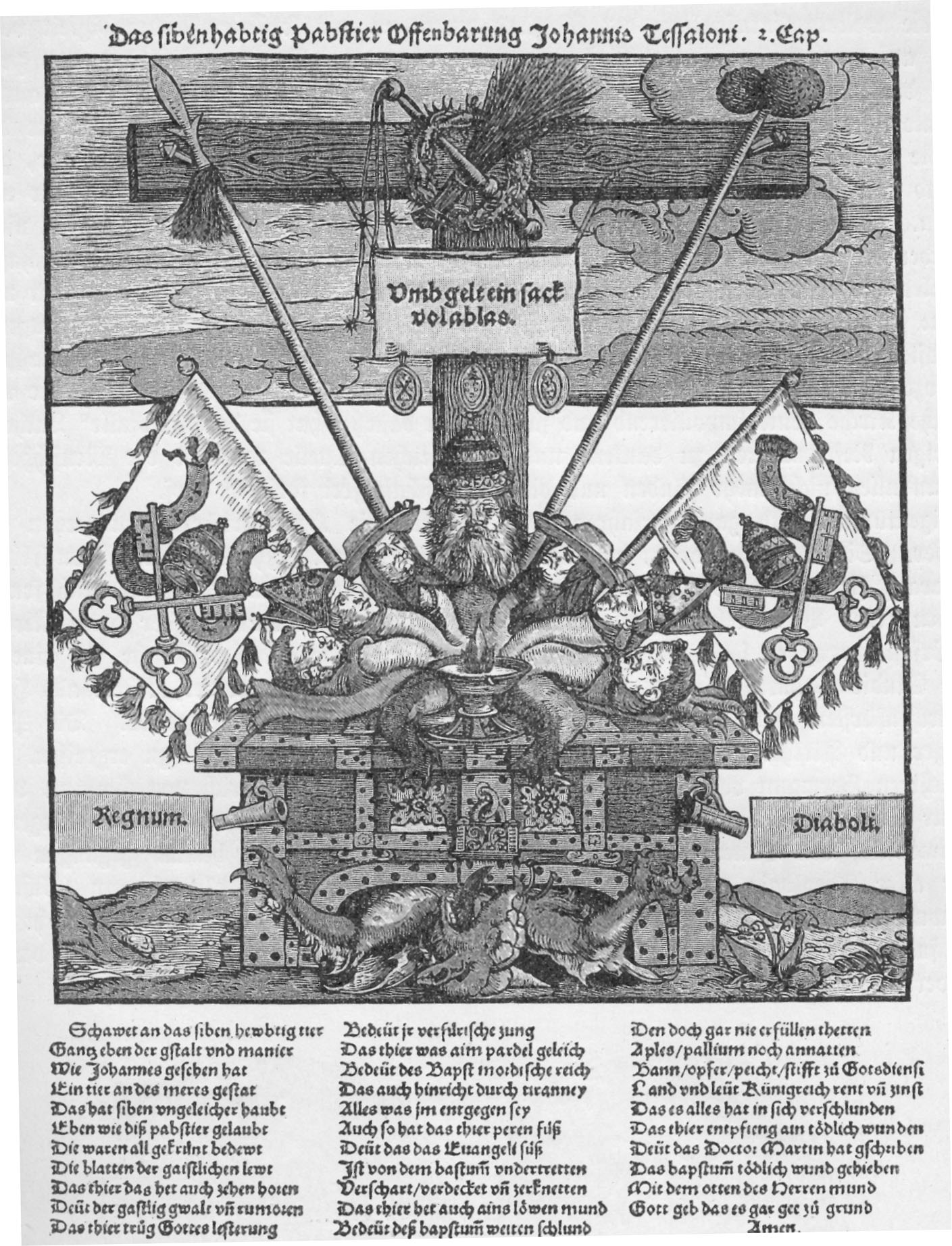
Against the anti-papists

(Note: this is an English paraphrase of an earlier post.)

The Left Party took a clear position on the pope's recent visit to Germany: half its MPs were to leave the room during the pope's speech before the Bundestag. I believe this attitude, widespread among the German Left both within and without parliament, is wrong both theoretically and strategically. The following is intended as a kick-off to a left-wing response to no-to-popery rhetoric in Germany: a critique of the critique of the pope, if you will.

Last year's papal visit to Britain, until recently my home, was similarly contested. At the time, Simon Hewitt outlined why hostility to the pope was suspect, but his argument, rooted as it is in historical materialism, applies mostly to a British context. But just as in Britain, German anti-Catholicism would do well to understand its own history.

Germany, almost uniquely among the European states, is divided into two denominations of roughly equal size.* The religious wars of the sixteenth and seventeenth centuries ended in a draw. The decline of imperial authority left no power above the princes, who proceeded to enforce uniform religious observance among their subjects. (It may have been for this reason that my Protestant ancestors left Upper Austria for Pomerania in the early eighteenth century.) After Prussia expelled Austria from the German Confederation, sixteen million Catholics remained in the newly unified German state: mostly in the south and west, in Ermland, Upper Silesia and the Polish border regions - beside twenty-eight million Protestants.

The Hohenzollern emperors were none too fond of these Catholics. They suspected them, the 'inner France', of conspiring with foreign powers and branded them 'enemies of the Reich'. Bismarck waged a protracted war of position - the Kulturkampf of the 1870s - against the Catholic Church. In short, Catholicism served the rulers of the Junker State as an imaginary enemy to secure their own power. Catholics fought back in the political arena through the Centre Party; many also joined the fledgling Social Democrats. At the same time, German nationalists in Austria-Hungary founded the 'Away from Rome' movement, combining virulent anti-Catholicism with antisemitism; protofascists like Georg von Schönerer converted to Protestantism.

Though officially neutral with respect to religion, Nazism was suspicious of the Catholic Church as a 'foreign' power from the beginning. In Catholic regions the Nazis never achieved the electoral breakthroughs that made the rural Protestant North their stronghold. In his infamous Myth of the Twentieth Century, Alfred Rosenberg claimed the Papacy descended from the haruspices - Etruscan soothsayers - and was thus of Asiatic, 'non-Aryan' origin. In western Germany, Catholicism only won equality and the capacity to contribute equally to public life after 1945.

Of course most latter-day anti-papists will be appalled at the unsavoury history of German anti-Catholicism: many, indeed, will not be familiar with it. Most of those hostile to the papal visit are of a generally secular frame of mind rather than hailing from a traditionally Protestant backgrounds. Either way hostility to the Catholic Church is not neutral terrain: any critique of the pope must formulate a response to the historical persecution of Catholics and unequivocally defend Catholics' enduring right to practise their faith in Germany.

Rejecting simplistic criticisms of the pope does not, of course, mean a blithe acceptance of the Vatican's teachings. Critics are right to lambaste Rome's stance on gender and sexuality as well as its treatment of the abuse scandal. As a Protestant, I also have fairly wide-ranging disagreements with Catholic teachings, from salvation to ecclesiology, the Eucharist and the use of images. None of that means, however, that one shouldn't invite the pope and hear him out. Not to mention that anyone who rejects the pope must be consistent: will he or she show the same zeal protesting President Obama, who is responsible for the deaths of thousands through drone attacks - which, however hostile, no-one could quite claim of the pope?

Liberal secularists opposing Protestants and Catholics as well as Muslims and religious Jews must be prepared to be self-critical and accept that, just like the Christianity of yore, their agitation has frequently been exploited in the cause of imperial aggression in recent years. Western Crusaders like Henryk Broder and Christopher Hitchens use a critique of religion to justify the invasion of Muslim countries as well as the continuing occupation and colonisation of Palestine. Secularism must be as wary of its false friends as it is of its supposed or real enemies. It must be critical of its own vocabulary and accept that it is counter-productive to stereotype Christians as, in the admirable words of Professor Dawkins, 'dyed-in-the-wool faith-heads'. Painting Joseph Ratzinger, a highly intelligent theologian, as an out-of-touch fuddy-duddy won't do much for anyone's credibility.

Most varieties of secularism find their origin not in Marxism but in a - particular and arguably wrong - interpretation of the Enlightenment, and the Left should be wary of applying them uncritically. Marx's real critique of religion cannot be separated from his critique of the social order, as a quick glance at the Introduction to the Critique of Hegel's Philosophy of Right will show:
The foundation of irreligious criticism is: Man makes religion, religion does not make man. Religion is, indeed, the self-consciousness and self-esteem of man who has either not yet won through to himself, or has already lost himself again. But man is no abstract being squatting outside the world. Man is the world of man – state, society. This state and this society produce religion, which is an inverted consciousness of the world, because they are an inverted world. Religion is the general theory of this world, its encyclopaedic compendium, its logic in popular form, its spiritual point d’honneur, its enthusiasm, its moral sanction, its solemn complement, and its universal basis of consolation and justification. It is the fantastic realisation of the human essence since the human essence has not acquired any true reality. The struggle against religion is, therefore, indirectly the struggle against that world whose spiritual aroma is religion.
Religious suffering is, at one and the same time, the expression of real suffering and a protest against real suffering. Religion is the sigh of the oppressed creature, the heart of a heartless world, and the soul of soulless conditions. It is the opium of the people.
The abolition of religion as the illusory happiness of the people is the demand for their real happiness. To call on them to give up their illusions about their condition is to call on them to give up a condition that requires illusions. The criticism of religion is, therefore, in embryo, the criticism of that vale of tears of which religion is the halo.
Unlike Marx I do not believe 'religion' - which Marx rather unacceptably generalises as a universal phenomenon - to be an illusion, but the main thrust of Marx's argument is hard to argue with. Proclaiming the end of religion without at the same time fighting for the end of a state of affairs that leads people to long for a less terrible Beyond is not just an admission of impotence, but apologetics for the vale of tears. Unlike liberal atheism Marxism dissolves superstition into history, not vice versa: it seeks to overthrow the present society rather than pointlessly demand that people should bear it without illusions.

But left-wing anti-papism is wrong not only in theory but also in practice. The Left Party has struggled for years to overcome its own east-west division: a mass party in eastern Germany but often the weakest of five parliamentary parties in the West, it is faced by the task of establishing itself among the West German working class. The most industrialised regions of the West (the Ruhr and the Rhineland), however, are also among the country's most strongly Catholic. Spicing up democratic socialism with God-is-dead sloganeering is self-sabotage. Left-wing politics must approach workers without prejudice, not condemn their beliefs, whatever they may be, as antediluvian.** It must engage real human beings, not the sort it would like in a perfect world. The party oddly has no problem grasping this when it comes to Iraq or Palestine, which should make one at least a little uneasy.

In other news, the decline of Christianity in Germany has led to strange side-effects. When the pope declined to advance the ecumenical integration of the churches, the press considered this a 'disappointment' to Protestants, whose hopes were apparently 'dashed' by the Pontiff. It would appear that when he said he felt closer to the Orthodox than to the Protestant churches, the pope made Protestant bishops cry. One might imagine the Eastern and Lutheran churches as prodigal sons competing for the approval of a displeased father and eager to move back into his house at the earliest opportunity. Well, I must announce my disappointment is somewhat limited: the Protestant tradition, be it Lutheran or Calvinist, has long been sufficiently strong to survive without a papal blessing. We'll live.


*Yugoslavia and Ireland are somewhat similar in this respect.
** Of course there are limits: the Left must always be a force against racism and sexism among workers, for example, which are morally unacceptable and weaken the working class.

Sunday, 25 September 2011

Los von Rom? Eine Kritik der Papstkritik

Die Linke bezog klar Stellung zum Papstbesuch. Die Hälfte ihrer Abgeordneten wollte zur Papstrede im Bundestag den Saal verlassen. Ich halte diese Ablehnung, die auch außerparlamentarisch in linken Kreisen weit verbreitet ist, für theoretisch und strategisch falsch. Wir bedürfen einer linken Antwort auf die Nein-zum-Papst-Rhetorik - eine Kritik der Papstkritik, wenn man so will.

Auch die Reise des Papstes nach England, bis vor kurzem meine Wahlheimat, war umstritten. Simon Hewitt legte damals dar, warum ihm die Gegnerschaft suspekt war, allerdings fußt sein Argument auf historischem Materialismus und damit einem britischen Kontext, der für Deutschland nicht gilt. Der deutsche Antikatholizismus täte gut daran, die eigene Geschichte zu verstehen.

Deutschland ist in Europa fast einzigartig in seiner Teilung in zwei Konfessionen ähnlicher Größe.* In den Religionskriegen des sechzehnten und siebzehnten Jahrhunderts gelang keiner Seite der Sieg, und durch die Zermürbung der Kaisermacht gab es in Deutschland bald gar keine Instanz über den einzelnen Fürstenhäusern, die nach dem Prinzip cuius regio, eius religio ihre Untertanen dem eigenen Glauben unterwarfen. (Vielleicht aus diesem Grunde wanderten meine evangelischen Vorfahren im frühen achtzehnten Jahrhundert aus Oberösterreich nach Pommern aus.) Nachdem Preußen Österreich aus Deutschland drängte, verblieben im Kaiserreich sechzehn Millionen Katholiken - vor allem im Süden und Westen, im Ermland, in Oberschlesien und den polnischen Grenzgebieten - zu achtundzwanzig Millionen Protestanten.

Den Hohenzollern waren diese Katholiken nicht lieb, sie wurden als "inneres Frankreich" des Sympathisantentums mit äußeren Mächten verdächtigt, als Reichsfeinde gebrandmarkt und im Kulturkampf von Bismarck bekriegt: kurzum, die Kirche diente den Herrschern des Junkerstaates als Scheinfeind, um die eigene Macht zu sichern. Katholiken wehrten sich politisch durch die Zentrumspartei, viele traten auch der SPD bei. Zugleich formierte sich unter den Deutschnationalen Österreich-Ungarns die Los-von-Rom-Bewegung, die Antikatholizismus mit Antisemitismus verband. Protofaschisten wie Georg von Schönerer traten zu dieser Zeit zum Protestantismus über.

War der Nationalsozialismus offiziell konfessionsneutral, so stand er doch der katholischen Kirche von Anfang an als außerdeutscher Macht ablehnend gegenüber. Im katholischen Deutschland gelang den Nationalsozialisten niemals der Durchbruch, der das ländliche, evangelische Norddeutschland zu ihrer Hochburg zumindest nach Stimmenanteilen gemacht hatte. Alfred Rosenberg erklärte im Mythus des zwanzigsten Jahrhunderts, das Papsttum sei aus den haruspices, den Wahrsagern der Etrusker, entstanden und somit asiatischen, "nichtarischen" Ursprungs. Erst nach 1945 gewann der Katholizismus im Westteil Deutschlands Gleichberechtigung und konnte auch zum Kulturleben der Bundesrepublik oft entscheidend beitragen.

Natürlich betrachten die meisten heutigen Papstgegner diese unschöne Geschichte des deutschen Antikatholizismus mit Abscheu, viele werden auch gar nichts davon wissen. Jedenfalls ist die Ablehnung der katholischen Kirche kein unbeflecktes Gelände: ein Nein zum Papstbesuch muß mit einem Ja zum Existenzrecht des Katholizismus in Deutschland einhergehen. Auch stammen die wenigsten Papstgegner aus dem Umfeld des klassischen Protestantismus, sondern sind allgemein säkular eingestellt. Dennoch muß jede Papstkritik zum historischen Antikatholizismus in Deutschland Stellung beziehen und Katholiken klarmachen, daß ihrem Glauben und Brauchtum nicht allgemein das Daseinsrecht abgesprochen wird.

Eine Kritik der Papstkritik bedeutet nun keineswegs das unbedingte Ja zu allen Lehren des Vatikans. Die Gegner haben ja recht damit, daß zum Beispiel die Sexual- und Geschlechterpolitik Roms, auch der Umgang mit dem Mißbrauchsskandal sehr unzureichend war. Ich als Protestant melde natürlich weitreichende theologische Differenzen mit dem Papst an, von der Erlösung zur Ekklesiologie, dem Abendmahl und dem Bilderstreit. Das heißt aber nicht, daß man den Papst nicht einladen und ihm höflich zuhören könnte. Und wer den Papst ablehnt, der muß sich die Frage nach der eigenen Prinzipienfestigkeit gefallen lassen: würden dieselben Menschen ebenso energisch gegen Präsident Obama protestieren, der immerhin Tausende Menschen in Pakistan durch Drohnenangriffe hat töten lassen - was man vom Papst ja nicht behaupten kann?

Die säkulare Religionskritik wendet sich unterschiedslos gegen Protestanten und Katholiken, auch gegen Muslime und religiöse Juden. Sie muß sich dabei kritisch zu sich selbst verhalten und sich eingestehen, daß ihre Position oft zu imperialistischen Zwecken mißbraucht wird, wie es einst mit dem Christentum geschah. Westliche Kreuzritter wie Christopher Hitchens und Henryk Broder rechtfertigen mit der Religionskritik den Überfall auf muslimische Länder ebenso wie die fortdauernde Besatzung und Kolonisierung Palästinas. Sie muß also von ihren falschen Freunden genauso Abstand nehmen wie von ihren vermeintlichen oder wahren Gegnern. Außerdem muß sie ihr eigenes Vokabular überprüfen und sich klarmachen, daß es ihr nicht hilft, Christen für verblendet oder dumm zu erklären. Wer einen hochintelligenten Theologen wie Joseph Ratzinger als zurückgeblieben abstempelt, hat ein Glaubwürdigkeitsproblem.

Die weitestverbreiteten Strömungen des Säkularismus entstehen nicht aus dem Marxismus, sondern aus einem falsch verstandenen liberalen Aufklärungsdenken, und sollten von der Linken darum nicht unkritisch angewandt werden. Marx' tatsächliche Religionskritik ist untrennbar mit der Gesellschaftskritik verbunden, wie in Zur Kritik der Hegelschen Rechtsphilosophie: Einleitung zusammengefaßt:
Das Fundament der irreligiösen Kritik ist: Der Mensch macht die Religion, die Religion macht nicht den Menschen. Und zwar ist die Religion das Selbstbewußtsein und das Selbstgefühl des Menschen, der sich selbst entweder noch nicht erworben oder schon wieder verloren hat. Aber der Mensch, das ist kein abstraktes, außer der Welt hockendes Wesen. Der Mensch, das ist die Welt des Menschen, Staat, Sozietät. Dieser Staat, diese Sozietät produzieren die Religion, ein verkehrtes Weltbewußtsein, weil sie eine verkehrte Welt sind. Die Religion ist die allgemeine Theorie dieser Welt, ihr enzyklopädisches Kompendium, ihre Logik in populärer Form, ihr spiritualistischer Point-d'honneur, ihr Enthusiasmus, ihre moralische Sanktion, ihre feierliche Ergänzung, ihr allgemeiner Trost- und Rechtfertigungsgrund. Sie ist die phantastische Verwirklichung des menschlichen Wesens, weil das menschliche Wesen keine wahre Wirklichkeit besitzt. Der Kampf gegen die Religion ist also mittelbar der Kampf gegen jene Welt, deren geistiges Aroma die Religion ist.
Das religiöse Elend ist in einem der Ausdruck des wirklichen Elendes und in einem die Protestation gegen das wirkliche Elend. Die Religion ist der Seufzer der bedrängten Kreatur, das Gemüt einer herzlosen Welt, wie sie der Geist geistloser Zustände ist. Sie ist das Opium des Volkes.
Die Aufhebung der Religion als des illusorischen Glücks des Volkes ist die Forderung seines wirklichen Glücks. Die Forderung, die Illusionen über einen Zustand aufzugeben, ist die Forderung, einen Zustand aufzugeben, der der Illusionen bedarf. Die Kritik der Religion ist also im Keim die Kritik des Jammertales, dessen Heiligenschein die Religion ist.
Zwar halte ich im Gegensatz zu Marx "die Religion", die Marx unzulässig als allgemeines Phänomen zusammenfaßt, nicht für eine Illusion. Dem Hauptargument der Marxschen Religionskritik aber kann ich zustimmen. Wer das Ende der Religion proklamiert, ohne zugleich für das Ende aller Zustände, die den Menschen auf ein betteres Jenseits hoffen läßt, zu kämpfen, der ist nicht nur kraftlos, sondern Apologist des Jammertals. Im Gegensatz zum liberalen Atheismus leitet marxistische Kritik nicht die Geschichte aus dem Aberglauben, sondern den Aberglauben aus der Geschichte ab; sie sucht die gegenwärtige Gesellschaft aufzuheben, statt sinnlos zu verlangen, daß der Mensch sie illusionslos zu ertragen habe.

Aber die linke Papstkritik ist nicht nur theoretisch, sondern auch strategisch falsch. Die Linke bemüht sich seit Jahren, ihr West-Ost-Gefälle zu überwinden: im Osten Volkspartei, im Westen oft kleinste der parlamentarischen Parteien, muß sie unter den Arbeitern Westdeutschlands Fuß fassen. Nun sind aber die Industrieregionen Westdeutschlands, wie das Ruhrgebiet und Rheinland, unter den am stärksten katholischen Gegenden. Wer dort den demokratischen Sozialismus mit Gott-ist-tot-Parolen anreichert, stellt sich selbst ein Bein. Linke Politik sollte sich den Arbeitern vorurteilsfrei nähern und von ihnen lernen, nicht ihre Anschauungen von vornherein für vorsintflutlich erklären.** Sie muß den Schulterschluß mit wirklichen Menschen wagen, nicht mit solchen, wie sie sie gerne hätte. Das erkennt die Partei ja seltsamerweise auch, wenn es um Palästina oder den Irak geht, aber in Dortmund soll es aus irgendeinem Grunde (der ja, man vergesse es nicht, auch anrüchig sein kann) anders sein.

Der Schwund des Christentums in Deutschland hat übrigens eine merkwürdige Nebenwirkung. Die Absage, die der Papst dem weiteren Zusammenwachsen der Kirchen erteilte, wertet die Presse als "Enttäuschung" für Protestanten, deren Hoffnungen der Papst zunichte mache. Er fühle sich Orthodoxen näher als Protestanten, sagte der Papst und brachte damit, so möchte man meinen, evangelische Kirchenhäupter zum Weinen. Das klingt, als seien Ost- und Lutherkirchen verlorene Söhne, die um das Wohlwollen eines unzufriedenen Vaters wettbuhlen und am liebsten so bald wie möglich wieder bei ihm einziehen wollen. Ich darf vermelden, daß meine Enttäuschung sich in Grenzen hält: die protestantische Tradition, sei sie lutherisch oder calvinistisch, reicht längst aus, um auch ohne den Papstsegen fortzubestehen. Das überstehen wir schon.

* Jugoslawien und Irland ähneln Deutschland in dieser Hinsicht.
** Natürlich hat diese Einstellung Grenzen. Frauen- und Fremdenfeindlichkeit sind z.B. stets abzulehnen, da sie die Arbeiter teilen und schwächen. 

UPDATE: An English paraphrase of this post can be found here. 

Sunday, 14 August 2011

Why I won't condemn the riots

As unexpected as the riots in England's cities were, the response was tediously predictable. Beside the hang-'em-high fulminations of the right-wing press, media consensus from the Guardian to the Telegraph was to deplore 'mindless', 'senseless' violence by 'feral youths', 'thugs', and so on. We're used to this: it's how they've talked about all clashes on Britain's streets since Millbank (and long before that).

The BBC's stance, too, was well-rehearsed. Their reporting was thoroughly on-message, narrowing the issue at stake to 'Is the police response effective or not?' The most distinctive characteristic of such reporting on Tory Britain, however, was that from Diane Abbott to Nigel Farage, anyone who had a microphone shoved in their face was asked to condemn the rioters before anything else.

Those who did not do so with sufficient force ran into trouble with their interviewers, as Darcus Howe found out. It's a test of loyalty: agree with our political elites or become a non-person, an Other as far as the media are concerned. Such ideological rigidity rather gives the lie to our liberal democracy's self-professed openness.

David Starkey's racist comments, on the other hand, were not condemned as vigorously. (Toby Young's incompetent attempt to exonerate Starkey is typical of the 'He wasn't racist' crowd.) I don't think Emily Maitlis gave Starkey a free pass: she challenged him repeatedly. The historian may simply have been ignorant: he confused Jamaican Patois with Textspeak and saw rap as the reason for the riots (one might ask him about the role of rap in 1790s riots).

But there's something more malicious and calculated here. Starkey consistently attempted to racialise the debate, reducing debates about gang culture (valid by themselves) to questions about 'black culture' (and Owen Jones was spot on when he pointed out that by 'white' Starkey meant 'respectable'). Of course, the last forty years have seen a change in the discourse: instead of skin colour the Right now talks about culture, understood as a fixed quality innate to human beings, not a constantly changing process influenced by all sorts of factors, i.e. dialectically. Thus the sign 'culture' still points to the signified 'skin colour', but without embarrassingly blatant racism.

There's the first reason we shouldn't condemn the rioters: the racist vocabulary in which they are being execrated. Starkey is only making explicit what has been implied in much of the condemnation: the rioters are, pardon my Disney, savages, barely even human. Here's Max Hastings's astonishing tirade:
The people who wrecked swathes of property, burned vehicles and terrorised communities have no moral compass to make them susceptible to guilt or shame... They are illiterate and innumerate, beyond maybe some dexterity with computer games and BlackBerries. They are essentially wild beasts. I use that phrase advisedly, because it seems appropriate to young people bereft of the discipline that might make them employable; of the conscience that distinguishes between right and wrong. They respond only to instinctive animal impulses — to eat and drink, have sex, seize or destroy the accessible property of others. (emphasis mine)
Hastings goes on to express regret that looters were not shot, and complains about their antisocial refusal to watch the royal wedding. Disadvantaged young people are constructed as an utterly alien and contemptible Other. This isn't new: the people we now dismiss as 'chavs' were once Burke's 'swinish multitude' and the Victorians' 'vicious, semi-criminal' urban poor. To smear an entire segment of the population as the forces of chaos is hardly ethical.

Secondly, this demonisation both ignores and facilitates neoliberal 'reforms'. The Right initially insisted that any attempt to search for root causes amounted to an endorsement, and with good reason: such a search might uncover that youth club closures left young people with nothing to do and nowhere to go. It might find that 20 per cent of youth and half of young black people are unemployed, or that black people are 26 times more likely to be stopped and searched than their white peers. By moralising looting and demonising the young such inconvenient facts can be ignored, while their 'feral' nature can be used to justify the attacks on jobs and services this government is anxious to push through.

Thirdly, the condemners keep bad company. The moralism now echoing through the Commons, from people who cheerfully defrauded the taxpayer, is nought but rank hypocrisy. David Cameron enjoyed smashing private property in his youth. The BNP and EDL racists now coming out of the woodwork to act as Freikorps are using understandable fear and anger to preach a message of hate. Frankly, I don't want to agree with these people on much at all.

Lastly and perhaps controversially, looting shows a response to real injustice, however poorly expressed. I hold that any attack on property is political - it claims that 'this should not belong to you'. What sort of politics this expresses depends on the situation: after all, imperialism or the current looting of the public sector are also attacks on the property of others. But the riots attacked a system in which corporations and the rich running them control the vast majority of human wealth, expropriating and withholding them from the majority. Ultimately, looting is an unhelpful, sporadic, localised response to this general malaise: a much better response would frankly be to expropriate all capital.

In refusing to condemn the riots, let's not fall into the trap of claiming they were not terrifying and destructive to many people, few of them wealthy. It's in the nature of riots that most of the people hurt will be subaltern, not the elites. But that doesn't mean we should collude in demonising the rioters: it means that we should argue for better working-class politics and engage with frustrated young people in building resistance movements. Riots are counter-violence, but ultimately they do little to hurt ruling-class violence. For that, we need revolutionary politcs.

Tuesday, 26 July 2011

Smash the dragons!

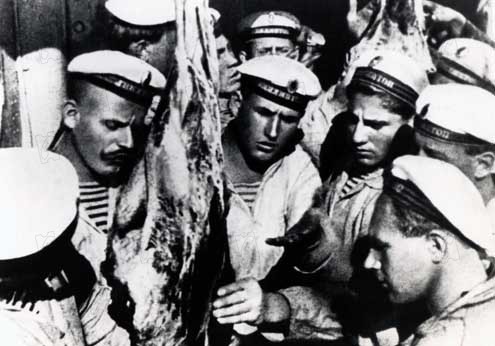
Occasionally, life is awesome. And thus it was that the local 'independent' cinema put on a screening of The Battleship Potemkin (1925), a film I had previously only seen on DVD. It absolutely blew me away. If you see The Battleship Potemkin - and until you do, your life will be incomplete - you must see it in the cinema: the film needs the space the big screen affords to develop its full power.

It's worth recalling the extent to which the Russian Revolution, which director Sergei Eisenstein served as a Red Army soldier from 1918, inspired an incredible boom of the avant-garde in Russia: in music, visual arts and film, Russia was world-leading in the first half of the 1920s, until the ossification of Soviet public life stifled the arts.

The Battleship Potemkin was Sergei Eisenstein's second full-length feature, after 1924's Strike. At twenty-seven years Eisenstein was considered a prodigy when he filmed The Battleship Potemkin, the troubles with Soviet authorities that would cast a shadow over his masterpiece, October (1927), still ahead of him. Although the film's success at home was less than stellar, it fared better internationally.

Designed as the ultimate revolutionary propaganda film, The Battleship Potemkin is divided into five dramatically distinct parts. In 'Men and Maggots', sailors on the battleship Potemkin of the Black Sea Fleet become angered by the rotten, maggot-infested meat they are asked to eat during the first, failed Russian Revolution of 1905.

In 'Drama on the Deck', the conflict comes to a head as the officers' decision to shoot down those unwilling to eat is confronted by a mutiny led by Grigory Vakulinchuk (Aleksandr Antonov). After a fight, the mutinous sailors take over the ship.


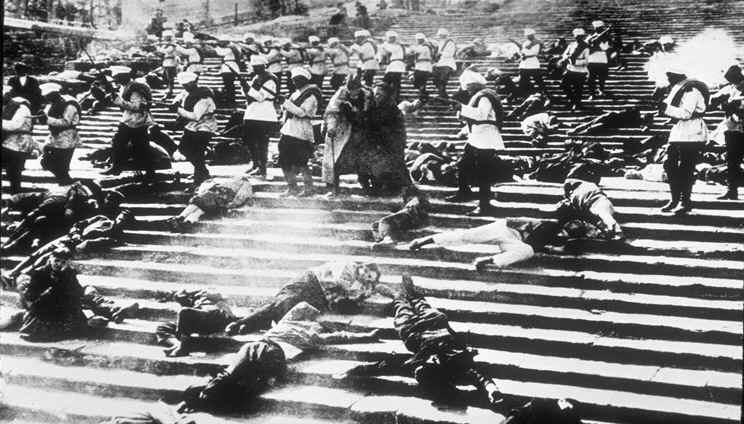
After the fallen Vakulinchuk is mourned over by the people of nearby Odessa in 'A Dead Man Calls for Justice', the revolutionary population is massacred by Tsarist troops and Cossacks on 'The Odessa Steps'. Finally, the Potemkin must face a naval squadron sent to quash the mutiny.

The version I saw was restored by the Deutsche Kinemathek and claims to be as close to the original as possible, unlike previous versions compromised by Stalin-era re-editing. It is distinctive for its soundtrack, a re-recording of Edmund Meisel's original score, and for the colouring of the red flag the Potemkin flies after the successful mutiny. The brilliant red in a black-and-white film is quite striking and I am more than willing to accept this deviation from the original, since it seems very much in the spirit of Eisenstein. There, are, however, some errors in the subtitles: the call to 'smash the dragons!' is a point of particularly hilarity, although thankfully it does not impede efforts to disarm the dragoons.

Seeing The Battleship Potemkin on the big screen I was very much struck by the perfection of the compositions by cinematographer Eduard Tisse and Eisenstein himself. Image after image is perfectly created; this almost leads to a feeling of sensory overload as the modern viewer is too used to the narrative-centred, 'getting out of the actors' way' style of twenty-first-century direction.


The Odessa steps sequence is the film's most famous by far. And it deserves to be: it's perfectly shot and shockingly violent by the standards of the times. But it shouldn't overshadow other scenes. The early confrontation between recalcitrant sailors and officers is particularly tense, as is the climactic showdown between Potemkin and the Tsarist squadron.

Eisenstein films are notable in eschewing the individualism that is endemic in western cinema. So it is with The Battleship Potemkin: although Vakulinchuk is the only named sailor, he is killed in the second of the film's five episodes and remains a cipher, no more than a spokesman for the revolutionary proletariat. No, the protagonist of The Battleship Potemkin is the collective of the mutinous sailors and, in chapters three and four, the revolting populace of Odessa. It is virtually only the villains who actually receive names.


Speaking of villains: as a work of Soviet propaganda, the film of course deals in broad stereotypes. The bad guys walk around in finery and sport monocles; one attempts to turn the people's assembly in Odessa into a pogrom and is beaten to death for his troubles by the people, who of course know their woes cannot be blamed on the Jews. But such a clear distinction between heroes and villains is not necessarily a bad thing; indeed The Battleship Potemkin absolutely could not work if the counter-revolutionaries were treated fairly.

Propaganda, then: but what propaganda! You don't need to be a dirty Red like me to enjoy this film (although it helps): Joseph Goebbels was apparently a jealous admirer of Eisenstein's craft. But you must  bring a willingness to accept collective protagonists, the flexibility to adjust to silent film, and sturdy footwear to prevent your socks from being blown off. What are you waiting for? To the cinema, post haste.

Tuesday, 7 June 2011

Fleischhauer schlägt wieder zu!

Daß ich regelmäßig die Spiegel Online-Kolumne des Herrn Fleischhauer lese, mag auf Persönlichkeitsprobleme hindeuten. Fleischhauer liest man am besten in kleinen Dosen, sonst erschöpft sich der eigene Zorn an der schieren Gemeinheit und Dummheit seiner Polemik. Der feine Herr ist die Abteilung Attacke einer gewissen Art rechten Bürgers, der sich bestens frisiert und in edle Anzüge gekleidet über den realitätsfernen Pöbel lustig macht. Der nämlich - man glaubt es kaum! - verlangt Dinge wie Atomausstieg, Frieden, ein Ende des Klassenkampfes von oben. Der Linke als Träumer ist der Mittelpunkt der Rhetorik Fleischhauers, der sich selbst als Bewahrer der Aufklärung sieht. Politik ist die Herrschaft der aufgeklärten Elite über den unwissenden und nichts wissenwollenden Gefühlsmenschen.

So in seiner neuesten Kolumne, in der Herr F. den Kirchentag in Dresden kritisiert. Für mich als Christen und Sozialisten ist das Thema doppelt interessant. Daß Fleischhauer die EKD nur als eine der "Vorfeldorganisationen" der ihm verhaßten Grünen ansieht, ist kurios, entspricht aber seiner kämpferischen Grundhaltung. Die von ihm zitierten Resolutionen - "Alternativen zum Wirtschaftswachstum", Schutz der Roma vor Ausweisung und das "Recht auf ein Leben ohne Bedrohung durch atomare Strahlen" sind vernünftig; allein den Antrag an die Kirchenleitung, das Schicksal der "der als Hexen hingerichteten Bürger und Bürgerinnen" aufzuarbeiten, scheint mir ein bißchen lächerlich. Was wendet nun Fleischhauer gegen besagte Resolutionen ein?

Vor allem dies: die Anträge zeigten einen "Stolz auf das unbedarfte Denken" auf.

Mit dem Herzen zu denken beziehungsweise mit dem Kopf zu fühlen... gilt auf dieser Art von Veranstaltung als besondere Tugend. Mit der Aufklärung hat sich der Sentimentalismus nie wirklich anfreunden können, Rationalität muss seit langem mit dem Vorwurf leben, zynisch, kalt, ja irgendwie männlich zu sein. Der Stolz auf das unbedarfte Denken ist geradezu Signum der Gefühlstheologie: "Präreflektierte Unmittelbarkeit" sei doch "eigentlich ganz schön", verkündete Margot Käßmann zum Auftakt der grünen Tage in Dresden, womit sie zweifellos vielen Zuhörern aus dem - ja: Herzen - sprach.
 Und ganz unrecht hat Herr Fleischhauer hier gar nicht: tatsächlich hat sich "der Sentimentalismus" mit "der Aufklärung" nicht abfinden können. Hat nicht die Bourgeoisie "die heiligen Schauer der frommen Schwärmerei, der ritterlichen Begeisterung, der spießbürgerlichen Wehmut in dem eiskalten Wasser egoistischer Berechnung ertränkt" (Marx/Engels)? Aber der selbsternannte Hüter aufklärerischer Vernunft ist der eigentlich Unvernünftige.

Stimmt es, daß "es auf Dauer schwierig sein dürfte, ein Industrieland ganz ohne verlässliche Energiequellen am Laufen zu halten"? Was heißt "verläßlich"? Verläßlich ist bei fossiler Energie nur die zunehmende Umweltzerstörung nebst ständig drohender Katastrophen, d.h. die Vernichtung unseres Lebensraumes. Damit ist "ein Industrieland" vielleicht "am Laufen zu halten", die Menschen aber nicht. Das ist durchaus logisch: der Bourgeois setzt die Reproduktion seiner Macht gleich mit dem Wohlergehen der Gesellschaft und arbeitete darum im Namen des Fortschritts einst Kinder zu Tode (was nun angenehmerweise größtenteils anderswo geschieht - zum Glück gibt es ja die räumliche Distanz).

Marcuse charakterisiert das als eindimensionales Denken, die Anwendung tadelloser Logik und Rationalität, die sich beim kritischen Hinsehen als katastrophal unvernünftig erweist. Ständiges explosives Wirtschaftswachstum mag den Herren Wirtschaftsweisen vernünftig erscheinen, ja vielleicht sogar eine Existenzbedingung des heutigen Kapitalismus sein. Weil die Ressourcen der Erde aber endlich sind, wird die Forderung nach größerem Wirtschaftswachstum zur Forderung nach der beschleunigten Selbstvernichtung der bürgerlichen Gesellschaft - was so schlimm nicht wäre, wenn sie uns allesamt nicht mit ins Grab risse. Nichts ist unvernünftiger als die Position der Kanzlerin, die uns schnellstens in die Vorkrisenzeit zurückversetzen will, als wir eben vor der Krise standen.

Auch das brutale Absenken des allgemeinen Lebensstandards, die wir gerade in Großbritannien und anderen Ländern erleben, die gewaltsame Umverteilung von unten nach oben scheint sinnvoll, will man den stotternden Motor des Kapitalismus wieder in Fahrt zu bringen (vorausgesetzt, man hält Binnennachfrage für unwichtig). Wer aber am Wohlergehen des Menschen und nicht am Kontostand der Herrscher ansetzt, wird diese "Vernunft" höchst unvernünftig finden. Dazu muß man keineswegs nur mit dem Herzen denken. Die Logik des Kapitalismus läßt sich verteidigen, aber nur "by arguments which are too brutal for most people to face, and which do not square with the professed aims of the political parties". Darum die beispiellose Propagandaoffensive der letzten Jahre.

So löst sich Fleischhauers Kritik an "sentimentalem" Wunschdenken letztlich auf in Kritik alles Denkens, das beim Menschen statt beim Gewinn des Kapitalisten ansetzt. Wer den Menschen als Subjekt und nicht nur als Instrument wahrnimmt, kann Fleischhauer nicht folgen.

Gegen Ende seines Auswurfs aber gelingt es Fleischhauer dann doch, eine interessante Debatte anzustoßen. Er sieht das kirchliche Interesse an weltlichen Themen als fatale Selbstschwächung:

Die Folgen der Selbstsäkularisierung sind heute an vielen Gottesdiensten ablesbar. Kaum ein Pastor traut sich noch, ungeniert von Himmel und Hölle zu sprechen, und wenn, dann ist das nur allegorisch gemeint, wie er sich hinzuzufügen beeilt. Stattdessen findet sich in jeder guten Sonntagspredigt die Litanei über den Kriegstreiber Amerika, die Schrecken der Globalisierung, das Elend der Hartz-IV-Empfänger.

Diese Diesseitsfixierung hat einen für die Kirche unschönen Nebeneffekt: Mit der Verschiebung des Erlösungshorizonts, der sich ganz aufs Heute richtet, setzt sie sich der Konkurrenz zu weltlichen Glaubensorganisationen aus, die dem Bedürfnis nach entschiedenem Handeln sehr viel besser nachkommen können. Warum nicht gleich Mitglied bei Greenpeace, Peta oder Amnesty werden?
 Fleischhauers Argument liegen zwei falsche Annahmen zugrunde.

Erstens hat es niemals ein Zeitalter gegeben, in dem Kirchen sich unpolitisch verhalten hätten - und das nicht nur, weil Politik zwangsläufig alle Lebensbereiche durchdringt. Kirchen sind immer politisch positioniert. Die Kirchen des Kaiserreichs lehrten statt der Subversion, die Fleischhauer mißfällt, eben Ruhe, Gehorsam und Ordnung als Christenpflicht und halfen damit dem status quo in Deutschland. Luther verfaßte neben der Freiheit eines Christenmenschen auch An den christlichen Adel deutscher Nation und griff damit religiös-politische Zustände an. Eine Art politische Neutralität der Kirche ist nur durch Staatsterror zu erreichen.

Zweitens ist die Trennung zwischen "Religion" und "Politik" fiktiv. Es gibt keine religiöse Sphäre, in der es nur um Engelein und Abendmahl ginge, die Gesellschaft insgesamt aber fein säuberlich außen vor bliebe. In der Gottesherrschaft des Alten Testaments ist das unübersehbar, aber auch das Evangelium ist zutiefst politisch. Die Werte, die Gläubige ihrer Religion entnehmen, beeinflussen ihr politisches Engagement, und die Gesellschaftskonstellation durchdringt umgekehrt die Kirche. Die scheinbare Trennung von Religion und Politik, Staat und Kirche ist dafür sogar das beste Beispiel, denn sie ist das unmittelbare Produkt der kapitalistischen gesellschaftlichen Revolution (wozu siehe Marx, Zur Judenfrage).

Stimmt es nun, daß "[k]aum ein Pastor [sich noch] traut..., ungeniert von Himmel und Hölle zu sprechen"? Damit hat Fleischhauer in meiner Erfahrung allerdings recht. Und wenn die Kirche also zur Gruppentherapie und Ethikstunde verkommt, in der man sich der Bibel schämt, wie vielerorts geschehen, macht sie sich tatsächlich selbst überflüssig. Aber daraus läßt sich keineswegs schließen, daß die Kirche gesellschaftliches Engagement aufgeben und nur noch von Kreuzigung und Höllenfeuer zu erzählen hätte. Ein solcher Rückzug wäre wie schon gesagt ohnehin unmöglich. Vielmehr gibt das Evangelium der Kirche eine einzigartige Perspektive auf gesellschaftliche Fragen und kann einen Dialog zwischen Gott und Welt anstoßen, der beide bereichert.

Jesus' Spruch, wonach ein Kamel leichter durch ein Nadelöhr als ein Reicher ins Himmelreich gehe, ist wenig tröstlich für die Herrschaft. Jesaja 58 zerlegt die zurschaugestellte Frömmigkeit jener Elite, die zugleich die Armen auspreßt. Das Evangelium - daß alle Menschen in ihrem Wert, aber auch ihrer Schuld vor Gott gleich sind und Christus als Mensch lebte, hungerte, litt und für uns starb - gehört keineswegs jenen, die aus ihm Akzeptanz der Gesellschaftsordnung ablesen wollen. Vielmehr leitet es zur Kritik an. Diese Kritik - den Dialog zwischen Wort und Welt - kann die Kirche führen. Daß sie sich in Dresden in die großen Gesellschaftsfragen einmischt, ist gut für die Kirche und gut für die Gesellschaft.

Saturday, 26 March 2011

Impressions from London: which side are you on?

I’ve just got back from the great anti-cuts march in London. Estimates of numbers are still confused – the number most often cited is 250,000, although the Guardian claims half a million. One of the most paradoxical aspects of attending a demonstration of this size is that while you’re there, you have no idea what’s happening on a larger scale; it takes leaving and reading the news to gain an impression of the whole. But I thought I should record a few impressions.
 
We got off the Unison coach at Euston and proceeded to ULU where we joined a students’ feeder march. Upon reaching Embankment, where we joined the main march and the trade unionists, the previously tense atmosphere, changed markedly. The mood was one of cheerful defiance as we moved on to Parliament Square and from there to Trafalgar Square. (Being the largest demonstration I’ve ever attended, it was also the slowest.) The news reports will tell you about ‘protesters’, as if these were isolated people; but the overwhelming impression on the ground was that we were with the working class, union banner by union banner. And what banners! We were near the CWU and (massive) RMT contingents most of the time, and they were not alone in having the most fantastic and individual banners for local sections, clearly painstakingly sewn and painted; many were decades old but clearly beloved. I – and as a child of the bourgeoisie I felt like an imposter – was quite overwhelmed by the pride these workers had in their self-organisation, their struggles and their past: many banners referenced the labour tradition. There was great solidarity between the unions as well, a shared sense of having come here to defend working people. When I say ‘working people’, I include teachers and others in accordance with the Marxian tradition – a sense that will hopefully be revived as all who need to work for their living come together to resist the class warfare of this government.

What I mean to say is that there was love: a recognition that public services are an expression of love for one another, and a willingness to smile and talk to total strangers recognised as comrades. Sure, the usual suspects were around: in Hyde Park the CPGB-ML, the CPB, the SWP and the SP had their stalls quite close together. There were plenty of hooded activists, but the day was not about destruction of property (which I do not oppose), unlike the student demonstrations. Instead, it was dominated by this peaceful celebration of the working class. I hope that the march will have helped create a working-class sense of solidarity that goes far beyond any individual cut but recognises the government as attacking working people as a whole. The fight-back must begin in practical terms very soon. There need to be occupations of government buildings and of public spaces, actual disruption of the smooth running of the machinery of power. Defeating the cuts practically is the only way to honour this country’s great tradition of working-class struggles.

Sunday, 20 March 2011

Economic apotheosis, with reference to South Park

In the South Park episode ‘Margaritaville’, Randy becomes a preacher, explaining the Great Money Disappearing Event to a rapt audience:

We have become lovers of pleasure rather than lovers of the Economy! There are those who will say that the Economy has forsaken us! Nay! You have forsaken the Economy! And now you know the Economy's wrath! O thoust can shop at a sporting goods store, but knowest thou that the Economy will take away thy Broncos' cap from thine head! Mock the Economy without fear! Thine own stockbrokers... now lie dead by their own hand and thou knowest that thy stockbrokers did not fear the Economy! Well here we are, my friends! You have brought the Economy's vengeance upon yourselves! … We must all wear sheets instead of buying clothes that need detergent! Instead of cars that take gasoline we can get around on llamas from Drake's farm! Instead of video games that take batteries and software, our kids will play with squirrels! We must let the Economy know that we are capable of respecting it! No more needless spending! The Economy is our shepherd. We shall not want.
Modern society, whose elites pride themselves on their rationality, has made ‘the economy’ into a god. Not an ever-kind and smiling one, mind you: this one puts the Greek gods to shame in its fickleness. Economists, who are its priests, cannot predict its actions; governments cannot tame it; its victims must bear its wrath cheerfully as the vengeance of a power beyond comprehension. And yet ‘the economy’ is fundamentally a set of relationships between human beings: it is man-made. Where does this mystification come from?

According to Nicos Poulantzas, the concept of the ‘free labourer’, who owns nothing but his labour power,

generates the relative separation of the State and the economic sphere… a separation which underlies the characteristic institutional framework of the capitalist State, since it maps out the new spaces and respective fields of the State and the economy. This separation of the State and the space of the reproduction of capital is therefore specific to capitalism: it must not be understood as a particular effect of essentially autonomous instances composed of elements that remain constant whatever the mode of production. (State, Power, Socialism, p. 18.)
In feudal society, by contrast, producers owned (that is, lived on and tilled) the land and the tools, so extracting their product involved the direct application of legitimate state violence; and the guy who took away your produce was quite obviously the same person that ruled you politically. I want to suggest, however, that there is a different approach to the question of why ‘the economy’ appears as a thing capable of action in capitalism. The explanation, I think, lies in capitalism’s capacity to produce periodic crises.

We tend to accept as given that economic crises happen; despite the protestations of bankers and politicians, everyone knows that the next crisis is certain. In that environment, it is difficult to remember that internal crisis was simply unknown in feudal society. Since commodity production was only a tiny proportion of overall economic activity, there could be no crisis of overproduction; since finance in the modern sense hardly existed and was only employed by a narrow sector of society, financial crises were also impossible. Crises of confidence could not occur where economic activity was not based on investment and information travelled very slowly, preventing panic. The feudal economy’s need for natural resources was insignificant compared to the enormous appetite of today’s productive sector, and hence no supply crises could occur. Thus internal systemic crisis was impossible as long as capitalism as a mode of production was restricted to a small part of the urban population. The feudal economy was not based on explosive growth, but could exist in equilibrium.

Not, of course, that feudal society was incapable of crisis per se. External crisis not only existed, but could have harrowing consequences. Droughts, floods, excessively cold winters and other natural disasters easily led to famine. The low productive surplus feudalism generated often resulted in large loss of life in such crises. External crises could profoundly affect social relations, of course. The Black Death of the mid-fourteenth century killed so many English peasants that the position of the remaining peasants vis-à-vis the nobility was immediately strengthened by the shortage of labour power. King Edward III cracked down in 1351, laying down laws to limit peasants’ gains. The Black Death led to a wave of migration to the cities and the creation of opportunities for women, as economic sectors previously monopolised by men opened up because of mass death.

Such crises have much in common with capitalist crises. Both strike suddenly, seemingly out of nowhere, and destroy livelihoods and fortunes, leading to a decline in living standards and in many cases to starvation and death (be it directly or indirectly, through ‘structural adjustment’). Both tend to lead to political polarisation and a rise in tension and. Both, in short, rapidly destroy the lives their stunned victims were accustomed to and create a new, much more unpleasant reality. But of course there is a key difference between the two. The sort of crisis that could ravage medieval society was caused by acts of God. Capitalist crisis is man-made: indeed natural disasters tend to create wonderful opportunities for capitalists rather than impoverish them. The former sort of crisis was caused by the mode of production’s vulnerability to external events; the latter kind is inherent in the mode of production itself.

That difference, it seems to me, neatly explains how ‘the economy’ became a sphere of life quite distinct from others – politics and everyday life. The inexplicable natural disasters that befell medieval society were attributed to God; but since, at least officially, economic life is man-made and God has no hand in it, he cannot be held responsible. The system can inflict punishment all by itself. Thus begins ‘the economy’s’ reign of terror as it smites its terrified victims. We must propitiate the economy and treat it well, or expect awesome vengeance.

Of course, in reality ‘the economy’ is an abstraction from sets of social relations, productive and commercial. Mystification, the elevation of the abstraction into a godlike being (alienation), serves dominant interests because it denies individuals’ and classes’ specific roles and responsibilities. Blame the bankers? Not if Bob Diamond has anything to do with it. Failure is an orphan, and when crisis strikes it can only be ‘the economy’ that somehow malfunctioned. Economic crises become as natural as the seasons rather than being, as they should be, associated with a particular form of society – one that can be overcome.

The non-existence of ‘the economy’ in pre-modern society also points us to what will happen to this strange god if an alternative form of life is attempted. For, as people begin to take control of their own lives, as the profit motive is removed, production is for use rather than profit and crisis disappears, ‘the economy’ will lose its dreadful power and, like all false gods, will wither away.

Monday, 10 January 2011

Die rote Bedrohung vom Karl-Liebknecht-Haus

Gesine Lötzsch verlangt eine Parteidiktatur sowjetischer Prägung in Deutschland, und zwar sofort. Inspiriert von Stalin, Mao und Pol Pot will sie unser Land in den strahlenden Morgen der kommunistischen Utopie versetzen, selbst – nein, gerade! – wenn es Abermillionen Menschenleben kostet.

Könnte man meinen, wenn man in der letzten Woche die bürgerliche Presse durchblätterte. Der „Spiegel“ hatte die Alarmglocken geläutet ob eines Artikels, den Gesine Lötzsch, Parteichefin der Linken, in der „Jungen Welt“ veröffentlicht hatte, Titel: „Wege zum Kommunismus“. „Klartext bei der Linken“, fand „Spiegel“-Autor Stefan Berg. Jan Fleischhauer setzte noch einen drauf: die Linkspartei nehme Frau Lötzsch „vor allem übel, dass [sic!] sie den Leuten so direkt auf die Nase gebunden hat, wohin die Reise mit der Linkspartei geht, sollte sie wieder [sic!] an die Macht kommen“.

Die Linke, eine Bande gemeinster Verschwörer! Aber sehr marxistisch kann man solches Doppelspiel kaum nennen. Heißt es nicht im „Kommunistischen Manifest“: „Die Kommunisten verschmähen es, ihre Ansichten und Absichten zu verheimlichen. Sie erklären es offen, daß ihre Zwecke nur erreicht werden können durch den gewaltsamen Umsturz aller bisherigen Gesellschaftsordnung“? Da gleicht die Linke dann wohl eher jenen roten Komplotten, die die Phantasie der Kalten Krieger Amerikas zirka 1950 bevölkerten.

Daß der „Spiegel“ sich gerne ab und an als staatstragendes Hetzblatt betätigt, interessiert hier nicht. Es hülfe den Herren Berg und Fleischhauer aber möglicherweise, den anstößigen Artikel auch zu lesen. Reichlich seltsam nimmt sich zum Beispiel Stefan Bergs Ausspruch aus, daß Lötzsch die „Blutspur“ des Kommunismus vergesse: „Kein Wort verliert sie über die Opfer des Kommunismus, über die Lager in der Sowjetunion, in China oder in Korea, die alle im Namen des Kommunismus errichtet wurden.“ Es ist kein Wunder, daß diese Opfer nicht erwähnt werden – lehnt doch Lötzsch einen leninistischen Kurs ausdrücklich ab. Sie spricht sich aus für den „Linksradikalismus – [diese] ‚Kinderkrankheit des Kommunismus‘ (Lenin)“. Für Rosa Luxemburg, deren Ideen hier bewundert werden, war der Sozialismus „kein fertiges Ideal, kein genial entworfener Bauplan, sondern etwas, das aus den realen Kämpfen wachsen würde“, ganz im Gegensatz eben zu den Ideen Lenins und Trotzkis, die zur gleichen Zeit das Sowjetsystem aufbauten.

Tatsächlich tritt Gesine Lötzsch in diesem Artikel ein für etwas, das früher Revisionismus geheißen und vor hundert Jahren noch von der SPD als rechtssektiererisch verdammt wurde: die graduelle Verschiebung des Machtgefüges durch die Demokratisierung und Sozialisierung von Institutionen und Wirtschaftsbereichen, das „Zurückdrängen“ kapitalistischer und imperialistischer Kräfte: „die Profitdominanz über Wirtschaft und Gesellschaft zu überwinden, die Ansätze einer neuen Gesellschaft ‚hineinzupressen‘ in die alte, bis sich beweist, daß dem demokratischen Sozialismus die Zukunft gehört“. Nun ist das natürlich nicht mehr als die seit Jahren aus Wahlprogrammen und dem Parteiprogramms-Entwurf bekannte Strategie der Linkspartei, nicht ganz korrekt präsentiert als ein konsequentes Umsetzen der Ideen Rosa Luxemburgs. Aber so schreiben sich keine reißerischen Artikel: nein, der Russe muß her, wie er mit Plattenbau und Kalaschnikow die abendländische Kultur bedroht.

Das Zahlenspiel über Opfer, das die „Spiegel“-Autoren begeistert herbeirufen, könnte man mitspielen, aber eine solche Instrumentalisierung ermordeter Menschen gereicht den Beteiligten nur zur Schande. Daß aber der Kapitalismus, der in imperialistischen Kriegen, durch Hunger, Krankheit und Schufterei seit über zweihundert Jahren Menschen systematisch hinwegrafft, im Namen der Menschlichkeit verteidigt wird, ist an Zynismus kaum zu überbieten.

Saturday, 8 January 2011

Socialism, liberalism, and the student movement

The emerging student movement has seen activists from a huge range of different political backgrounds join forces to resist the government’s onslaught on education. This diversity is one of our strengths, but it will inevitably lead to debates – not just philosophical ones, but concrete disagreements as to the correct course, what allies to choose, how to interpret the cuts etc. This piece examines one ideology common among students, liberalism, and how socialists might best interact with it to help our cause. The terms used here are classically Marxist ones, so be warned if that’s not your cup of tea.

Liberalism is older than socialism. It emerged properly during the enlightenment, as a critique of the repressive authoritarianism of the ancien régime. Liberals championed freedom of speech and conscience, and declared universal human rights considered inviolable by the state. The crucial point here is that liberalism posits a conflict between the individual and the state: the individual is its basic reference point, and that basic unit’s rights are to be defended against the encroachments of the alien, authoritarian force of the state.

It is not difficult to see that liberalism was the ideology of the rising bourgeoisie during the seventeenth and eighteenth centuries (first merchant and manufacturer, then factory owner), for the hostile state was the still largely feudal establishment that attempted to resist the shift in the economic and political balance of power in favour of the bourgeoisie. In championing the freedom of the individual, liberalism defended a rising class against its opponents: it effectively functioned as a tool of class struggle. That’s not to reduce liberalism to merely a class ideology, for many of its ideals are transparently universally valid, but to see it as also useful to class struggle, and therefore naturally an ideology popular with the bourgeoisie in the late feudal state. The individual central to liberalism appears here as the early capitalist entrepreneur, desiring to pursue his affairs without undue interference.

If liberal ideology was a weapon in the struggle of the bourgeoisie against its aristocratic opponent, its role changed fundamentally once the bourgeoisie had prevailed, either almost completely as in France or by arrangement with the old elites as in Britain. Certainly, a liberal ideology of reason, civilisation and enlightenment was employed in the nineteenth-century imperial conquest of the globe, with the bourgeois state as Hegel’s ‘march of God in the world’. But once it was in power, a strong defence of individual liberty became more of a liability than an asset to the bourgeoisie. As the ruling class – particularly in the financialised, monopolised form capitalism took in the second half of the nineteenth century – the capitalists had no use for these remnants of their own rise. As Adorno explained, liberal ideals fell by the wayside as capitalism created an increasingly total society in the twentieth century, creating ‘enemies’ and persecuting dissenters more subtly but no less effectively than the dictatorships of the East.

But now an interesting moment had come: liberalism regained its critical potential. In the nineteenth century, liberal thought was already invoked in both jingoist and anti-imperial rhetoric (witness, for example, arguments about the British occupation of Egypt in 1882). As capitalist society became total and increasingly authoritarian in its habits of thought and action, liberals began to criticise its excesses: McCarthyism, segregation, the colonial wars in Kenya, Algeria, Vietnam etc. Although their critique was often less fundamental than that put forth by Marxists, liberals nevertheless provided vital opposition to the capitalist and imperial order, especially in the United States where no labour movement comparable to those in Europe had developed. Dissent during the ‘war on terror’ has been liberal to a very significant extent. It is unsurprising that many liberals have also rebelled against the authoritarianism of the current British government, even as a supposedly liberal party is in coalition with the Conservatives.

It follows from liberalism’s class origins that it was an ideology of the privileged. Even today, liberal ideas do not have much traction with the working class, but are mostly espoused by sections of the bourgeoisie, particularly the intellectuals. If liberalism was marked as a bourgeois ideology in its insistence on the individual as the fundamental point of reference, socialism is a proletarian ideology through its casting of classes as the fundamental subjects of history and politics. That’s not to say socialism is somehow the ‘natural’ ideology of the working class: as Lenin recognised, socialism was conceived in the universities, just like liberalism before it, and then carried into the working class, quickly becoming the chief ideology of that class for its clear expression of the workers’ fundamental interests (the socialisation of the means of production and overthrow of the exploiters).

Socialism has always put class front and centre. It does not demand ‘human rights’ in the abstract, but concretely the emancipation of the working class and classes similarly exploited – not because it does not believe in human rights, but because it recognises that only a successful revolution of the working class can end the conditions of oppression and exploitation that affect all of humankind: that is, by recognising the proletariat as the fundamental revolutionary subject. Not the individual’s liberation from an encroaching state, but the proletariat’s self-liberation from its oppression and exploitation is the crucial step towards a society without oppression and exploitation. Liberalism’s revolutionary potential in capitalist society is limited, partly through the largely bourgeois class character of its adherents, partly through its atomised view of society; socialism, by recognising and organising large social forces capable of challenging established power structures, creates that potential. Socialism insists on class as the fundamental reference point because the condition of the worker in industrial society is precisely not one of isolated individual activity, but of labour in mass conditions (factories, call centres, and so on).

Liberalism was and is central to the resistance against the neo-liberal programmes of enriching the wealthy by taking from the working class, e.g. through privatisation, regressive taxation and the dismantling of public services. Liberals have been particularly active in struggling against the attacks on individual liberty of the last ten years, such as ‘anti-terror legislation’ and more recently the practice of kettling and other repressive police tactics. The massive cuts and tuition fee increases in higher education have also spurred liberals who insist on free education as a human right to action.

Socialists have linked up with liberals and others in defence of free education, and must continue to do so. While recognising and stressing our philosophical similarities – evinced by the fact that publications such as the Guardian and the New Statesman unite liberals and leftists, sometimes awkardly –, we must also continue to push the argument, already well understood by many, that the cuts agenda is not merely ‘ill-advised’, but is part of a wider class struggle on behalf of the ruling class. This class struggle does not only affect students alone, but the working class too. In order to succeed, the student movement must ally itself to the organised labour movement: it must recognise, as socialists already know, that there is a very definite class enemy, and definite class allies. Appeals and civilised demonstrations – fighting the ruling class on the ground it has generously set aside for us – will not suffice. Direct action is needed, and for that we need a firm alliance of students and workers.

Sunday, 19 December 2010

Julian Glover and the Thatcherite Left

The Guardian commentariat is divided into two groups: left-wingers of all shapes and colours on the one hand, and ‘progressive’ pro-European liberals on the other. It’s no secret where my sympathies lie, and so I must turn to the second group: for there we have, among many well-meaning, idealistic people, others who, having drunk deep at the well of Thatcherism, evince some very unpleasant tendencies.

Take Julian Glover. Glover often writes news items, but he’s also a fairly regular commentator, and not one you’d suspect of being ‘loony left’. ‘Smearing Labour’s new leader, a decent man, as Red Ed will backfire on his critics’, Glover warned upon Ed Miliband’s election, which was of a ‘peculiar and undemocratic nature’. In there, you have all the instinctive suspicion some ‘progressives’ harbour towards socialism and the labour movement: if Ed is a decent man, he obviously can’t be red. Those trade union crazies, it seems, are beyond the pale of common human decency. ‘Progressives’ draw up a political spectrum which, in including the wealthy and educated and excluding the working class, reveals their elitist nature.

Glover went further in this delightful piece: ‘The left should recognise that equality is undesirable’. His argument runs like this: life isn't fair. ‘[F]air opportunity in a liberal society’ (‘equality of opportunity’, that old Blairite watchword) does ‘not produce equal outcomes’. People are different, you see. ‘Life is an erratic blend of luck, ability and effort. We should encourage effort and hope for ability, and try to minimise dependence on luck. But we are fooling ourselves if we think we can eradicate inequality.’

There is an unacknowledged right-wing framework to all this, and before I lay out what is hopefully a more persuasive account of ‘opportunity’ and ‘outcomes’, let's take that framework apart. I can think of no better place to start than Glover’s own sub-heading: ‘It sounds horribly rightwing [sic], but a fair society may be one in which people have the right to strive for inequality.’

‘It sounds horribly rightwing’: Glover, of course, wants you to take his argument as something a ‘liberal’ or ‘progressive’ person can accept. But he's also, in advance, trying to belittle his opponents by using that word ‘horribly’, which suggests they are stuborn creatures of tradition. Enlightened inequality against the proles' ‘yuck’ reaction!

A ‘fair society’: as Glover himself points out, ‘fair’ is a popular word with politicians because you can use it to describe almost anything, projecting warm fuzziness all the while – unlike ‘equal’. ‘People’: there's the mindset of the atomised individual who ‘strives’ (yet to come!) for various things, possibly competing with others, but not working in a larger, constraining framework. ‘The right to... ’: and now the game is surely up, for that’s the language of big business: ‘free market’, ‘economic freedom’, ‘the right of management to manage’. The right always tries to paint accumulation as the exercise of freedom. ‘Strive for inequality’: there’s that word ‘strive’, which paints the capitalist’s accumulation of profits as an heroic quest. But in the phrase ‘strive for inequality’, Glover’s failure – wilful or otherwise - to comprehend inequality reveals itself, and that failure concedes the entire argument to the Right. Think in their terms – as too many nominally on the Left do – and it’s not surprising you end up with their conclusions.

It turns out that life isn’t really the way Glover imagines. In his mind, human beings are race horses: some will turn out to be faster and more successful than others, thanks to that ‘erratic blend of luck, ability and effort’, and to the victor go the spoils. (A left-wing government to Glover’s liking would presumably attempt to level the playing field – make sure all horses stand the same chance at the outset.) That view – some are just luckier, better and more hard-working than you and me – flatters the rich immensely. They rather like thinking of themselves that way, either as hard-working success stories or, as your Richard Bransons and Alan Sugars go, as big bad predators who out-competed the plebs. But this narrative conveniently forgets the most fundamental fact of capitalism, namely class.

Class in capitalist society means that a few people own and control what is needed to produce society's wealth – machines and factories (industrial capital), but also communications, infrastructure, financial institutions etc. The majority of the population – the working class – operates these means of production to produce goods and services, from cars and microwaves to wireless broadband, in return for a wage from the owner of the means of production – that is, they sell their labour power. The capitalist then sells the finished products on the market for a profit. Everything is owned by the employer, but nothing would be produced without the labour of the many.

Who produces social wealth: the corporations? No, it is the working class. If no-one worked (if no labour power was expended), the means of production would be useless, nothing would be produced and sold, and the capitalist would be deprived of his profit. That is, it is the work of the majority of the population that makes the rich rich. Note that the reverse is not true: if the capitalist class was relieved of its power there can be no suggestion that all production would immediately cease, although we would need to imagine new ways of administering and coordinating economic life.

The bourgeoisie (let’s call a spade a spade, in the manner of the Deputy Prime Minister) may have become the capitalist class through ‘luck, ability and effort’, but once there they retain their position through the work of the many, enforced by the institutions of the state. There is no level playing field, nor can there be one so long as private property exists. The class system reproduces itself as people are born into ‘their’ class, grow up in their neighbourhoods, attend their schools and begin working in the jobs available to their class. The capitalist gets richer as he siphons off the value created by the workers, who take home a very small share of the social product (just how small is negotiated through trade union class struggle).

So I just thought I’d set the record straight. There is no capitalism without class, and class means that a few rule while many labour. The rich aren’t more successful, ruthless, lucky, able: they're just in a position to reap the benefits of others' work. It’s nonsense to demand the ‘right to strive for inequality’. People are not atomised individuals ‘competing’ with each other - they're engaged in a set of very definite social relations, a class system that holds the many down to enrich the few. Under capitalism, there can be no wealth without poverty. Time to break the structure up, eh?