Showing posts with label Gothic. Show all posts

Tuesday, 14 May 2013

My castle is in the hills above the village

After Dracula made boatloads of cash in 1958, a sequel was a foregone conclusion. Initially, it was to be strictly formula. Both Christopher Lee and Peter Cushing were approached to reprise their roles, but Lee declined, and the screenwriting team (Jimmy Sangster of Dracula, helped out by Peter Bryan, Edward Percy and producer Anthony Hinds) had to cobble together a new script. The result, released in 1960, is a thoroughly good Gothic horror film, but boy, do the seams ever show.

Some of that, of course, is just a marketing ploy: naming a film The Brides of Dracula (with the poster advertising 'the most evil, blood-lusting Dracula of all!', no less) when the prologue immediately explains that Dracula is (still) dead is at least a tiny bit cynical. Sexing up the property by using a premise designed to have lithe young women wander around in nightgowns is as shameless, but it's not like vampire fiction was ever particularly wholesome.

A young schoolteacher, Marianne Danielle (Yvonne Monlaur), is on her way to a new job at a girls' boarding school in Transylvania when, through shenanigans inexplicable and foreboding, her coach driver abandons her. She accepts the offer of a seemingly lonely aristocrat, Baroness Meinster (Martita Hunt), to spend the night at her château. (Note to self: refuse any invitation that begins with, "My castle is in the hills above the village...")

At Château Meinster, Marianne discovers that the baroness is not quite alone: she keeps her son (David Peel) chained up in one part of the castle, ostensibly because he is mad. During the night, though, Marianne frees the baron after he tells her his mother has locked him away to keep his land and titles for herself. To nobody's surprise, this is a terrible idea. Although Marianne does not understand it yet, the younger Meinster is in fact a vampire, kept confined for years and fed a steady diet of young women by his mother, who could bear neither to let him loose nor to dispatch him. Now that he is loose, he quickly takes off with the aid of his nanny, Greta (Freda Jackson).

The following day, Doctor Van Helsing (Peter Cushing) finds a traumatised but otherwise unhurt Marianne in the woods. He asks her detailed questions about her experience, but fails to tell her what's going on. After dropping Marianne off at the girls' school, Van Helsing investigates the Château Meinster. There he encounters the baroness, who has been turned into a vampire by her son against her will. Van Helsing stakes her in her sleep, but finds the young baron's coffin missing. That the threat isn't over becomes obvious when a young girl in the village nearby dies from a neck bite. And soon, Marianne is engaged to be married...


The plot of The Brides of Dracula starts strong, but descends into a frustrating muddle by the second act before hurtling towards an outright nonsensical conclusion. If Van Helsing had told anybody except the village priest (Fred Johnson) about the vampiric goings-on lives might have been saved, but I'd forgive that contrivance if  The Brides of Dracula didn't also feel like two separate stories stitched together: one about a lonely mother who keeps her vampire son locked up, the second about a hypnotic vampire who draws young women into his coven. Most frustrating are the half-developed characters. Freda Jackson (from Nottingham! fist bump) turns in an outstanding performance as Greta, whose sour-faced demeanour hides a fanatical devotion to Baron Meinster. She's rewarded with a terrific soliloquy early on; thereafter, the script decides she'll be a cackling goon, and she is eventually killed off in a decidedly underwhelming fashion.

Jackson is splendid, but she's far from a lone standout. Hunt's Baroness Meinster is as impressive, all austere aristocratic dignity covering desperate love for and fear of her monstrous son. Cushing turns in another excellent performance, settling into the role and beginning to hone his characterisation of Abraham Van Helsing, battling the forces of evil with science! Yvonne Monlaur, drop-dead gorgeous in a very sixties way and working an adorable French accent, hits all the right notes; it may not be a performance for the ages, but it's enough to regret Monlaur retired from acting only a few years later. The problem, really, is the villain: Peel is good as a brash young baron but never develops a take on monstrous bloodsucking, and he absolutely lacks the astonishing physical presence of Christopher Lee. Where Dracula was a terrifying battle against evil, its sequel just has me rooting for Cushing to beat up a blue-blooded punk.


The lack of a compelling villain means The Brides of Dracula is ultimately a notch below its predecessor, but in other ways it surpasses that film. Take the production design. Where Bernard Robinson's work in Dracula was a little musty he goes gloriously over the top here, sticking dragons and gargoyles all over the already impressive Neo-Gothic architecture of Oakley Court; and since in Gothic horror 'crazier' almost always means 'better', this is a very good choice indeed. There's more action too, awkward in places though it is; and we get the most rocking Peter Cushing moment yet, in which he neutralises the effect of a vampire bite by cauterising his own neck wound.

Despite being a bigger, sexier and more action-packed sequel The Brides of Dracula also makes some significant adjustments to the series mythology: shapeshifting, explicitly ruled out in the 1958 film, enters the series here, with a not-terrible giant bat effect. Vampires now need human servants to watch over them during the day (they learnt from what befell Dracula's original bride, I presume). Elsewhere, what was hinted at in Dracula is more fully developed, first and foremost the notion of vampirism as 'the cult of the undead', 'a survival of one of the ancient pagan religions and their struggle against Christianity'.

Certainly, Baron Meinster's coven has the character of an extremely patriarchal religious community, and in portraying it as supernaturally wicked The Brides of Dracula inadvertently ends up critiquing patriarchy even while exploiting it to pander to the audience. It's a good film, is what I'm saying in a roundabout way: it doesn't blow the roof off the horror film, but it's a very fine example of the developing Hammer template.

Saturday, 11 May 2013

Horror... from beyond the grave!

Faced with the mythic stature of Hammer Film Productions in British pop culture, it's amusing to consider how little the company's rise had to do with stodgy English reserve. Hammer's first real horror film, 1955's The Quatermass Xperiment, was so named to cash in on the X certificate, and that was a sign of things to come: for the next two decades Hammer churned out lurid low-budget films that aimed to titillate as well as terrify. The closest analogue is the Italian film industry of the same period, which has a similar track record of sleazy horror films made quickly using the same actors again and again, to tremendous profits.

But where the Italian horror industry - at least in retrospect - was centred on directors, Hammer Horror is most firmly associated with its stars: and no stars more famous than Peter Cushing and Christopher Lee, first working together in 1957's The Curse of Frankenstein (as Victor Frankenstein and the creature, respectively) and teamed up again in the following year's Dracula, because that's how Hammer did things.

That intro may not sound like Dracula is a great work of art, but it is: as a B-movie and as a film qua films it runs laps around the tedious and overpraised Lugosi film, which it absolutely refuses to be shackled by. As such, Jimmy Sangster's screenplay adapts Bram Stoker even more freely than the reworked-for-the-stage approach behind the 1931 film, into something that shares some names with Stoker's novel but little in the way of locale or plot.

Jonathan Harker (John Van Eyssen) arrives at the castle of Count Dracula (Christopher Lee) in Transylvania. Ostensibly tasked with reorganising the count's library, Harker is on a secret mission to destroy the vampires. He succeeds in staking Dracula's bride (Valerie Gaunt) but is overpowered and turned by the count. Anxious about the fate of his confederate, Abraham Van Helsing (Peter Cushing) just walks into Castle Dracula during the daytime (in this film, everybody hangs out at Castle Dracula like it's a popular stop for a picnic during a Sunday afternoon stroll) and dispatches the newly vampiric Harker, but finds Dracula himself gone.

Meanwhile in Germany (or, you know, somewhere: see below), Arthur Holmwood (Michael Gough) and his wife Mina (Melissa Stribling) worry about the worsening health of Arthur's sister Lucy (Carol Marsh). The well-meaning but inept Doctor Seward (Charles Lloyd Pack) is unable to determine the cause of her ailment. Van Helsing arrives to tell the family of the death of Lucy's fiancé Jonathan Harker, but stays to look after Lucy. When his cryptic instructions are ignored, Lucy dies and is buried, but it isn't long before the revenant begins preying on her niece Tania (Janina Faye).


Having been told what's going on, Arthur joins Van Helsing in hunting Lucy down, but rejects the professor's suggestion of using his sister to find Dracula. (Arthur's conflict - let his sister's wretched undeath go on and endanger others in the hope of catching Dracula, or put her to rest at once? - is played to the hilt; it's a terrific plot element invented wholecloth by Sangster.) Instead, Lucy is staked. But it isn't long before the count has selected his next victim - Mina - and Arthur and Van Helsing are engaged in a desperate race against time to track down the count and take him out once and for all.

That's quite a lot of changes: some characters disappear (poor Quincey Morris, forever cut out until Francis Ford Coppola had a heart in Bram Stoker's Dracula). Others are changed radically and relationships restructured (Seward as a GP, Harker as a vampire hunter, Arthur Holmwood as Mina's husband rather than Lucy's fiancé). The geography of the film is likewise different; none of it takes place in England, but where it is set is not quite clear. Given all the border business the Holmwoods presumably live somewhere in southern Germany; but it's best to assume that the whole story takes place somewhere in the composite Europe of the British imagination, a land full of medieval castles and superstitious peasants. Certainly, considering all the locals speak in clipped British stage accents despite being (a) peasants and (b) German, it's not easy to pin down.

Cushing, too, doesn't bother pretending to be Dutch. But it's a great performance: driven and professional, he is far more scientist than crazed medicine man. And if his talk of biology (it's an exposition-heavy film, with Cushing's scenes doing the heavy lifting of explaining the series mythology) weren't enough, there's hardly a clearer indication of Van Helsing as the champion of scientific modernism than the fact that the film assigns him Dr Seward's phonograph. Carol Marsh's Lucy is another very good performance, but Lee of course is the standout, despite the fact that he doesn't even appear very much. But director Terence Fisher makes his scenes count. From an iconic gallery entrance quoted by George Lucas in Revenge of the Sith to a latex-heavy disintegration scene, he's an all-round terrific villain: a real monster only incidentally inhabiting a human body, instead of Lugosi's aristocratic twit.

Dracula isn't perfect. The relatively grounded production design can't keep up with the terrific matte paintings and surreal castle interior of the 1931 film: all things considered, the film looks a little bit too much like a 1950s postcard of rustic holidays on the continent. If those holidays occasionally ended in a bloodbath, that is: Dracula thoroughly earns its notoriety with fairly gut-churning violence. Ultimately, what Fisher does with the limited resources at his disposal is impressive. Fifties horror films, let's be honest, tend not to be all that scary to us enlightened moderns. But the combination of Lee's animal menace, Fisher's fantastic horror direction and James Bernard's awe-inspiring score turns Dracula into a genuinely terrifying experience.

Thursday, 19 January 2012

Viva Bava, Part 4: With his stripes

Italian horror developed at an astonishing pace in the early 1960s. I've previously referred to just how many films across a range of genres Mario Bava made during those years. But it's worth remembering that Bava and his collaborators barely had time to wait and see if Black Sabbath would be a success, for the maestro's next film was released on 29 August 1963, just twelve days after its predecessor. Put that in your pipe and smoke it, Terence Malick.*

That The Whip and the Body (La frusta e il corpo) was a Mario Bava film may not have been obvious to audiences at the time, though (nor, I think, would they have cared very much: the age of the auteur was not yet at hand, excepting superstar directors like Alfred Hitchcock). For it was in The Whip and the Body that Bava first used the nom de plume John M. Old, and pretty much everyone else involved in the production also adopted Anglo-Saxon pseudonyms: having managed to hire Christopher Lee at the height of his stardom, they were trying to seem as non-Italian as they could. It's a pity, but at least we know who the very capable folks behind the scenes really were.

The Whip and the Body is set at a castle in the nineteenth century. Kurt (Christopher Lee), the violent, sadistic son of the elderly, invalid count (Gustavo de Nardo, sporting the ingenious nom de plume Dean Ardow), returns to claim his patrimony, having been exiled years before after driving the daughter of housekeeper Giorgia (Harriet Medin) to suicide. In the meantime, his former lover Nevenka (Israeli actress Daliah Lavi) has married his spineless brother Christian (Tony Kendall), frustrating his cousin Katia (Ida Galli), who'd had her sights set on Christian. Reluctantly, the count allows Kurt to stay.

It soon turns out, however, that the prodigal son hasn't changed. While Nevenka is at the beach alone, she is surprised by Kurt, who flogs her with a horsewhip before raping her, claiming that she is really enjoying the violence. Before long, Kurt is killed when he's stabbed in the neck by an unseen assailant. He's buried in the family crypt, but the family's relief soon turns to terror. A ghostly Kurt, apparently risen from the grave, appears to Nevenka during the night and brutally whips her again. Christian at first assumes his sister is hallucinating, but when the count is found murdered by being stabbed in the neck, he too accepts that his brother must be a revenant.

Besides its subject matter - which would be heavily censored when the film was released in the United States, under the title What! - it's the contrast, perhaps even conflict between Bava as director and as cinematographer that makes The Whip and the Body so fascinating. Bava's visual vocabulary was developing at a rapid pace, and in this, his fourth horror film, he's using a whole lot of sudden, violent zooms that seem to prefigure his later work (and the erratic direction of American horror directors like Tobe Hooper). Frankly, it doesn't work: Gothic horror calls for steadier camerawork than Bava was interested in at this point, and the film's most effective sequences are among the most conservatively staged.

As a cinematographer, though, Bava does extraordinary work here: together with longtime collaborator Ubaldo Terzano, he makes The Whip and the Body hands down his most gorgeous film so far. Italian cinema was fonder of vivid colours than Hollywood, and Bava doesn't disappoint with luscious blue, green and red lighting: a sequence of Kurt walking down a corridor is downright breathtakingly beautiful. If The Girl Who Knew Too Much proved anything, it's that nobody put ol' Mario in a corner when it came to lighting his leading ladies' faces, making the most of the interplay of light and shadow on pale skin. The shots of Lavi's frightened face are nothing short of brilliant.


The Whip and the Body is, of course, about sadomasochism. Villains with psychosexual hangups were nothing new at the time: the most famous was Norman Bates of Psycho, who had inspired countless knock-offs. Kurt is a more disturbing character even than Norman, though. Where the latter kills because he must destroy the objects of his desire, finding himself unable to mortify the desire within, Kurt inflicts pain to establish and maintain his dominance. He is totally egocentric, quite incapable of pangs of conscience.

What makes this more stomach-turning, of course, is that Kurt's insistence that deep down Nevenka enjoys and loves him for his violence is true. It doesn't take long for Nevenka's pain to turn into sexual ecstasy: Kurt's aggression provides something she misses with the weak-seeming Christian. She has internalised her patriarchal subjection to such an extent that she begins to crave it, and in several scenes she fetishises the welts Kurt has dealt her, and obviously enjoys being beaten:


Eventually, Nevenka accepts Kurt's 'love', sucking the thumb he extends to her in a scene straight out of L'âge d'or, and it seems inevitable that the sex act alluded to in a shockingly bald way is one so expressive of gender dominance. Lavi, whose attempt to base a career on her very considerable sex appeal eventually floundered despite her appearance in Casino Royale, isn't all that good. I'm suspecting Bava must have been unpleasant to his leading ladies: Michèle Mercier, in Black Sabbath, is the only actress in his films so far who really seems at ease. Christopher Lee, though, is a wonder to behold: his natural stage presence would hold the film together if Bava couldn't.

It will hopefully have become obvious by now - and if not, just wait for Blood and Black Lace, but please ignore the horror IMDB have chosen as the page image - that Bava's films usually have extraordinarily vivid, beautiful posters. I mention this because The Whip and the Body is the first Bava film whose poster is, as we say in the Fatherland, a little nullachtfünfzehn (08/15 - the serial number of a Great War machine gun, naturally): bog-standard, in other words. It wasn't in all markets: the demented French poster continues to delight. This was the first time, though, that I regretted being tied to the Italian poster. Enough said.

All in all, The Whip and the Body may be the most fully rounded and satisfying film of Bava's I've seen so far. As with most Italian genre films, story logic clearly ranked far below style in the director's list of priorities: but with a motion picture as gorgeous as this one, I shan't complain. The Whip and the Body perhaps marks Bava's peak as a master of Gothic horror, and clearly the man was in a roll. For the next film on our list is what is often called the greatest of the gialli, 1964's Blood and Black Lace. 

*This depends somewhat on what release date you accept for Black Sabbath, but the most widely reported is 17 August 1963.

Monday, 16 January 2012

Viva Bava, Part 3: Figure in black which points at me

This series has repeatedly discussed the profound influence Mario Bava and his imitators would have on the American horror film of the 1970s and 1980s, but the flow of ideas went both ways. I've already referred to the importance of Psycho, but it is to the series of Edgar Allan Poe adaptations by American International Pictures and Roger Corman, beginning with 1960's House of Usher, that Bava's next feature is most obviously a homage.

By 'homage', I only partly mean 'rip-off'. I tre volti della paura, released in August 1963, is not one of Bava's best films, but though not a masterpiece it's much more interesting than it appears on the surface. It's conducting a cinematic dialogue between Gothic horror and the emerging giallo, and points both to Bava's roots and to his future; not to mention that its importance in the development of exploitation horror is vastly underrated.

Oh, and when AIP released it in the English-speaking world they decided to give it a title reminding audiences of Bava's previous hit, Black Sunday; and thus a film whose original title means The Three Faces of Fear (translated literally for most European markets) became Black Sabbath, and as such a couple of Birmingham lads, members of a band called Earth, spotted the film's poster at a cinema across the street from band practice. They realised the occult theme attracted crowds, renamed themselves, and the world was given a great many awesome guitar riffs.

Black Sabbath is an anthology film composed of three horror stories unrelated by plot. They were put in a different order for release in America, and 'The Telephone' was butchered to remove a lesbian subplot, but thankfully it's the Italian original that has survived. In that version, the film opens with an absolutely delightful soliloquy by Boris Karloff - yes, that Boris Karloff - obviously having an amount of fun one can't usually obtain legally, standing in front of a vaguely scary-looking background while discussing whether creepy-crawlies attend cinemas (they do, apparently) and introducing the horrid tales we're about to see unfold.

We begin with 'The Telephone', the first Italian thriller film shot in colour, which is set entirely in the Paris apartment of Rosy (Michèle Mercier), a callgirl who receives phone calls in which a man threatens to kill her. Rosy realises the anonymous caller is likely to be Frank (an uncredited Milo Quesada), a recently escaped convict her testimony condemned to prison. Terrified, she asks her former lesbian lover Mary (Lydia Alfonsi) to come over so she'll feel safer, but unbeknownst to her it was Mary, masking her voice, who was making the calls all along just to be able to spend some time with Rosy. Unfortunately for both of them, the real Frank is out on the prowl too.


In the second segment, 'The Wurdalak', Vladimir, an aristocratic fop (Mark Damon, of House of Usher), rides through the wilderness of an unspecified region of eastern Europe (portrayed, as it was in Black Sunday, by Italy) when he discovers a headless body with a precious dagger in its back. He comes up to a house where Giorgio (Glauco Onorato) informs him that the dagger belongs to his father Gorca, meaning that the dead body must be the wurdalak, an undead monster Gorca had set out to hunt.

The household otherwise consists of Pietro (Massimo Righi), Giorgio's kid son Ivan (the actor's name isn't listed), as well as his wife Maria (Rica Dialina) and his sister Sdenka (Susy Andersen, the name adopted by Maria Antonietta Golgi - it was the sixties, remember, and Bava himself assumed an English nom de plume on occasion). These last two seem to cast a lot of longing glances at each other, or maybe I just want that to be true because, with due respect, they're both extraordinarily fit.

Anyway, Gorca (Boris Karloff) soon returns, but he seems changed, harsh and cruel while refusing food. His sons' suspicions that he has himself been turned into a wurdalak are confirmed when Gorca kills Pietro and drags off Ivan because, in the best idea the film takes from the Aleksey Tolstoy story this segment is based on, the wurdalak attacks those he loved in life. Vladimir, revealing himself as the hateful scumbag he seemed from the first, persuades Sdenka to run away with him because, he claims, he loves her, but will they manage to escape the growing wurdalak clan? (No.)


In 'The Drop of Water', set in Victorian London, a nurse (Jacqueline Pierreux) is called late at night to the home of an elderly medium who has just died. While preparing the dead body, she is tempted by the precious ring on the dead woman's finger and nicks it, when a glass of water tips over and drops of water fall to the floor; she's also annoyed by a fly. While at home, she is haunted by dripping water and supernatural occurrences all over her flat.

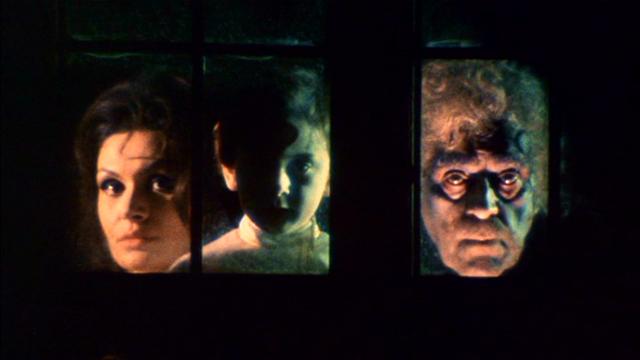
'The Drop of Water' is the weakest of the three segments by far, brought down by a boring, derivative story. The other two are excellent, but before we get to that we need to appreciate the glorious ending, in which the fourth wall is not so much broken as smashed down and danced upon. The closing soliloquy is delivered by Boris Karloff atop a horse; and before we know it Bava zooms out, the horse is revealed to be mechanical, and Karloff laughs maniacally while PAs run past him with branches on what we can now very clearly see is a film set. It is one of the most surreal, delirious, incredible scenes I've ever seen in a film, and I can't believe they cut it from the American release.

There's thus a lot of tongue-in-cheek self-referentiality to Black Sabbath that I like very much - and so did Karloff, who declared his segments the most fun he'd ever had in a film. The horror veteran's presence is one of Black Sabbath's greatest assets, not just in his demented soliloquies but also in his more serious turn as a blood-sucking grandfather (the only time Karloff played a vampire, incidentally).

The episodes pretty much stand or fall with the actors: 'The Telephone' is anchored by Mercier (alone for half the running time) and Alfonsi, 'The Wurdalak' can rely on Karloff, Onorato and Dialina even as Damon is an annoying, bland disappointment, while Pierreux's weak performance dooms 'The Drop of Water'.

'The Telephone' is the most obviously proto-giallo of the three segments. There's a shot of Rosy's stalker peering through the curtains that is very reminiscent of Norman Bates, with an attending focus on the eye that also marks Black Christmas a decade later and countless horror films since. It's also here that the fetishism of the gleaming knife, absent from The Girl Who Knew Too Much but characteristic of the later giallo, is developed, and a later stylish murder in which a character is strangled with a stocking is a sign of things to come.

The superficially less proto-anything 'Wurdalak' really points both to Italian Gothic horror and the gialli of the future. The scene in which Vladimir is introduced to Gorca's entire family is, let's face it, a 'meet the meat' scene. It's basically a bodycount picture in Gothic trappings: the killer does not have an aim in the pursuit of which he may kill people (as in Black Sunday, where Asa is trying to resurrect herself by draining Katia's life force) but the killing is itself the aim; and the way in which individuals are isolated and picked off one by one is distinctly slasherish. The idea of Boris Karloff as the original slasher villain, though inexact, is too tempting to just be dropped, even as the final scene is not at all in that later tradition but rather cribbed from Dracula:
And then insensibly there came the strange change which I had noticed in the night. Her breathing grew stertorous, the mouth opened, and the pale gums, drawn back, made the teeth look longer and sharper than ever. In a sort of sleep-waking, vague, unconscious way she opened her eyes, which were now dull and hard at once, and said in a soft, voluptuous voice, such as I had never heard from her lips, 'Arthur! Oh, my love, I am so glad you have come! Kiss me!'

Arthur bent eagerly over to kiss her, but at that instant Van Helsing, who, like me, had been startled by her voice, swooped upon him, and catching him by the neck with both hands, dragged him back with a fury of strength which I never thought he could have possessed, and actually hurled him almost across the room.

'Not on your life!' he said, 'not for your living soul and hers!' And he stood between them like a lion at bay...

I kept my eyes fixed on Lucy, as did Van Helsing, and we saw a spasm as of rage flit like a shadow over her face. The sharp teeth clamped together. Then her eyes closed, and she breathed heavily. (p. 116)

Even with such literary references, it's encouraging to see that Bava's exploitation instincts were being honed. There's a head prop, crafted once again by his father Eugenio, that is far better than anything they managed to create for Halloween: Resurrection almost forty years later, and in general the gore (of which there is little) is of the excellent quality one has come to expect. 'Exploitation' means something else too, though, and indeed Black Sabbath is quite desperate to emphasise its actresses' heaving bosoms; 'The Telephone', being a half-hour segment of the lovely Mercier in a nightgown, is pretty much just a delivery system for titillation.

It's a beautiful film, shot by Ubaldo Terzano and Bava himself to emphasise otherworldly indigoes and dark blues. I praised Bava's black-and-white cinematography in The Girl Who Knew Too Much, and I'm sad to see there'll be no more of the exquisite contrasts of that film; but his mastery of colour here almost makes up for it. It's an important film: transitional, certainly, 'lesser' Bava, perhaps, but no less entertaining for that.

Monday, 9 January 2012

Viva Bava, Part 1: A riot is an ugly thing, and it's just about time we had one

This is the first post in a series exploring the films of Italian horror maestro Mario Bava. Not, I should clarify, a proper retrospective. Italian genre cinema of the post-war period being what it is, Bava's filmography is an extraordinarily ragged mess. As a workhorse, Bava did shedloads of second-unit direction, uncredited work and films that have nothing to do with the origins of the modern horror film I'm interested in tracing here.

Bava's father was a cinematographer, and the young Mario earned his spurs shooting other people's films in the late forties and fifties, when pepla, Italian sword-and-sandal pictures in which strongmen like Hercules and Maciste performed deeds of heroic valour, were ripping off  American epics like The Ten Commandments. Bava himself directed his share of pepla, from Hercules in the Haunted World (Ercole al centro della terra) to the Viking-themed Erik the Conqueror (Gli invasori).

I shan't consider those films here, nor will I discuss his forays into Spaghetti Western (Roy Colt and Winchester Jack/Roy Colt e Winchester Jack) and crowd-pleasing comic-book adaptations (Danger: Diabolik). I'll restrict myself instead to the horror films credited to Bava, although I may come back later for The Devil's Commandment (I vampiri) and Caltiki - The Immortal Monster (Caltiki - il monstro immortale), both of which Bava salvaged when the temperamental director Riccardo Freda walked off set.

That means that the first film for our consideration is Bava's official directorial debut, 1960's La maschera del demonio. Titled Black Sunday and The Mask of Satan in the United States and Britain respectively, the film was an international box office smash, although it barely made back its production costs in Italy itself. The Mask of Satan (which I keep misspelling 'The Mask of Stan') fell foul of the British Board of Film Censors, who refused to grant the film a rating; it was thus not seen in the UK until 1968. Despite concern over its outré gore effects, Bava's debut immediately found a devoted fanbase including many critics.

We open with an execution: in seventeenth-century Moldavia, a vampire witch, Princess Asa Vajda (Barbara Steele in her star-making turn, even though the opening credits misspell her name as 'Steel'), is about to be burnt at the stake together with her accomplice Javuto (Arturo Dominici) by her brother. She places a curse on his descendants before a heavy mask bristling with spikes on the inside - the titular mask of Satan - is hammered on her face, killing her in a scene that's no less harrowing fifty years on.* A heavy downpour, however, prevents the customary destruction of the body.

Two hundred years later, we meet Dr Thomas Kruvajan (Andrea Checchi) and his assistant Dr Andre Gorobec (John Richardson), who are crossing the Moldavian landscape by coach on their way to an academic conference. They bribe Nikita the coachman (Mario Passante) to take a shortcut through the woods the locals fear is haunted. The carriage breaks down, and while Nikita fixes the damage the scientists explore nearby ruins, where they discover the tomb of the long-dead witch, who's prevented from rising again by a cross fixed to her sarcophagus.

After Gorobec has gone outside again, Kruvajan is attacked by a 'bat' that's obviously a rag waved into shot by a PA. In the process of subduing the beast, the clumsy professor manages to smash the cross into pieces and injure himself a minute later, dripping blood onto the witch's face when he attempts to remove the satanic mask (which, as we know, is just bad archaeological practice). I mean, seriously. What is with these people? Having both fed the vampire and destroyed the safeguard holding her in place, our idiot scientists travel on to a nearby village, not before meeting Katia (also portrayed by Steele), the beautiful daughter of Prince Vajda, with whom Gorobec is instantly smitten.


Asa, reanimated but too weak to leave her coffin, commands Javuto to rise and do her work for her, which he does by attacking Prince Vajda (Ivo Garrani). He's warded off with a cross and flees, but when Katia and her brother Constantine (Enrico Olivieri) call Dr Kruvajan to help their delirious father, the scientist is abducted by Javuto and turned into a vampire by Asa. Now Gorobec must figure out what's going on before Asa is able to consume Katia's life-force and rise to resume her satanic service.

The Mask of Satan is elevated to classic status by Bava's stylish direction. It's difficult to single out moments, but an absolutely terrific pan after the carriage drives off near the beginning of the film that feeds into Bava's use of branches as a visual theme is among the most impressive. Bava, acting as his own cinematographer, uses the monochrome colour scheme to highlight contrast and emphasise shadows: when a door Kruvajan has passed through falls shut revealing Asa's griffin symbol, it's one of the most beautiful black-and-white scenes I've ever seen, confirming the sinister undertones we already suspected in a single striking image.

The film's stunning special effects, courtesy of Bava himself and his father (one wonders what Eugenio Bava, a deeply religious man who also created sacral art, would have made of his son's later splatterfests), make it worth watching even now. For a film from 1960, The Mask of Satan is quite extraordinarily gory: a vampire is staked through the eye, another is burnt to death, and bugs and scorpions crawl over the undead witch's face before she is reanimated in a really terrific sequence, to become the iconic spike-scarred face below.

Unfortunately The Mask of Satan is bedevilled (ho ho) by cheapness. A portrait referred to as 'canvas' in dialogue is obviously goddamn paper glued on wood, and they would have done well to omit animals: supposedly frightened Dobermans are cheerfully wagging their tails at the actors, while an allegedly panicked cow is peacefully masticating, suggesting the set was a less terrifying experience than the final product. (And look, I'm the descendant of a long line of farmers, and no-one milks their cows late at night.)

Nor are the performances all that great, and they're butchered by absolutely dire English dubbing, complete with wildly inconsistent accents. The exception is Steele who - despite being, as she says, 'drunk, barely over eighteen, embarrassed... not very easy to be around' and annoyed with Bava's very exploitative insistence on emphasising her body - makes a good Katia and an outstanding bloodsucking sorceress. (The film seems to think 'witch' and 'vampire' are synonyms, and presents a decidedly heterodox spin on both.)

There's a moment in The Mask of Satan in which the inglorious future of horror cinema is suddenly glimpsed. In the film's third act, Prince Vajda's servant Ivan (Tino Bianchi) is killed by being strangled from behind with a piece of rope. The way this murder is filmed is very giallo, slasherish even: it could be straight out of Twitch of the Death Nerve or Friday the 13th, and just for a second, the road that led from the shores of Italy to America's grindhouses is laid bare. 

*Tim Burton cites the influence of The Mask of Satan on his work. I'm no Burton fan, but it helps that Sleepy Hollow, my favourite Burton feature, is the one that bears the mark of Bava most clearly.

Tuesday, 3 January 2012

Wings of dark desire

With Black Swan, Darren Aronofksy returned to the inspired lunacy of his earlier work. The Wrestler (2008), for all that was good about it, was ultimately a realistic, calmly directed, even subtle film. That was fine, but 'realistic', 'calm' and 'subtle' are not words you'd pick to describe Π (1998) or Requiem for a Dream (2000), and they sure as hell aren't what you'd call Black Swan (2010), which is absurdly heavy-handed, wildly melodramatic and overblown.

That's a compliment. In the often maddeningly pedestrian world of Oscar bait, its self-conscious grandeur makes Black Swan fascinating and worthwhile. It also marks a further step in the evolution of Darren Aronofsky, staying true to his concerns as an artist but finding new and inventive ways of tackling them, and as a fan that makes me very excited.

Natalie Portman is Nina Sayers, a ballerina in her late twenties who is finally given a chance to step into the limelight with the retirement of the company's ageing star Beth (Winona Ryder), and Nina is chosen to portray the Swan Queen in a new production of Tchaikovsky’s Swan Lake by playboy director Thomas Leroy (Vincent Cassel). The fearful, self-conscious Nina is a natural fit for the virginal Odette, but cannot relax enough for a convincing portrayal of the seductive, carnal Odile.

When she is befriended by the wild, free-spirited new dancer Lily (Mila Kunis), Nina begins to come out of her shell and rebel against her loving but controlling ex-ballerina mother (Barbara Hershey). Soon, however, she comes to believe she is followed by a dark doppelganger and menaced by Lily, who she fears is trying to replace her. Her paranoia causes her to grow more afraid and tense just when she needs to finally overcome the repression that's holding her back as a dancer.

Before discussing the film itself, it's worth addressing a certain controversy that engulfed Black Swan's Oscar bid. To my mind, it's quite irrelevant who performed Natalie Portman's dance scenes in Black Swan. Film is artifice: we know, and accept, that actors do not and cannot do the things they seem to be doing in films. The willing suspension of disbelief is broken and the viewing experience damanged only when the artifice draws attention to itself by being unconvincing: poor CGI, for example, or bad acting. Black Swan passes that test with flying colours.

It shouldn't matter how much dancing the lead actress did. But Fox Searchlight brought the whirlwind on themselves by not combating the impression that Portman had become a professional ballerina in a year and a half. This not only fanned the irritating cult of authenticity - a symptom of commodification but powerless to create an alternative -, it was also grossly discourteous to Portman's dance double Sarah Lane and her colleagues. Motion pictures are collaborative efforts, and it should always be deplored when the people who make a film possible are sidelined at the expense of a few marketable stars. Hopefully the fiasco will teach studios to give all involved due credit in future productions. 

Rant over! Black Swan pretty much screams its most obvious interpretation: it's about Nina's attempt to overcome her own sexual repression, and the stresses and splits in her personality that this struggle causes. She can't win her freedom without coming apart at the seams. She's constantly infantilised by living with her mother, who calls her a 'sweet girl' (a phrase that comes to haunt Nina) and makes her live in her pink childhood bedroom, complete with cuddly toys. She's deeply uncomfortable when Thomas inquires about her sex life and asks her to masturbate to loosen up. She desires those things she will not allow herself to have and is locked in a cycle of guilt, self-hatred and perfectionism.
 
Aronofsky chose to convey that message not through conventional drama but through body horror, perhaps the most uncomfortable and terrifying subgenre. In body horror, we're attacked not from the outside (as in, say, The Texas Chain Saw Massacre) but from the inside. We can flee Leatherface, but we can't escape or fight the evil that's spreading within ourselves. Black Swan thus has strong echoes of the Calvinist doctrine as total depravity - the notion that no part of us remains uncorrupted by debilitating sin. Nina is gradually destroyed by her inability to live up to the rigid standards she has internalised: she despairs of works-righteousness, but there is no saviour to take her burden. 
 
The willingness to portray her own body becoming her enemy makes Natalie Portman's extraordinary performance more courageous than, for example, Charlize Theron's unrecognisable turn in Monster. In Black Swan Portman shows the vulnerability of the same body we know from perfume ads - although having lost twenty pounds for the film the already petite actress looks disconcertingly frail. Mila Kunis, showing off her natural easy charm, is the perfect opposite to Portman, while Vincent Cassel - an actor who's always interesting, even when he's not good - turns in a rather terrific performance as a man driven by impulse and desire. 
 
Subtle it all ain't, and that goes doubly for Clint Mansell's score. Disqualified from Oscar consideration for liberally quoting Tchaikovsky, the music would be greatly lessened without the use of 'Swan's Theme', a grand, devastating piece of music that says 'tragic foreboding' like nothing else (witness, for example, its use in the Last Supper scene in Des hommes et des dieux); but as it is, the sweeping orchestration fits the melodrama like hand in glove. 
 
Aronofsky, I said, is developing as a director. He's still up to his favourite techniques: the over-the-shoulder camera following actors around makes a number of appearances and is used to great effect in dance sequences. Aronofsky is less fixated on his bag of tricks these days, but he's learnt new ones too. The horizontal expanse provided by the film's 2.35:1 aspect ratio gives him the space he needs for thrilling dance sequences: the climax has the best of the lot, but there's stiff competition.
 
Praise is due, too, to the bold decision to almost totally abandon narrative coherence for a psychological stream of consciousness in the last half-hour, creating a sustained nightmarish rush of horrifying images up to the climax - which, as in all Aronofsky films, is inexorable, the only logical conclusion to his characters' lives. Aronofsky films are about people who are obsessed by something - numerology, heroin, wrestling, ballet - whose ultimate fates are dictated by these fixations.

Monday, 19 December 2011

Long road out of Eton

In the Golden Age of Hollywood, studios' control over the creative process was near-total. It strikes us as absurd now that to make the jump to Hollywood, Alfred Hitchcock had to sign a contract for seven years of indentured labour with legendary producer David 'O.' Selznick of Gone with the Wind fame. But although they didn't always get on - both men were headstrong perfectionists - that collaboration paid dividends in the annals of cinema.

The first Selznick-Hitchcock production, 1940's Rebecca, proved something of a nightmare for the notoriously cash-strapped Selznick, who was aghast when the film cost a grand total of $1,288,000. Set in France and Cornwall but shot entirely in California, Rebecca was a first for Hitchcock in more than one way: not least, it netted him his only ever Best Picture Oscar.

The prologue is perhaps one of the most famous in cinematic history: 'Last night I dreamt I went to Manderley again', a woman begins as the camera travels through the iron gate and up the overgrown road to the ruin of the house, and I must admit my heart sank, for although the sequence is gorgeous the voiceover narration is quite awful, intoned in the most strange and inappropriate way. It was early still, and even in 2011 voiceover is overused or used badly far more often than it is employed effectively.

We cut to Monte Carlo, where a man (Laurence Olivier) is standing at a precipice, seemingly ready to hurl himself over the edge; he is interrupted by a young girl (Joan Fontaine, cast against the objections of Olivier, who preferred his lover Vivien Leigh for the part). The gentleman turns out to be Maxim de Winter, recently widowed lord of the family seat of Manderley in Cornwall; she's a never-named orphan who serves as a paid companion to the horrid social climber Edythe Van Hopper (Florence Bates). (Unfortunately the film cuts my favourite moment in the novel, in which Maxim stealthily insults Mrs Van Hopper by assuring her that Manderley hasn't entertained royalty since Ethelred the Unready: 'In fact, it was while staying with my family that the name was given him. He was invariably late for dinner.')

The girl falls in love with the distant, wounded Maxim, and he soon asks her somewhat brusquely to marry him. To Mrs Van Hopper's chagrin, she accepts and, after a quick wedding in Monte Carlo and a honeymoon in Europe, Maxim and the second Mrs de Winter return to Manderley. She finds that the house is still living under the long shadow cast by the first Mrs de Winter, Rebecca, who drowned off the coast. Most servants are friendly, with the exception of the prim Mrs Danvers (Judith Anderson), who is fiercely devoted to Rebecca and makes it very plain that her master's nervous, low-born new wife does not measure up.

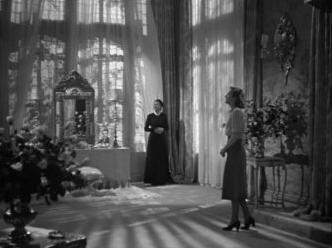
In the hands of Hitchcock and cinematographer George Barnes, who received a richly deserved Academy Award for his work, Rebecca is a film of windows, doors and shadows, of actors dwarfed by the house around them. It is also curiously fixated on curtains, opened and closed by the second Mrs de Winter and Mrs Danvers to enter and leave Rebecca's room: a number of great images spring from the juxtaposition between white curtains and Mrs Danvers's black clothes.

Hitchcock uses his characteristic zooms and pans to great effect, and creates what may be my favourite image in the film: the second Mrs de Winter in mid-ground as Maxim steps in front of the camera in the foreground, totally obscuring her. At the same time, Rebecca suffers oddly from mixing Hitchcock's two prevalent modes: in the third act, the film goes from mythic to procedural, and as a result of that dissonant tonal shift it sags mightily before rallying at the end.

It's tempting to read Rebecca as an allegory of the profound social changes then underway in England. My friend noted that there seemed something distinctly Jane Austenish about life at Manderley; but this, we agreed, was more appearance than reality. Jane Austen's works were read by a literate, sufficiently well-off élite; by contrast, in the age of mechanical reproducibility the troubles of Mrs de Winter were splashed all over the world's cinema screens. Frith (Edward Fielding), Manderley's oldest servant, refers to the fact that once a week the general public is admitted to the great hall; this would have horrified Austen's contemporaries, but by the 1930s aristocrats could count themselves lucky if they were able to retain their country houses by surrendering to the new mass culture.

If we take Manderley as a microcosm of England under the aristocracy, Rebecca is the symbol of that fading ruling class: commanding all the qualities of a lady, she is the final flowering of England's noble houses. Even in death, her vengeful spirit lingers on, resenting the intrusion of the upstart second Mrs de Winter into her place. It's notable, though, that Max is remarkably relaxed about the new equality. His social position permits him that luxury. Mrs Danvers, however, must defend Manderley: her whole identity is bound up with the old social order.

These three poles - the commoner, awed but increasingly assertive in the face of aristocracy; the aristocrat himself; and the faitful servant - are portrayed by three of the most capable actors to ever appear on screen together; but to me there's no doubt Judith Anderson is the greatest of the three. She plays the character to perfection: her contempt hiding behind cold courtesy, her faithfulness to Manderley, her devotion to Rebecca that carries more than a hint of lesbian infatuation (this, of course, makes her crazy). The famous window scene between her and Joan Fontaine is as chilling and moving as anything you're ever likely to see.

The film's gender politics are fascinating, too. Rebecca is known to have been sexually voracious in a way that Max can't seem to imagine of his new wife. There's something distinctly uncomfortable about his belittling of the second Mrs de Winter, whom he treats more like a child than an equal; but if he hopes to keep the shadow of Rebecca at bay by choosing a passive woman to whom he can be a father as much as a husband, he fails. It's a film about the failure of old loyalties, of feudalism, of patriarchy - and yet, at the same time, about their lingering terrible power.

Friday, 14 October 2011

Gotham City always brings a smile to my face

We comic-book geeks live in a golden age. While the myriad popcorn epics featuring spandex-clad heroes may not always be good, at least they're there to enjoy or deride. Our forefathers were not so lucky. Once upon a time, live-action superheroes were confined to serials, action-comedies, and cheesy television specials.

Richard Donner's Superman (1978), released in the wake of Star Wars (1977), introduced the superhero blockbuster and dominated the eighties with its sequels, but during that decade films and comic books were out of sync: on the page, the Dark Age was dawning with Alan Moore's V for Vendetta (1982-89) and Watchmen (1986-87) as well as Frank Miller's The Dark Knight Returns (1986) and Batman: Year One (1987).* Tim Burton's Batman (1989), the first really serious superhero film, changed that and kicked off the first wave of comic-book adaptations. (The last film in the series, 1997's Batman & Robin, killed off that wave as well as its own franchise.)

Twenty-odd years on, what was highly revisionist at the time has become 'classic'. The plot begins with Batman still a rumour, scoffed at by the less superstitious of Gotham's criminals. The new district attorney, Harvey Dent (Billy Dee Williams), is preparing to challenge the criminal empire of Carl Grissom (Jack Palance), who is struggling with his overly ambitious lieutenant Jack Napier (Jack Nicholson). Grissom double-crosses Napier, sending him to raid a chemical plant at night and ordering corrupt policeman Eckhardt (William Hootkins) to ambush Napier's men. In the ensuing struggle, Batman disarms Napier, who falls into a vat of green acid and is believed dead.

Napier, however, has miraculously survived both the acid and the ensuing botched plastic surgery ('You understand that the nerves were completely severed, Mr Napier. You see what I have to work with here...') and becomes the villainous Joker in the film's strongest and most iconic scene. After murdering Grissom, he plots to poison Gotham City's hygiene products with Smilex, which will kill the victim while fixing their face in a horrid rictus grin, in the run-up to the city's bicentennial celebrations. (Incidentally, this provides an excellent way to guess at Gotham's location: with a foundation date of 1789, the city is presumably in Ohio, the Great Lakes region, or the north-eastern Atlantic coast.) The Joker also pursues photographer Vicki Vale (Kim Basinger), who is dating wealthy Bruce Wayne (Michael Keaton).

It's a Joker picture, then, even more so than The Dark Knight (2008): Nicholson takes top billing,  and Batman functions almost solely as his foil. The focus on the Joker's origin sets the 1989 film apart from the latest Christopher Nolan picture, which has Batman's nemesis appear from nowhere. Giving a definitive origin story for the Joker was controversial among fans (Batman: The Killing Joke by Alan Moore had given a possible, but deliberately ambiguous origin the previous year). But it works: Nicholson's Joker is a crazed villain even before being disfigured (his pre-murder one-liner, 'Have you ever danced with the devil in the pale moonlight?', goes back to his ordinary criminal days), suggesting the Joker is merely a useful persona.

Nicholson gets the best setpieces, too, the most famous perhaps his dance routine desecrating an art gallery to the sounds of Prince's 'Partyman' supplied by a boombox-carrying goon ('I am the world's first fully functioning homicidal artist!'). The actor goes all out on the craziness, and while Nicholson's shtick can be irritating - witness his horrendous overacting almost derail The Departed (2006) - it's perfect here. Granted, I still prefer Heath Ledger's funnier, more anarchic, better-acted take on the role, but Nicholson's Joker, unlike previous live-action iterations simply a ruthless mass murderer, is very good.

That brings us to the film's darkness, infamous in 1989. Again, The Dark Knight has one-upped Batman's on-screen nastiness but not, I think, the earlier film's attitude. Whatever you may say about Christopher Nolan's films - cold procedurals all of them - he tends to choose scripts that ultimate believe in and reward goodness and humanity (as The Dark Knight does repeatedly in its last half-hour). Not so in Batman: here we have a hero who kills off henchmen like there's no tomorrow and, in the film's climax, defeats his opponent with a highly questionable move. If The Dark Knight is willing to show a great deal more darkness, Batman ultimately has a more pessimistic view of the world.
The casting of Keaton, a well-known comedian, was greeted with scepticism, but he is a revelation in the role. Christian Bale is a closer fit to the character's physical description in the comic books, but his Bruce Wayne is nothing but a mask, ultimately shallow, while Batman is his real personality. That works, sure, but Keaton's Wayne - a shy, ordinary man in a mansion he barely knows - is much easier to empathise with. We'd never suspect this nice guy of being Batman, so when he picks up a poker, screaming 'You wanna get nuts? Come on! Let's get nuts!' at the Joker it really works. Keaton's Batman cares about people, whereas Bale's Batman often seems to be quite ready to burn down half of Gotham to get at the Joker. (No-one would do that to Burton's Gotham: a Gothic excess of spires and gargoyles where the Nolan films offer the atmosphere of a techno-thriller, it's just too gorgeous to destroy.)

Despite everything, though, it's not a great film. The plot is functional at best, Basinger is phoning it in, and the action scenes are not quite top-notch. If I like Batman, it's as a radically different vision to the Miller-Nolan school of Batman as man become symbol, brutally disregarding the limitations of his body: in the Millerverse, if Batman's chest had been a mortar, he'd burst his hot heart's shell upon it. Keaton's Batman is defiantly human, struggling with relationships and self-doubt, and he's all the stronger for it.


*With the benefit of hindsight, Moore easily emerges as the greater of the two, but the jury is still out, I think, on who had the greater cultural impact.