I don't remember much of the previous Bourne films. 2002's The Bourne Identity has managed to stick in my mind because it came first, and because like any good German I find the presence of my compatriots in Hollywood films inherently exciting and memorable. The Paul Greengrass-helmed Supremacy and Ultimatum have mostly flowed together, joining the Lethean mush of fuzzy franchise memories where Jason Voorhees murders and Rocky Balboa punches in a realm of abstraction at once ill-defined and Platonically pure.
So I can't weigh in on the controversy surrounding The Bourne Legacy: did writer-director Tony Gilroy retroactively ruin the first three films out of spite after falling out with Matt Damon and Paul Greengrass? What I can tell you is that once Gilroy is done ponderously explaining the series' plot, Legacy turns into breezy, brainless fun. This may be due to incompetence, to be sure; but either way it's a step in the right direction for a series that shed all artistic ambitions once studio necromancers decided they could milk the brand forever.
This time round we learn that with Jason Bourne still on the loose and Pamela Landy testifying before a congressional committee, Col. Eric Byer (Edward Norton) has decided to shut operations down for good lest the rot spread. That means, of course, eliminating all existing agents. Aaron Cross (Jeremy Renner), training in the Alaskan wilderness, escapes a drone attack meant for him by sheer luck. Meanwhile, in Maryland Treadstone virologist Dr. Marta Shearing (Rachel Weisz) survives a killing spree by a sleeper agent colleague. Once Cross rescues her from the mopping-up death squad, the two team up for a trip to Manila, where Cross hopes to find more of the special drugs that turned him into a super-soldier.
In structure, then, Legacy mirrors Identity: our hero flees from the guys trying to kill him with a tag-along woman, the challenge being to stay alive. But where Identity was about Jason Bourne finding out who he really was, Legacy offers no such startling revelations, let alone the drama of Bourne turning the tables on his former handlers in Supremacy and Ultimatum. Instead, we have low stakes: a bloke who really wants his super-serum, and Rachel Weisz following him around because she has no choice.
That wouldn't be such a problem if Legacy did not have a slow and overlong first act. Before anything happens, we must first say hello to a bunch of new characters and suffer long scenes of Renner walking through Alaskan forests, having pointless conversations with another operative (Oscar Isaac) and tussling with wolves in the vein of The Grey, less that film's pervasive nihilism. The Bourne Legacy's excessive 135 minute running time could be quite easily shortened by a good half-hour.
Once Legacy kicks into high gear, though, it's surprisingly good fun. The scene in which Renner and Weisz face off against four operatives at Dr. Shearing's house is a marvel of suspense mixed with hard-hitting action. The Manila scenes are not half so realistic, but they are ridiculously entertaining, particularly once Louis Ozawa Changchien's cartoonish villain is thrown into the mix. Weisz is always a welcome presence and does well in a thankless role, while Renner proves an acceptable substitute for Matt Damon. Palatable popcorn entertainment is several rungs below the glory days of the franchise, but considering the depths to which zombie franchises can sink we should be grateful for Legacy's general adequateness.
Showing posts with label survival. Show all posts
Monday, 13 August 2012
Tuesday, 6 March 2012
Grim up north
Liam Neeson is a force of nature. His transformation from historical dramas and kindly-mentor roles to action stardom is the most stunningly successful Hollywood rebranding of recent years. It's not just Neeson's 6'4'' frame and steely blue eyes that help the makeover click. Rough around the edges in middle age, the Irishman is not your average slick action star: he portrays men who have lost someone. That made the otherwise simple Taken, and it goes a long way to explain the success of The Grey.
John Ottway (Neeson) is a hunter tasked with keeping wolves away from an oil drilling site in the Alaskan wilderness. When the operation winds up, the men (mostly) look forward to returning to civilisation, but their plane crashes in the middle of nowhere leaving most dead, with just half a dozen survivors. When grey wolves attack, they decide to make a run for the treeline. The rest of the film is essentially a long chase in which the men are picked off one by one, fighting back with very limited success.
Remember how in the rebooted Battlestar Galactica, Adama pretends he knows the way to the Promised Land to give the remnant of humanity hope in a hopeless situation? The Grey doesn't even have that. Ottway - whom we first meet about to blow his head off - doesn't know where they are; he's perfectly aware the group is unlikely to survive, and doesn't pretend otherwise. He makes mistakes that get men killed. There is no destination, no safety for the survivors: there's only running and fighting for as long as they possibly can, not going gentle into that good night.
The advertising would have you believe The Grey is mostly Liam Neeson punching wolves, but not so: it's a philosophical film, all about meaning and fate or the lack thereof. As Diaz (Frank Grillo) points out, the fact that several men survived the plane crash only to be killed by wolves does not bode well for any traditional notion of destiny, while a late-film scene in which Ottway screams defiance mixed with pleading at an empty sky suggests that the filmmakers don't believe in an interventionist God. Even so it's more existentialist than nihilistic as the men find new meanings in their interactions and in the fight itself.
The wolves are created using a mixture of real animals (for close-ups), animatronics and CGI. The latter two look rather poor, in all honesty, so we should be grateful the wolves are rarely shown in detail. Their behaviour is in any case more archetypical than realistic, a physical and philosophical foil to the humans rather than 'real' animals. It's a well-acted, well-shot film: nothing in the career of Joe Carnahan would have led you to suspect he had such a taut thriller in him, but there you have it. Mean, lean and ferocious, The Grey may be more depressing than entertaining, but it makes for a good time at the cinema.
John Ottway (Neeson) is a hunter tasked with keeping wolves away from an oil drilling site in the Alaskan wilderness. When the operation winds up, the men (mostly) look forward to returning to civilisation, but their plane crashes in the middle of nowhere leaving most dead, with just half a dozen survivors. When grey wolves attack, they decide to make a run for the treeline. The rest of the film is essentially a long chase in which the men are picked off one by one, fighting back with very limited success.
Remember how in the rebooted Battlestar Galactica, Adama pretends he knows the way to the Promised Land to give the remnant of humanity hope in a hopeless situation? The Grey doesn't even have that. Ottway - whom we first meet about to blow his head off - doesn't know where they are; he's perfectly aware the group is unlikely to survive, and doesn't pretend otherwise. He makes mistakes that get men killed. There is no destination, no safety for the survivors: there's only running and fighting for as long as they possibly can, not going gentle into that good night.
The advertising would have you believe The Grey is mostly Liam Neeson punching wolves, but not so: it's a philosophical film, all about meaning and fate or the lack thereof. As Diaz (Frank Grillo) points out, the fact that several men survived the plane crash only to be killed by wolves does not bode well for any traditional notion of destiny, while a late-film scene in which Ottway screams defiance mixed with pleading at an empty sky suggests that the filmmakers don't believe in an interventionist God. Even so it's more existentialist than nihilistic as the men find new meanings in their interactions and in the fight itself.
The wolves are created using a mixture of real animals (for close-ups), animatronics and CGI. The latter two look rather poor, in all honesty, so we should be grateful the wolves are rarely shown in detail. Their behaviour is in any case more archetypical than realistic, a physical and philosophical foil to the humans rather than 'real' animals. It's a well-acted, well-shot film: nothing in the career of Joe Carnahan would have led you to suspect he had such a taut thriller in him, but there you have it. Mean, lean and ferocious, The Grey may be more depressing than entertaining, but it makes for a good time at the cinema.
Tuesday, 31 January 2012
The short end of the stake
Okay, so that's not true, or at least an unfair generalisation: while certain narratives and cinematic languages occupy a hegemonic position, alternative ways of doing cinema make it through all the time. They're marginalised, but they're there. That first paragraph, though, is precisely the sort of response Stake Land - a film of whose existence I would never have learnt were it not for idly clicking on cross-references at 2 a.m. - induces in the viewer.
Because you see, Stake Land is pretty great, an indie-horror film with guts and ideas and gorgeous cinematography; but after making the rounds at festivals in 2010 and receiving a limited release in a couple of countries, the film managed to scrape up a grand total of $18,469 domestically ($33,245 internationally). And I should mention Stake Land's director Jim Mickle was in a relatively privileged position: he managed to get a budget of $4 million, which is by no means bad when a lot of talented filmmakers can't get the funding to make feature-length films at all - or, you know, anything.
(Sure, these films often manage to cover their costs because fans seek them out on home video, and that's great. But it limits their audience to those who already know what they're looking for: the horror ghetto, a particularly insular and unfairly maligned community. The point is that you and I never get a chance to go to the cinema and say, 'What shall we watch? Hey, Stake Land sounds kind of cool, let's check it out!')
Anyway, Stake Land takes place in a world in which a mass outbreak of vampirism has turned most people into either blood-drinking night-dwellers or non-walking corpses. As the film begins, the family of Martin (Connor Paolo) are preparing to flee to a less densely populated area. They're slaughtered by a sudden vampire attack, but Martin is saved by Mister (Nick Damici), a gruff, taciturn vampire hunter. (Why yes, it did remind me of Wesley's brief stint as a 'rogue demon hunter' on Angel, but that's all the Buffyverse references we'll make here.) The two strike up an unlikely friendship as they travel north towards Canada, now referred to as 'New Eden', where legend has it no vampires exist.
Along the way they have to navigate the dangerous physical and political landscape of North America. While national governments have to all intents and purposes collapsed, many towns still hold out, armed to the teeth and suspicious of strangers. Global catastrophe has also allowed fiefdoms to be carved out by demagogues like Jebedia Loven (Michael Cerveris), whose Brotherhood believes that vampires are a punishment sent by God, and also, it seems, that one should be awful to everyone for no reason. (Post-doomsday cults are always called the Brotherhood. Remember that the next time you're in the wasteland stuck for something to do, and decide to start your own new religious movement. Also, child brides. Gotta have those.) For company and protection, Martin and Mister are eventually joined by a Catholic nun (Kelly McGillis), a pregnant singer (Danielle Harris), and an ex-marine (Sean Nelson).
The film's strongest element are the astonishing visuals. It's easy to compare Stake Land to Zombieland, another film about a ragtag bunch of strangers on a roadtrip through a post-apolyptic America swarming with hungry ex-people. But the films couldn't be more different. It's not just that Zombieland is a comedy. While not ugly, Z-Land is ultimately filmed in a fairly straightforward point-and-shoot way. Mickle and cinematographer Ryan Samul, by contrast, deliver one carefully composed image of striking gorgeousness after another:
Stake Land's vampires are magnificently ugly beasts. Largely unintelligent - they hunt in packs, but are incapable of speech and easy to trap - they most closely resemble the nosferatu of Vampire: The Masquerade, or indeed their silent-film progenitor. Brutal killing machines, they share none of the deceptive simulation of human beings that usually makes vampire fascinating.
Well, there's a reason for that. The script, written by the director and co-star Nick Damici, is a bit undecided on what it wants to be, but either way isn't really interested in vampires. They exist primarily as a backdrop to explore how society would respond to near-total collapse of its structures, and what that tells us about human beings. It's ultimately hopeful: yes, some people do become homicidal fanatics, but most learn to take a pure joy in each other amid the utter horror that is Vampireland. (Proceeding purely from theme rather than what its monster is called, that makes Stake Land a zombie film, but let's not quibble.)
The simple plot - moving north, avoiding trouble - allows the filmmakers to take us through a variety of post-apocalyptic communities, showing new societies arising in the wake of disaster. Hence, I think, the beauty. As a wacky mixture of Zombieland and Badlands with a dash of Into the Wild, Stake Land is fundamentally introspective, even contemplative; and since Martin's voiceover narration is mostly used for exposition, the visuals have to do the heavy lifting. And that they do. The outdoors photography of the wilderness in the later part of the film is especially memorable.
Stake Land is unfortunately let down by a weak villain. I don't think that's Michael Cerveris's fault: with a script so eager to sell us on evil fundamentalists, he can't really do much. I'm always perplexed by the portrayal of fundamentalist Christians in films. See, I disagree with the loony fringe of my faith when I meet them, but it seems like Hollywood screenwriters have never met a Christian, fundamentalist or otherwise, and just sort of assume they must be mad and eat babies. So again, I could be offended by the way Mickle and Damici caricature Christianity, but really the Brotherhood does not resemble anything existing in the real world - and there's no reason it should: a catastrophe of the scale portrayed here would certainly change the contours of mainstream Christianity and spawn a plethora of cults.
Connor Paolo turns in a sensitive performance in a thankless role: as the audience substitute, his job is mostly to observe and react to Damici. Shorter than Taylor Momsen - who's three years his junior- during their Gossip Girl days, he looks too slight and adolescent to break into leading-man roles anytime soon, but he's a talented actor. Damici - a poor man's Josh Brolin by looks - is pretty much pure awesome, while Danielle Harris is left a bit stranded (she was originally to be Damici's love interest, but her youthful appearance scuppered that storyline).
With beautiful cinematography, engaging characters and a streak of humour (says one character of a vampire who regularly forages near her house: 'It's Walter again. I went to high school with him, and I haven't been able to get a clean shot. He's such an asshole.'), Stake Land is definitely worth your while. It's by no means purely original, but as a synthesis of concepts it brilliantly breaks some of the patterns we're used to in vampire films. It's ironic that there should be a real renaissance of creativity in the genre at the same time as Twilight is raking in the cash, but c'est la vie.
Labels:
after the end,
horror,
survival,
the North,
vampires
Tuesday, 24 January 2012
Just Roman around
The ancient epic revived by Gladiator collapsed under its own weight after Alexander, Troy and Kingdom of Heaven bored, bothered and bewildered audiences in 2004-5. It's no coincidence that semi-legendary director Ridley Scott should have been the genre's father as well as its gravedigger: at its height it attracted talent and money of a kind otherwise only seen in comic-book adaptations.
To all appearances the ancient epic was dead, but green shoots soon appeared. 300 proved that classical antiquity could still sell tickets, and the film's basic ingredients - a middling budget, a relatively junior director, over-the-top masculinity - became the building blocks of the revived revived classical picture. No longer epics but mid-range action-adventure flicks, films like Pathfinder, Clash of the Titans and Conan the Barbarian have not yet stopped making money.
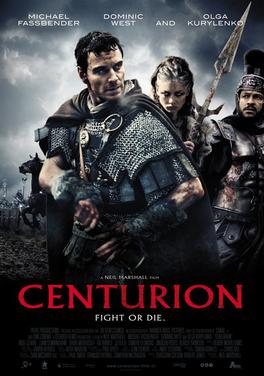
Excepting 300, there hasn't yet been a single good film in the subgenre. Sadly Centurion proves no exception to this rule, but the film's thorough failure is especially frustrating considering its potential. Let's quickly run through the factors that ought to make Centurion utterly awesome. It was directed by Neil Marshall, he of The Descent (which, to my enduring shame, I haven't seen); it stars a post-Hunger Michael Fassbender, one of the greatest actors on this earth, as well as Dominic West of The Wire; it's set along the spectacular Caledonian frontier of Roman Britain; and oh yeah, there's the little matter of Olga Kurylenko wearing warpaint. But instead of being great or even diverting, Centurion just flails around wasting its potential for an hour and a half, and then ends.
We open with credits, and what ugly credits they are! As we're treated to a long aerial shot of Scottish mountains (beautiful in themselves), the credits woosh towards us in the most aggressive way possible; and if you like hideous fonts you're in luck, because the monstrosity in which everyone's name is presented will later double as subtitles for the Picts' barbarian tongue. My jaw dropped at the sheer atonal artlessness of this sequence: it looks like a computer game trailer from 1996, and I first assumed Centurion must be designed to be viewed in 3D like those early 80s films in which the credits seem out to stab you in the eye. But no, it's all two dimensions.
Anyway, we now get a shot of a half-naked man running through the snow-covered Caledonian wilderness, hunted by barbarians; in voiceover, he introduces himself as Quintus Dias, a Roman centurion. And with that we're back to sometime earlier, when Dias's fort is overrun in a Pictish surprise attack, all the soldiers are killed and Dias himself is captured and brought before the Pictish king Gorlacon (Ulrich Thomsen). Some heated words are exchanged, and then Dias escapes offscreen. Got all that? Don't worry if not: everything I've just told you is irrelevant, and any information contained therein will shortly be repeated.
Anyway, Marshall cuts away to York, where General Titus Flavius Virilus (Dominic West) is ordered to take his Ninth Legion north of the border and defeat Gorlacon. He's assigned the mute British scout Etain (Olga Kurylenko) to guide him north of the border. During the expedition, Virilus saves the still-fleeing Dias from the Picts. The cheerful camaraderie does not last long, for like you and I Neil Marshall saw The Last of the Mohicans, wherefore Etain leads the Romans into an ambush where they're slaughtered by theHuron Picts. (On the plus side, West gets to shout 'It's a trap!'.)
All, that is, except for Dias himself and a ragtag bunch of misfit soldiers including Brick (Liam Cunningham). Dias leads these survivors to save their captured general, but their rescue operation is a fiasco: not only do they fail to rescue Virilus, but one of the Roman soldiers kills Gorlacon's son, leading the enraged Pict to swear blood vengeance on the fleeing legionaries. Before long, they're pursued across the harsh mountains of Caledonia by a posse led by the wrathful Etain.
Centurion's most crippling flaw is the absolutely wretched script, penned by Marshall himself. Let's not dwell for too long on the fact that it's relentlessly derivative, playing like a wacky mash-up of The Last of the Mohicans, Apocalypto, and Cold Mountain; nor will it do much good to groan at the plot holes, or the awkward way in which the mysterious disapperance of the Ninth is shoehorned in at the end. (And by 'mysterious disappearance', we of course mean 'failure to appear in the very patchy extant documents we have, although many of its officers do turn up in various places').
No, let's focus on the stuff that leaves the actors stranded. Fassbender's character, for example, has a backstory (his father was a gladiator) that's referred to exactly once and never impacts the plot; most other characters are not granted even that luxury. (Kurylenko gets an origin that opens the film's largest, most amusing plot hole.) As a result, Marshall is guilty of criminal negligence in wasting a very capable cast: I hesitate to use a phrase like 'career-worst performances all round', but anyone who's seen that already legendary dialogue scene between Fassbender and Cunningham in Hunger can only weep.
Surprisingly, Marshall's direction isn't much better than his script. He's so keen on Dutch angles one might think he was filming a Bizarro-World prequel to Battlefield Earth. His action scenes are best described as uninspired (they're shot and edited in the same choppy, disorienting way we see everywhere now). There is a stunningly tasteless zoom shot of Kurylenko screaming that lovingly shows off her tongueless mouth, too; and while this is a low point, it's not alone in this film.
The historical inaccuracies I complain about, but I can live with: I liked Gladiator, after all. I like the fact that the Picts are speaking Scottish Gaelic (although Arianne, played by Imogen Poots, goes for broad Scottish-accented English instead). Sure, it's not quite right: no-one knows for certain whether the Picts spoke a Celtic language, and if they did it was probably more closely related to the Brythonic languages of southern Britain rather than the Goidelic languages of Ireland and Dal Riada - from which Scottish Gaelic is descended - but I appreciate the effort.
That Roman soldiers in films forever use their gladii to slash away at their opponents, rather than viciously stab them in the gut as they should, is by now expected; that the Roman soldiers carry the wrong spears - hastae, thrusting spears used both in the early Republic and in the late Empire, rather than pila, heavy javelins - surprised me a little, but I'll take it as a bold attempt to draw attention to the fact that Roman equipment was not uniform throughout the empire. And I rather adore the film's earthy tone and the use of English regional accents to represent Vulgar Latin.
My tone has, I think, been somewhat harsher than Centurion really deserves: it's not totally incompetent. As a dully entertaining genre flick, it mostly works. The problem is that it's such a disappointment: filmed in the absolutely gorgeous outdoors of Scotland and northern England, the film should look amazing, but cinematographer Sam McCurdy can't hack it. Instead, its wintry landscapes quote the visual vocabulary of King Arthur, surely the most dire film ever made on similar subject matter. Its other flaws - strange fade cuts, the gruff growling that seems to be mandatory for male actors in these films - are forgivable; what makes Centurion especially appalling is the sheer sad, ruinous waste of talent and opportunity it presents.
To all appearances the ancient epic was dead, but green shoots soon appeared. 300 proved that classical antiquity could still sell tickets, and the film's basic ingredients - a middling budget, a relatively junior director, over-the-top masculinity - became the building blocks of the revived revived classical picture. No longer epics but mid-range action-adventure flicks, films like Pathfinder, Clash of the Titans and Conan the Barbarian have not yet stopped making money.
Excepting 300, there hasn't yet been a single good film in the subgenre. Sadly Centurion proves no exception to this rule, but the film's thorough failure is especially frustrating considering its potential. Let's quickly run through the factors that ought to make Centurion utterly awesome. It was directed by Neil Marshall, he of The Descent (which, to my enduring shame, I haven't seen); it stars a post-Hunger Michael Fassbender, one of the greatest actors on this earth, as well as Dominic West of The Wire; it's set along the spectacular Caledonian frontier of Roman Britain; and oh yeah, there's the little matter of Olga Kurylenko wearing warpaint. But instead of being great or even diverting, Centurion just flails around wasting its potential for an hour and a half, and then ends.
We open with credits, and what ugly credits they are! As we're treated to a long aerial shot of Scottish mountains (beautiful in themselves), the credits woosh towards us in the most aggressive way possible; and if you like hideous fonts you're in luck, because the monstrosity in which everyone's name is presented will later double as subtitles for the Picts' barbarian tongue. My jaw dropped at the sheer atonal artlessness of this sequence: it looks like a computer game trailer from 1996, and I first assumed Centurion must be designed to be viewed in 3D like those early 80s films in which the credits seem out to stab you in the eye. But no, it's all two dimensions.
Anyway, we now get a shot of a half-naked man running through the snow-covered Caledonian wilderness, hunted by barbarians; in voiceover, he introduces himself as Quintus Dias, a Roman centurion. And with that we're back to sometime earlier, when Dias's fort is overrun in a Pictish surprise attack, all the soldiers are killed and Dias himself is captured and brought before the Pictish king Gorlacon (Ulrich Thomsen). Some heated words are exchanged, and then Dias escapes offscreen. Got all that? Don't worry if not: everything I've just told you is irrelevant, and any information contained therein will shortly be repeated.
Anyway, Marshall cuts away to York, where General Titus Flavius Virilus (Dominic West) is ordered to take his Ninth Legion north of the border and defeat Gorlacon. He's assigned the mute British scout Etain (Olga Kurylenko) to guide him north of the border. During the expedition, Virilus saves the still-fleeing Dias from the Picts. The cheerful camaraderie does not last long, for like you and I Neil Marshall saw The Last of the Mohicans, wherefore Etain leads the Romans into an ambush where they're slaughtered by the
All, that is, except for Dias himself and a ragtag bunch of misfit soldiers including Brick (Liam Cunningham). Dias leads these survivors to save their captured general, but their rescue operation is a fiasco: not only do they fail to rescue Virilus, but one of the Roman soldiers kills Gorlacon's son, leading the enraged Pict to swear blood vengeance on the fleeing legionaries. Before long, they're pursued across the harsh mountains of Caledonia by a posse led by the wrathful Etain.
Centurion's most crippling flaw is the absolutely wretched script, penned by Marshall himself. Let's not dwell for too long on the fact that it's relentlessly derivative, playing like a wacky mash-up of The Last of the Mohicans, Apocalypto, and Cold Mountain; nor will it do much good to groan at the plot holes, or the awkward way in which the mysterious disapperance of the Ninth is shoehorned in at the end. (And by 'mysterious disappearance', we of course mean 'failure to appear in the very patchy extant documents we have, although many of its officers do turn up in various places').
No, let's focus on the stuff that leaves the actors stranded. Fassbender's character, for example, has a backstory (his father was a gladiator) that's referred to exactly once and never impacts the plot; most other characters are not granted even that luxury. (Kurylenko gets an origin that opens the film's largest, most amusing plot hole.) As a result, Marshall is guilty of criminal negligence in wasting a very capable cast: I hesitate to use a phrase like 'career-worst performances all round', but anyone who's seen that already legendary dialogue scene between Fassbender and Cunningham in Hunger can only weep.
Surprisingly, Marshall's direction isn't much better than his script. He's so keen on Dutch angles one might think he was filming a Bizarro-World prequel to Battlefield Earth. His action scenes are best described as uninspired (they're shot and edited in the same choppy, disorienting way we see everywhere now). There is a stunningly tasteless zoom shot of Kurylenko screaming that lovingly shows off her tongueless mouth, too; and while this is a low point, it's not alone in this film.
The historical inaccuracies I complain about, but I can live with: I liked Gladiator, after all. I like the fact that the Picts are speaking Scottish Gaelic (although Arianne, played by Imogen Poots, goes for broad Scottish-accented English instead). Sure, it's not quite right: no-one knows for certain whether the Picts spoke a Celtic language, and if they did it was probably more closely related to the Brythonic languages of southern Britain rather than the Goidelic languages of Ireland and Dal Riada - from which Scottish Gaelic is descended - but I appreciate the effort.
That Roman soldiers in films forever use their gladii to slash away at their opponents, rather than viciously stab them in the gut as they should, is by now expected; that the Roman soldiers carry the wrong spears - hastae, thrusting spears used both in the early Republic and in the late Empire, rather than pila, heavy javelins - surprised me a little, but I'll take it as a bold attempt to draw attention to the fact that Roman equipment was not uniform throughout the empire. And I rather adore the film's earthy tone and the use of English regional accents to represent Vulgar Latin.
My tone has, I think, been somewhat harsher than Centurion really deserves: it's not totally incompetent. As a dully entertaining genre flick, it mostly works. The problem is that it's such a disappointment: filmed in the absolutely gorgeous outdoors of Scotland and northern England, the film should look amazing, but cinematographer Sam McCurdy can't hack it. Instead, its wintry landscapes quote the visual vocabulary of King Arthur, surely the most dire film ever made on similar subject matter. Its other flaws - strange fade cuts, the gruff growling that seems to be mandatory for male actors in these films - are forgivable; what makes Centurion especially appalling is the sheer sad, ruinous waste of talent and opportunity it presents.
Subscribe to:
Posts (Atom)