Hey, remember when ensemble romantic comedies were all the rage? Okay, that's a bit misleading. First, it was more a trickle than a flood: you could probably count the subgenre's films on the fingers of one hand even if you'd suffered a moderately gruesome circular saw accident. And second, it wasn't exactly a long time ago. The fad's progenitor, He's Just Not That Into You, graced theatres in 2009, and the last gasp came in late 2011, with New Year's Eve.
Which means that last year's What to Expect When You're Expecting was late to the party, explaining both the film's unimpressive box office - a $41 million North American gross on a $40 million budget - and the general warmed-over feeling of the whole thing, as if everybody involved was just trying to get it over with so they could go home, or move on to less embarrassing projects. Which I get - excepting the over-the-hill stars, What to Expect When You're Expecting wastes a great deal of talent that could be more fruitfully employed elsewhere.
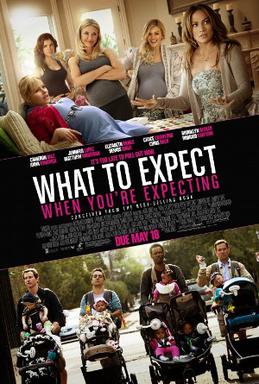
As per the genre, What to Expect has not one plot but half a dozen, plus assorted minor characters and cameos. The entire thing is connected only tentatively, and by 'tentatively' I mean that dialogue occasionally points out these people know each other, but they virtually never meet. So, we have the following elements:
- Photographer Holly (Jennifer Lopez) and her husband Alex (Rodrigo Santoro), unable to conceive, decide to adopt a baby from Africa, but Alex is fearful about parenthood.
- Food truck chef Rosie (Anna Kendrick) becomes pregnant after a one-night stand with friendly competitor Marco (Chace Crawford), but miscarries. Can they mend their strained relationship?
- Fitness guru and reality TV star Jules (Cameron Díaz) and star dancer Evan (Matthew Morrison) are about to have a baby, but they seem unable to agree on anything.
- Baby-book author and shop owner Wendy (Elizabeth Banks) finds pregnancy more stressful than she expected, while her husband Gary (Ben Falcone) feels constantly upstaged by his race car driver father (Dennis Quaid) and disturbingly young stepmother (Brooklyn Decker).
-In addition to this, there are smaller supporting roles for the likes of Chris Rock, and pointless cameos that include Cheryl Cole.
It's a hell of a lot of plot, or at least a lot of moving parts; and I appreciate that getting it all to intersect in some way isn't easy, but hermetically sealing the strands off from each other really isn't helping the film. But, though uninspired it might be, I can't in good conscience call it rote or derivative. You see, What to Expect When You're Expecting does away entirely with the time-honoured tradition of arcs. The film's storylines have no setup or payoff, they sort of just trudge along, and what conflict there is is not so much resolved as waved away at the ninety-minute mark: 'Hey look, they have a baby now! That makes all problems disappear forever!' Which is probably not something to expect when you're expecting. But I don't have any children, so what do I know?
The death-knell for the film, though, is that it just isn't funny - and not in the manner of Definitely, Maybe, which included next to no jokes despite nominally being a romantic comedy. Rather, What to Expect When You're Expecting fancies itself hilarious but ends up merely loud and obnoxious. The only bits that got a chuckle out of me revolved around Davis (Joe Manganiello), and I know it must be the writing because Manganiello is much worse here than he's ever been on True Blood.
I can't blame writers Shauna Cross and Heather Hach for the strange cultural disconnect over the bizarrely prominent circumcision storyline, but it's undoubtedly their mess of a screenplay that undoes What to Expect When You're Expecting. While neither author is a veteran, Cross wrote the fantastic Whip It (2009), so it's fair to view this as a disappointment rather than a predictable failure. It isn't, anyway, much to do with the rest of the production, which is the straightforward point-and-shoot affair one expects in this genre. Kirk Jones, the man doing the pointin' and the shootin', does his best to stay out of everyone's way, and the editing mostly sighs and does the best it can with what it's given.
With this script it's unfair to condemn a slew of bad performances, but it's probably worth stressing the one good performance: Anna Kendrick, whom I've never really liked in anything before (she tends to get saddled with unflattering scripts), creates the one fully likeable character and sells the film's single emotional scene that manages to connect. But then again, acting next to the vacuum that is Chace Crawford might make more than one actor seem like a great thespian.
For a film premised on the fact that women really want children and their men indulge them, What to Expect When You're Expecting is not as sexist as might have been supposed: full of offensive and deeply unfunny gender stereotyping, yes, but it does portray active fathers in a positive light, and allows two women out of four a more complex reaction than sheer exuberance at the news that they are pregnant. So, you know, that's something. But it's still thoroughly unnecessary, mostly ineffective fluff, and I want the hours of my life that I wasted on it back.
Showing posts with label comedy. Show all posts
Saturday, 26 January 2013
Saturday, 24 September 2011
Benefit fraud
For some reason 2011 turned out to be the year in which the pictures took on casual sex in earnest. That's fine, I suppose: 'friends with benefits' has become something of an issue in the public imagination, even though one suspects rather fewer people engage in it than are intrigued by the concept. But Hollywood is nothing if not conservative, and shackling edgy notions of casual sex and non-commitment to the rom-com formula means that the free-spirited 'friends' invariably discover that man was not meant to be this way, their trysts are very wrong, and salvation lies in heterosexual monogamy.*
Thus it was with the year's first 'friends with benefits' feature, the barbarically traditional No Strings Attached. There, the lack of chemistry between Ashton Kutcher and Natalie Portman made casual sex look deeply unappealing. So I'm glad to pronounce that Justin Timberlake and Portman's fellow Black Swan alumnus Mila Kunis do a much better job in Friends with Benefits.**
Justin Timberlake plays Dylan, a Person of Uncertain Job Description who is headhunted by Jamie (Mila Kunis) to take up a Position of Great Vagueness at GQ in New York. Jamie sells New York on sheer breezy charm, and the two soon become good friends - until, inevitably, they decide to sample the joys of casual sex together. That works well for a while, to the amusement of Jamie's promiscuous mother (Patricia Clarkson) and Dylan's hyper-masculine gay colleague Tommy (Woody Harrelson). Eventually Dylan invites Jamie to visit his family on the west coast, where their friendship is severely tested, leading to much angst.
They reconcile eventually. (Spoiler!) It's that sort of film. But for a long time it looks like it won't be: for its first hour Friends with Benefits is on fire, funny and fresh and, yes, sexy. Kunis and Timberlake have great chemistry, and they've proved their acting skills in Black Swan and The Social Network, respectively. Beautiful young people - oh, and how beautiful they are! - having fun together is quite infectious, and its sheer charm carries the film much of the way. Not to mention that the comic material is crisp, both the raunchy and the more traditional stuff; a recurring gag around Dylan's scepticism towards the 'miracle on the Hudson' gets funnier each time.
It's during the film's second hour that problems begin to crop up. The visit to Dylan's family - including his single-parent sister and a father suffering from Alzheimer's - marks the film's transition from light, breezy comedy to melodrama. It's not a mood that suits the film at all well, and it hardly helps that virtually all the comedy falls on one side of the divide. Nor do I find it believable that Friends with Benefits suddenly wants to provide serious commentary on family, friendships and relationships when the world the characters inhabit is so fantastic: as usual in romantic comedies, everybody is exceedingly well-off and enjoys a one hour work week.
In fact, characters are a bit of a problem for a film: Dylan is much more fleshed out than Jamie, but neither is particularly detailed. Supporting characters are even sketchier: like most rom-com friends Woody Harrelson exists mostly so Dylan has someone to talk to, although at least he has his one-note 'He's gay, but he's a jock! Teh funny!' comic persona. Harrelson carries it off, of course, for he is Woody Harrelson. Patricia Clarkson's character is similarly ill-defined and peripheral, and Bryan Greenberg is saddled with the thankless job of providing a one-dimensional foil to Dylan who is introduced, wreaks havoc, and is forgotten.
But I can't be angry with a film that struggles so mightily against rom-com tropes, even if it is all in vain: where No Strings Attached moved ahead mercilessly on its rails from Meet Cute to True Love, Friends with Benefits makes it clear that the characters are primarily concerned about their friendship, which is not merely treated as a transitional stage to romance. The acknowledgment that life isn't solely defined by the search for the right partner makes Friends with Benefits more interesting than your average cookie cutter chick flick, and helps it transcend its clichéd trappings even if ultimately it cannot escape them.
*Which I have no problem with: heterosexual monogamy doesn't get enough love. The problem is that foreordained endings are boring, and if the notion of 'friends with benefits' is morally unacceptable, it at least has the advantage of not being promoted by every Hollywood film ever.
**Incidentally, Black Swan was surely one of the least sexy films ever made. I don't think Aronofsky has ever portrayed a mutually fulfilling, non-exploitative sexual relationship on screen.
Thus it was with the year's first 'friends with benefits' feature, the barbarically traditional No Strings Attached. There, the lack of chemistry between Ashton Kutcher and Natalie Portman made casual sex look deeply unappealing. So I'm glad to pronounce that Justin Timberlake and Portman's fellow Black Swan alumnus Mila Kunis do a much better job in Friends with Benefits.**
Justin Timberlake plays Dylan, a Person of Uncertain Job Description who is headhunted by Jamie (Mila Kunis) to take up a Position of Great Vagueness at GQ in New York. Jamie sells New York on sheer breezy charm, and the two soon become good friends - until, inevitably, they decide to sample the joys of casual sex together. That works well for a while, to the amusement of Jamie's promiscuous mother (Patricia Clarkson) and Dylan's hyper-masculine gay colleague Tommy (Woody Harrelson). Eventually Dylan invites Jamie to visit his family on the west coast, where their friendship is severely tested, leading to much angst.
They reconcile eventually. (Spoiler!) It's that sort of film. But for a long time it looks like it won't be: for its first hour Friends with Benefits is on fire, funny and fresh and, yes, sexy. Kunis and Timberlake have great chemistry, and they've proved their acting skills in Black Swan and The Social Network, respectively. Beautiful young people - oh, and how beautiful they are! - having fun together is quite infectious, and its sheer charm carries the film much of the way. Not to mention that the comic material is crisp, both the raunchy and the more traditional stuff; a recurring gag around Dylan's scepticism towards the 'miracle on the Hudson' gets funnier each time.
It's during the film's second hour that problems begin to crop up. The visit to Dylan's family - including his single-parent sister and a father suffering from Alzheimer's - marks the film's transition from light, breezy comedy to melodrama. It's not a mood that suits the film at all well, and it hardly helps that virtually all the comedy falls on one side of the divide. Nor do I find it believable that Friends with Benefits suddenly wants to provide serious commentary on family, friendships and relationships when the world the characters inhabit is so fantastic: as usual in romantic comedies, everybody is exceedingly well-off and enjoys a one hour work week.
In fact, characters are a bit of a problem for a film: Dylan is much more fleshed out than Jamie, but neither is particularly detailed. Supporting characters are even sketchier: like most rom-com friends Woody Harrelson exists mostly so Dylan has someone to talk to, although at least he has his one-note 'He's gay, but he's a jock! Teh funny!' comic persona. Harrelson carries it off, of course, for he is Woody Harrelson. Patricia Clarkson's character is similarly ill-defined and peripheral, and Bryan Greenberg is saddled with the thankless job of providing a one-dimensional foil to Dylan who is introduced, wreaks havoc, and is forgotten.
But I can't be angry with a film that struggles so mightily against rom-com tropes, even if it is all in vain: where No Strings Attached moved ahead mercilessly on its rails from Meet Cute to True Love, Friends with Benefits makes it clear that the characters are primarily concerned about their friendship, which is not merely treated as a transitional stage to romance. The acknowledgment that life isn't solely defined by the search for the right partner makes Friends with Benefits more interesting than your average cookie cutter chick flick, and helps it transcend its clichéd trappings even if ultimately it cannot escape them.
*Which I have no problem with: heterosexual monogamy doesn't get enough love. The problem is that foreordained endings are boring, and if the notion of 'friends with benefits' is morally unacceptable, it at least has the advantage of not being promoted by every Hollywood film ever.
**Incidentally, Black Swan was surely one of the least sexy films ever made. I don't think Aronofsky has ever portrayed a mutually fulfilling, non-exploitative sexual relationship on screen.
Wednesday, 21 September 2011
Words fail me, as does Willie Nelson
It's rare that my spirit has been so utterly crushed by a film. Not that I hoped for much from a picture whose main draw appeared to be Jessica Simpson in skimpy shorts, but I did not expect this abysmal attempt at action comedy. The possiblity that The Dukes of Hazzard is a bold avant-garde work that deconstructs its genre in wildly innovative ways is explored by the great Tim Brayton. To his mastery, all I can add is deep sadness as I stare into my glass.
I suppose this thing has a plot, so let's open her up: the Duke cousins, Bo (Seann William Scott) and Luke (Johnny Knoxville), run moonshine for their uncle Jesse (Willie Nelson) until their family farm is seized by corrupt county commissioner Boss Hogg (Burt Reynolds), who is planning to strip-mine Hazzard County for coal with the help of Sheriff Rosco P. Coltrane (M.C. Gainey). Now the Duke boys must stop Hogg's wicked plans, while also winning the county rally with their car, a 1969 Dodge Charger nicknamed the General Lee.
Or, you know, something, because the plot is a mind-boggling mess. It's full of oddly superfluous characters like the race car driver Billy Prickett (James Roday), whom Boss Hogg has persuaded to join and win the race, or Annette (Jacqui Maxwell), the college roommate of Luke's old flame Katie (Nikki Griffin), who is used for one Australian joke and then tags along for the rest of the film without doing anything else. Perhaps these characters were in the 1979-85 television series, which I have not seen, and shoehorned in for that reason. Or screenwriter John O'Brien is simply not very good at his job - the more likely explanation, since his only other scripts are Cradle 2 the Grave (2003) and Starsky & Hutch (2004), and nothing at all after The Dukes of Hazzard.
Another oddity in the screenplay is the Duke Boys' cousin, Daisy Duke (Jessica Simpson). She only shares one scene with the two leads, and that indirectly, which leaves open the fascinating possibility that she does not exist, but is merely a projection of the fevered adolescent imagination of the fictional Hazzard County's menfolk, who seek to blame a sultry temptress for their repeated failure to stop morons like Bo and Luke Duke. (For this is a plot that 'would be resolved in five minutes if everyone in the story were not an idiot'.) To explain all this, I'd venture that a woeful original screenplay was chopped to pieces by concerned producers and reassembled into a ghastly, misshapen imitation of life.
That necromancy is the job of actors, and here we have a parade of great and not-so-great actors turning in awful work. I shan't mention the highest-billed stars, save to say Jessica Simpson is a worse actress that I should have considered possible. It's in the supporting roles that the tragedy lies. For here we have M.C. Gainey, a great actor who's recently been nothing short of fantastic on my new favourite show, Justified; and, on a somewhat lesser scale, Nikki Griffin*, who is much worse than she was during her enjoyable run as Jess the Coke Whore on The O.C. Perhaps I should not be angry with Burt Reynolds considering this has been his career since before I was born. But you see, this is not the first film set in the Appalachian backwoods of Georgia Reynolds as acted in. There's the little matter of Deliverance (1972), the finest of the countryside-revenge films, whose memory Reynolds has retroactively sullied. (Incidentally, both films share a fixation on bows and arrows. Coincidence? Hopefully, yes.)
But they pale before Willie Nelson, country singer extraordinaire and good old rebel against the Nashville establishment. I'm listening to Red Headed Stranger (1975) as I write, and weeping honest manly tears. This is, perhaps, to uphold the film's country cred: the television series was narrated by no lesser man than Waylon Jennings, on whose grave Nelson has now spat. Or perhaps not: maybe this is business as usual. Nelson himself certainly did not seem embarrassed about his part in perpetrating The Dukes of Hazzard since, unlike even its normally shameless leads, he consented to appear in the direct-to-DVD sequel.
Well, so it's not good: but does it deliver the goods? There is a lot of deeply unfunny comedy, although a couple of jokes could have worked in other hands than those of director Jay Chandrasekhar. It's largely hicksploitation and terrible sex jokes, although humour dealing in bodily functions is, much to my surprise, mercifully absent. So, no on the humour front. There's a significant amount of titillation, a good part of it on the part of Jessica Simpson in her character's eponymous Daisy Dukes; and although Simpson is certainly ridiculously attractive, the lingering shots act as a turn-off to the audience, who feel disgusted with themselves.** (See also: Bay, Michael.)
Finally, there's the action, viz. the numerous car chases. Make no mistake: the General Lee is a snazzy ride, for all that's worth from someone who failed his driving test twice and then gave up. But Chandrasekhar, largely a director of comedies, is clearly inexperienced at directing car scenes. He invariably uses far too many close-ups and rather too few wide angles, which makes it quite impossible to keep track of what's going on; crane shots would also have helped. And because everything else is so bad, the lack of realism irks me in a way it never does in better works. For example, a scene in which the General Lee drags a safe at high speed ought to have resulted in the messy death of Luke Duke, but is instead played as causing fear and mild discomfort; likewise, the many car jump scenes should lead to less exhilarating slow motion, and more broken axles and smashed skulls.
The series must be much better than this, since it ran for seven seasons. Or so I hope, if the eighties were indeed a more innocent time than an age in which the Transformers franchise rakes in billions. Them Duke boys, I like to think, lived in a colourful, creative universe that their lesser descendants just cannot hope to emulate. But I'm so back to watching Justified.
*I typed 'Nick Griffin', then realised my mistake. Perhaps I should have my head examined.
**This is an hypothetical member of the audience, and in no way me.
I suppose this thing has a plot, so let's open her up: the Duke cousins, Bo (Seann William Scott) and Luke (Johnny Knoxville), run moonshine for their uncle Jesse (Willie Nelson) until their family farm is seized by corrupt county commissioner Boss Hogg (Burt Reynolds), who is planning to strip-mine Hazzard County for coal with the help of Sheriff Rosco P. Coltrane (M.C. Gainey). Now the Duke boys must stop Hogg's wicked plans, while also winning the county rally with their car, a 1969 Dodge Charger nicknamed the General Lee.
Or, you know, something, because the plot is a mind-boggling mess. It's full of oddly superfluous characters like the race car driver Billy Prickett (James Roday), whom Boss Hogg has persuaded to join and win the race, or Annette (Jacqui Maxwell), the college roommate of Luke's old flame Katie (Nikki Griffin), who is used for one Australian joke and then tags along for the rest of the film without doing anything else. Perhaps these characters were in the 1979-85 television series, which I have not seen, and shoehorned in for that reason. Or screenwriter John O'Brien is simply not very good at his job - the more likely explanation, since his only other scripts are Cradle 2 the Grave (2003) and Starsky & Hutch (2004), and nothing at all after The Dukes of Hazzard.
Another oddity in the screenplay is the Duke Boys' cousin, Daisy Duke (Jessica Simpson). She only shares one scene with the two leads, and that indirectly, which leaves open the fascinating possibility that she does not exist, but is merely a projection of the fevered adolescent imagination of the fictional Hazzard County's menfolk, who seek to blame a sultry temptress for their repeated failure to stop morons like Bo and Luke Duke. (For this is a plot that 'would be resolved in five minutes if everyone in the story were not an idiot'.) To explain all this, I'd venture that a woeful original screenplay was chopped to pieces by concerned producers and reassembled into a ghastly, misshapen imitation of life.
That necromancy is the job of actors, and here we have a parade of great and not-so-great actors turning in awful work. I shan't mention the highest-billed stars, save to say Jessica Simpson is a worse actress that I should have considered possible. It's in the supporting roles that the tragedy lies. For here we have M.C. Gainey, a great actor who's recently been nothing short of fantastic on my new favourite show, Justified; and, on a somewhat lesser scale, Nikki Griffin*, who is much worse than she was during her enjoyable run as Jess the Coke Whore on The O.C. Perhaps I should not be angry with Burt Reynolds considering this has been his career since before I was born. But you see, this is not the first film set in the Appalachian backwoods of Georgia Reynolds as acted in. There's the little matter of Deliverance (1972), the finest of the countryside-revenge films, whose memory Reynolds has retroactively sullied. (Incidentally, both films share a fixation on bows and arrows. Coincidence? Hopefully, yes.)
But they pale before Willie Nelson, country singer extraordinaire and good old rebel against the Nashville establishment. I'm listening to Red Headed Stranger (1975) as I write, and weeping honest manly tears. This is, perhaps, to uphold the film's country cred: the television series was narrated by no lesser man than Waylon Jennings, on whose grave Nelson has now spat. Or perhaps not: maybe this is business as usual. Nelson himself certainly did not seem embarrassed about his part in perpetrating The Dukes of Hazzard since, unlike even its normally shameless leads, he consented to appear in the direct-to-DVD sequel.
Well, so it's not good: but does it deliver the goods? There is a lot of deeply unfunny comedy, although a couple of jokes could have worked in other hands than those of director Jay Chandrasekhar. It's largely hicksploitation and terrible sex jokes, although humour dealing in bodily functions is, much to my surprise, mercifully absent. So, no on the humour front. There's a significant amount of titillation, a good part of it on the part of Jessica Simpson in her character's eponymous Daisy Dukes; and although Simpson is certainly ridiculously attractive, the lingering shots act as a turn-off to the audience, who feel disgusted with themselves.** (See also: Bay, Michael.)
Finally, there's the action, viz. the numerous car chases. Make no mistake: the General Lee is a snazzy ride, for all that's worth from someone who failed his driving test twice and then gave up. But Chandrasekhar, largely a director of comedies, is clearly inexperienced at directing car scenes. He invariably uses far too many close-ups and rather too few wide angles, which makes it quite impossible to keep track of what's going on; crane shots would also have helped. And because everything else is so bad, the lack of realism irks me in a way it never does in better works. For example, a scene in which the General Lee drags a safe at high speed ought to have resulted in the messy death of Luke Duke, but is instead played as causing fear and mild discomfort; likewise, the many car jump scenes should lead to less exhilarating slow motion, and more broken axles and smashed skulls.
The series must be much better than this, since it ran for seven seasons. Or so I hope, if the eighties were indeed a more innocent time than an age in which the Transformers franchise rakes in billions. Them Duke boys, I like to think, lived in a colourful, creative universe that their lesser descendants just cannot hope to emulate. But I'm so back to watching Justified.
*I typed 'Nick Griffin', then realised my mistake. Perhaps I should have my head examined.
**This is an hypothetical member of the audience, and in no way me.
Thursday, 15 September 2011
I don't recall this much singing back in Upper Sixth
After the
first two instalments in the High School
Musical franchise, Disney executives have realised what the masses want:
they want more of the same. Enter High
School Musical 3: Senior Year, and with it not only the first instalment to
be released in cinemas, but also another dose of singing, dancing, and sheer
manic energy and good fun.
It’s senior
year and Troy
(Zac Efron) needs to figure out what the future has in store for him: will it
be basketball or singing, and what are the prospects for his relationship with
Gabriella (Vanessa Hudgens)? As he and his friends, foes, and hangers-on at
East High prepare for the musical at the end of the year (entitled, you’d never
have guessed, ‘Senior Year’), they must learn about friendship, romance, and
growing up.
Make no mistake: narratively High School Musical 3 is a mess. Sub-plots are forgotten halfway through, and the mighty machine-gods of Disney have to step in several times to force the story in the desired direction. Indeed the franchise has evidently reached the point where it begins cannibalising itself: the plot is essentially the same as that of the previous two films, and even some of the old musical numbers are brought in for a guest appearance.
Speaking of
music: the singing and dancing are, of course, the heart and soul of any High
School Musical, and the goods are definitely delivered here. The songs are
catchy, if not always memorable, and the choreographies impress. Listen out,
especially, for ‘The Boys are Back’, which sees Troy and Chad make creative use of a
junkyard. The temptation to sing along is ever present, as even this (slightly)
grumpy old student will admit.
The budget
is clearly bigger this time, and director-choreographer Kenny Ortega makes good
use of the amassed capital. The opening scene of the movie, a basketball match,
is especially well-done; the producers are clearly aware of the opportunities
the big screen gives them. Props are far grander than before, and this elevates
songs that might otherwise drag on; crucially, virtually none of the musical
numbers really outstay their welcome.
Ultimately the
High School Musical franchise is the
opium of the people, and proud of it. There is nothing wrong with that, and if
you’re willing to awaken your inner child, the kids of East High will still
leave you with a big grin on your face.
Note: this is an old review I originally wrote for a student publication in 2008, when the film came out. I was younger and just as foolish then.
Sunday, 21 August 2011
I want to say one word to you. Just one word. Plastics.
The Graduate is a fine example of an almost extinct subgenre: the funny comedy. Once, you see, funny comedies were fairly common, but in recent years they've been crowded out by scatological and infantile varieties, as well as alleged comedies that contain no jokes (Definitely, Maybe). But first things first.
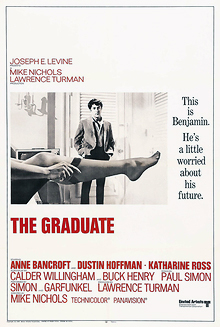
Benjamin Braddock (Dustin Hoffman, aged thirty in a comical case of Dawson Casting), has recently graduated from university and returned home to his affluent parents and their dreary friends, who are inexplicably enamoured with him (and want to recruit him for tedious careers). Plagued by ennui he begins an affair with Mrs Robinson (Anne Bancroft), the wife of his father's business partner. Things take a dramatic turn, however, when Benjamin is forced by his parents to date the Robinsons' daughter, Elaine (Katharine Ross), and ends up falling for her, much to Mrs Robinson's chagrin.
Let's get this out of the way first: no, The Graduate is not a universal tale of young people's disaffection. Benjamin, unlike most twentysomethings, is filthy rich and, even near the end of the post-war era of prosperity, spoilt for choice among high-flying careers. (As Roger Ebert remarked, 'I wonder how long it took him to get into plastics'.) It's a story of the horror of a life of luxury mapped out for you from birth: a dystopia, I suspect, that many would gladly trade for their less glamorous lives.
So yes, it's a self-indulgent story of privilege. What's more, it is curiously free of any of the struggles of the 1960s: no race conflict, no Vietnam War, no drugs, no real rebellion, in fact, at all: just a curious sense of being adrift. Perhaps the sanitised world the Braddocks inhabit was shielded from these tremors; perhaps that's not what Mike Nichols was interested in.
Ah yes, director Mike Nichols! For I referred to the fact that The Graduate is a funny comedy, and the inspired direction has a lot to do with that. The most famous image from the film is, of course, that of Mrs Robinson putting on her stockings while seducing Benjamin, embodying their lazy objectification of each other; another well-known sequence, Benjamin driving across the San Francisco Bay Bridge, was later to be lovingly ripped off by Cruel Intentions. The editing absolutely needs to be mentioned: my favourite moment is a cut from the protagonist lunging forwards in the swimming pool to a scene I dare not spoil.
All this with a whip-smart comedy script, full of hilarious lines ('Are you here for an affair?' can hardly be bettered, and the subsequent scene of Benjamin being accidentally introduced to various strangers is priceless), although the later turn into drama is not handled as well as it might have been. While The Graduate is clearly a product of its age, it remains mercifully free of the mustiness that can afflict some pre-1970 films.
That leaves us with the performances. To be frank, neither Hoffman nor Ross are exactly brilliant; both struggle with underwritten characters, and Hoffman shows few signs of the actor we know & love. But Bancroft shines as Mrs Robinson, dominating every scene she's in, although the script serves her ill during the third act. Not a timeless masterpiece, perhaps, but an excellent comedy well worth treasuring in our depraved age.
Benjamin Braddock (Dustin Hoffman, aged thirty in a comical case of Dawson Casting), has recently graduated from university and returned home to his affluent parents and their dreary friends, who are inexplicably enamoured with him (and want to recruit him for tedious careers). Plagued by ennui he begins an affair with Mrs Robinson (Anne Bancroft), the wife of his father's business partner. Things take a dramatic turn, however, when Benjamin is forced by his parents to date the Robinsons' daughter, Elaine (Katharine Ross), and ends up falling for her, much to Mrs Robinson's chagrin.
Let's get this out of the way first: no, The Graduate is not a universal tale of young people's disaffection. Benjamin, unlike most twentysomethings, is filthy rich and, even near the end of the post-war era of prosperity, spoilt for choice among high-flying careers. (As Roger Ebert remarked, 'I wonder how long it took him to get into plastics'.) It's a story of the horror of a life of luxury mapped out for you from birth: a dystopia, I suspect, that many would gladly trade for their less glamorous lives.
So yes, it's a self-indulgent story of privilege. What's more, it is curiously free of any of the struggles of the 1960s: no race conflict, no Vietnam War, no drugs, no real rebellion, in fact, at all: just a curious sense of being adrift. Perhaps the sanitised world the Braddocks inhabit was shielded from these tremors; perhaps that's not what Mike Nichols was interested in.
Ah yes, director Mike Nichols! For I referred to the fact that The Graduate is a funny comedy, and the inspired direction has a lot to do with that. The most famous image from the film is, of course, that of Mrs Robinson putting on her stockings while seducing Benjamin, embodying their lazy objectification of each other; another well-known sequence, Benjamin driving across the San Francisco Bay Bridge, was later to be lovingly ripped off by Cruel Intentions. The editing absolutely needs to be mentioned: my favourite moment is a cut from the protagonist lunging forwards in the swimming pool to a scene I dare not spoil.
All this with a whip-smart comedy script, full of hilarious lines ('Are you here for an affair?' can hardly be bettered, and the subsequent scene of Benjamin being accidentally introduced to various strangers is priceless), although the later turn into drama is not handled as well as it might have been. While The Graduate is clearly a product of its age, it remains mercifully free of the mustiness that can afflict some pre-1970 films.
That leaves us with the performances. To be frank, neither Hoffman nor Ross are exactly brilliant; both struggle with underwritten characters, and Hoffman shows few signs of the actor we know & love. But Bancroft shines as Mrs Robinson, dominating every scene she's in, although the script serves her ill during the third act. Not a timeless masterpiece, perhaps, but an excellent comedy well worth treasuring in our depraved age.
Labels:
comedy,
higher education,
New Hollywood,
the sixties
Subscribe to:
Posts (Atom)