Showing posts with label horror. Show all posts

Sunday, 28 April 2019

Freddy Krueger Has Risen from the Grave

I'm taking some time at the moment to rewatch some of the horror films of my misspent teens and twenties. First and foremost: the Nightmare on Elm Street series. I've seen and adored the 1984 original a good number of times over the years, but I haven't watched the sequels since boarding school, back in 2003-4, on DVD with a friend. (I remember being thrilled by cherry coke and microwave popcorn, which didn't exist in my parents' sensible household.) We gave up after The Dream Child, if memory serves at all right, which from what I've read seems both sensible (in the light of Freddy's Dead) and regrettable (I missed out on Wes Craven's New Nightmare). The point is, it's been a while.

Back in the day I enjoyed A Nightmare on Elm Street 2: Freddy's Revenge (1985), but the reviews I've read since haven't been kind. And yet the film really holds up. Freddy's Revenge has problems, sure; a lot of them if you're exacting, but none to my mind film-breaking. And at the same time it's really bold and experimental and subversive (within the limits of the extremely rigid slasher genre, you understand). That's partly by accident - slasher aficionados have given the genre far more thought than the people who made most of these films ever did - but it's real nonetheless.

We open on a school bus in Springwood, Ohio, where an awkward-looking teenage boy, Jesse (Mark Patton) sits alone, while groups of cool kids giggle among themselves. But what seems like a normal ride to school turns to terror when the bus driver, a burnt-looking man with a knife-glove, drives the bus off the road and into the desert (!?), where shenanigans ensue - until Jesse wakes up, soaked in sweat and screaming, in his bed.

It turns out that awful nightmares have been a regular feature of Jesse's life since his family moved to 1428 Elm Street, the house where Nancy Thompson lived in the first film. Jesse has trouble fitting in at school, spending time only with his girlfriend, Lisa (Kim Myers). The nightmares grow worse: Jesse finds himself walking into the boiler room in the basement and keeps running into the fedora-clad bus driver from his nightmares, one Freddy Krueger (Robert Englund). Freddy explains that he wants Jesse to 'kill for him' so that he can take over his body and return to the real world. Before long the bodies start to pile up, each followed by Jesse waking up with Freddy's glove on his hand...

The plot isn't just not a rehash of the original, it inverts it: where in A Nightmare on Elm Street Nancy was trying to pull Freddy into the real world to defeat him, in Freddy's Revenge it's Freddy himself who's trying to punch through the looking glass, while the heroes are trying to keep him down. What I like best, though (SPOILERS), is that the role of protagonist shifts from Jesse to Lisa at the end of the second act. As Jesse becomes ever more stressed and sleep-deprived, he's increasingly incapable of dealing with the situation; eventually, Freddy takes over his body entirely, so that Jesse, inasmuch as he exists any more, is now the antagonist. Lisa takes over as Final Girl and resolves the plot, so that the happy ending is her freeing him from captivity. The standard slasher structure is definitely there, but twisted for a more interesting take.

Here's what makes this messier, alas: Freddy's Revenge doesn't follow the franchise rulebook for what Freddy can and can't do. While he's still yelling about how he wants to return to the real world, he's already doing things in the real world that he shouldn't be able to. Specifically, a lot of stupid poltergeist crap that's more baffling than scary, like setting the family toaster on fire ('It wasn't even plugged in!' dunh dunh dunh) or the film's abiding moment of shame: Freddy possessing the family parakeet. Oh noes, the bird is swooping down on the family in tremendously goofy POV angles, giving Jesse's dad a minor cut on the cheek! Shock horror, Jesse's dad broke the lamp trying to hit the bird! Followed by the pièce de résistance: the bird bursts into flames and blows up, showering the family with feathers, like it swallowed a stick of dynamite in a forties cartoon.

But then again, A Nightmare on Elm Street didn't do it by the book either: Freddy levitates Tina off the bed, in one of that film's best scenes, in a way he absolutely shouldn't be able to do according to what we think of as the franchise rules. The ending, of course, is famously obscure and totally blurs the line between dream and real world: you tell me who's alive and who's dead at the end of the first film, since I can't (Freddy's Revenge clears that up in a bit of exposition), whether Glen and Nancy's mum were in fact dragged off bodily to the underworld or not and so on. Really, Freddy's Revenge is breaking rules that didn't exist yet when it was made, so I'm happy to give it a pass.

Then there's the issue of what, if you didn't know the meaning of words, you might call the film's 'homoerotic subtext'. Jesse is gay. It's just barely possible to read the film in other ways, since no-one ever says so in so many words; but really everything that's right there in the finished product insists on it. A small part of this is only due to Patton's performance (his palpable discomfort at Lisa's attempts at seduction, for instance), but pace writer David Chaskin, Jesse's visit to a fetish club or Coach Schneider's naked shower death are all in the writing and pretty hard to misinterpret. What's more, this can't be separated from the plot. Jesse's uncertainty about his own identity and inability to open up to his girlfriend create the insecurity that makes him a perfect victim for Freddy. 'The gay issue' isn't extraneous, it's central to the plot.

The dream sequences are much better than I remembered, though not a patch on Dream Warriors; the performances are fine, i.e. not Heather Langenkamp, but not Friday the 13th Expendable Meat either. Freddy is still a skulking shadow-dweller, but he does talk more this time around, since he has to explain the plot. He's definitely not yet the killer clown he'd later become, though. Witness this exchange towards the end of the film:

TERRIFIED PARTYGOER: Just tell us what you want, all right? I'm here to help you. FREDDY: Help yourself, fucker! *kills him*
Not exactly a zinger, is it?

Dream Warriors would bring back Heather Langenkamp and take the franchise in a totally different, initially delightful direction. That means Freddy's Revenge is a dead end, a road not taken. Does it have flaws? Yes, definitely. But it's still very much worth it: besides being a decent way to spend an hour and a half, it's one of the strangest slashers of the eighties.

Saturday, 20 June 2015

The courtship of Mr Dracula

I don't know Francis Ford Coppola, obviously. But Bram Stoker's Dracula (1992) suggests something about the director behind the project: namely that, stung by the middling reviews and accusations of cash-grab filmmaking that dogged him in the wake of The Godfather Part III, Coppola decided to make the most spectacular, overtly 'artistic' picture he could. And if the result was a film that would inspire devotion from some and bile from others, so much the better, for no-one could accuse him of playing it safe for guaranteed box-office returns.

Obviously, that may just be a fiction. But it would explain some of the eccentricities in Bram Stoker's Dracula, a film so chock-full of odd choices that it barely resembles a coherent narrative at all. An undead love story invented from scratch, perching precariously atop an almost slavishly orthodox retelling of Stoker's novel; milquetoast, bland performances right next to unfettered scenery-chewing; out-there visuals that never cohere as an aesthetic - Dracula has it all, and then some. It's a film of a thousand ideas, many of them clashing with each other in what could not possibly be classified as a success, but rather an endlessly watchable, legitimately fascinating failure.

The plot: in the fifteenth century, Prince Vlad of Wallachia (Gary Oldman) fights the invading Ottoman Empire. While he is gone, his wife Elisabeta (Winona Ryder) receives a false report of his death and kills herself in despair. Overcome with rage and grief upon his return, Vlad curses God, drives out his priests and becomes an immortal bloodsucking fiend.

In 1897, Jonathan Harker (Keanu Reeves) travels to Transylvania to seal a real estate deal with Count Dracula (Oldman). Arriving at Castle Dracula after an unsettling journey, he soon finds the count a strange host: besides being the only person Harker ever sees, Dracula also appears oddly obsessed with blood and medieval history and nurses a worrying hatred of mirrors. Harker soon realises that he has become the count's prisoner. His purchase of Carfax Abbey in London completed, Dracula departs the castle for England...

... where the psychiatrist Dr Jack Seward (Richard E. Grant) is troubled by his patient Renfield (Tom Waits), who rambles about 'the master' and has taken to devouring spiders and small insects. Meanwhile, wealthy socialite Lucy Westenra (Sadie Frost) has become engaged to Arthur Holmwood (Cary Elwes), despite also being courted by Seward and Holmwood's friend, Texan Quincey Morris (Billy Campbell). Lucy becomes ill after being found wandering outside at night by her friend, and fiancée to Jonathan Harker, Mina Murray (Winona Ryder), who happens to look exactly like Elizabeta. Lucy's strange case leads Seward to consult his mentor Abraham van Helsing (Anthony Hopkins). Meanwhile Mina's seemingly chance acquaintance with a recently arrived Transylvanian prince turns into a mutual obsession...


There are too many Dracula adaptations out there to claim that Bram Stoker's Dracula is the most faithful of the lot, but it undoubtedly hews far, far closer to the text than other well-known film versions. The film does actually reproduce the whole of Stoker's novel from beginning to end, missing virtually none of its beats (and if this seems like nothing special for an adaptation, please consult the 1931 and 1958 films). In places this is faithfulness for faithfulness' sake: the character of Quincey Morris remains exactly as inessential as he is in the novel and could easily be merged with Arthur Holmwood, but Coppola chooses to keep him in there. The devotion to the source material extends to seemingly trivial details earlier versions saw fit to dispense with.

And yet! The narrative structure of the novel is presented pretty much unchanged, but the story is completely different. Where Stoker wrote a Gothic horror novel about a sworn group of men fighting the vampiric villain who targets 'their' virtuous women, Coppola's is a tale of irresistible love/lust between an immortal lover and the reincarnation of his true love. The novel is terrified of female sexuality (Lucy's attempts to attack Holmwood are one with her amorous advances, forcibly interrupted by Van Helsing in his dual role of vampire hunter and chaperone), but the film's Lucy acts downright shockingly liberated (to put it politely) to begin with. Meanwhile, the overtly physical love between Dracula and Mina does not bring the latter to perdition, but helps the former renounce evil.

Adopting the novel's structure but repudiating its reactionary ideas does not, to me, work particularly well: it  turns the film's heroes into fools for at least the film's third act, when they're supposedly racing against time to stop evil. It also forces Oldman to portray two totally different characters: a hammy centuries-old monster liberally quoting Bela Lugosi's performance in the role (literally: his line readings of "I am Dracula. Welcome to my home" and "... What music they make" blow Lugosi's right out of the water, besides being a lot of fun for the actor), and a sensitive romantic lead. Both are fairly compelling, but they're impossible to reconcile as a single figure.


That decision also amplifies the tendency of the other performances to feel like they're from totally different films: Keanu Reeves's bland presence is frequently criticised, but his is a thin straight man part in which he acquits himself reasonably, mind-bogglingly horrible 'English' accent aside; Grant's twitchy Seward, a theoretically rational scientist who runs a nightmarish Bedlam while addled on then-newfangled drugs; Hopkins's Van Helsing, insane on a level that's occasionally amusing but clashes so badly with the other performances that several scenes he's in just fall apart; Elwes, a little unsure if his performance is an homage to or a parody of Errol Flynn. Ryder is, I think, the standout: her accent, too, is weak, but she never ceases to be convincing as the story's heart.

The film's enormous problems with its tone extend to the visuals, which are proudly overblown and lush but incoherent, throwing around idea after idea just to see what sticks. Some are fantastic: Castle Dracula, looking like a sinister enthroned figure against the backdrop of the Carpathians; vampire Lucy in her gorgeous and terrible shroud; the count suddenly dissolving into a mass of rats. Others are much less successful (Dracula's costume and makeup in his initial appearance are strikingly different from the usual 'You'll know I'm a vampire because I wear a cape' interpretations, but they're somewhat awful on their own merits).

It all adds up to a film that has a thousand things on its mind: being an homage to earlier iterations of the material (Coppola quotes without restraint from the genre's classics); half-baked explorations of fin-de-siècle signifiers like the cinematograph and absinthe-fuelled decadence; a young-and-sexy updating of Dracula for the MTV generation; a visual playground for an undoubtedly creative team; occasional questionable forays into horror-comedy (there's a particularly tasteless cut - you'll know it when you see it) -

- and, somewhere in there, an honest-to-God vampire picture that disregards an ossified cinematic tradition around Dracula to arrive at a totally new look at the count. Coppola foregrounds the beastly, feral nature of Dracula, his menacing presence - tinged with temptation - outside civilisation's hall and its hearth-fire in the Anglo-Saxon tradition. It feels at times as if Coppola is adapting not Stoker, but a take Angela Carter might have devised on Dracula.The result is a film that's unlike any other bloodsucker film out there. Unfortunately, its extravagant ambition never coheres. It's not boring for a second but, alas, that doesn't mean it's any good.

Wednesday, 24 July 2013

Retracing the wounds of the martyrs

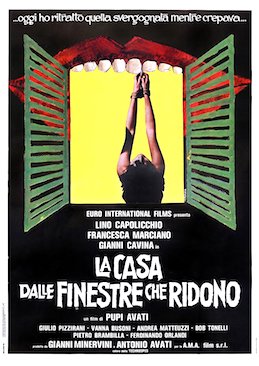
For an Italian horror film released in 1976, Pupi Avati's The House with Laughing Windows (La casa dalle finestre che ridono) is a little weird. Old-fashioned, in a sense: in the second half of the seventies, the giallo was in decline, wandering into the dustbin of obsolescence just like the Gothic horror genre it had replaced. The trend towards outré gory exploitation was already clear, even if most of the zombie and cannibal films that would exemplify this tendency hadn't been released yet.

In comes The House with Laughing Windows, and it's at once a throwback to chaster times - no series of elaborate murders here - and a weirdly experimental thing: a post-giallo, perhaps, both chronologically and thematically. It's a coincidence - Avati could hardly know that the time he finally moved from his earlier Gothic horror-comedies to the giallo would be an age of transition - but it's an interesting one. It's an exercise in deconstruction: Avati explores the spaces between the traditional beats of the giallo and discovers new loci of terror.

The film is set in a small marshland town in Emilia-Romagna. Struggling artist Stefano (Lino Capolicchio) has been commissioned by the diminutive mayor, Solmi (Bob Tonnelli), to restore a fresco of St Sebastian by an infamously morbid, long-dead artist that's recently been discovered at the parish church. Stefano also rents a room at the villa of a bed-ridden old woman, Laura (Pina Borione), begins a relationship with a young teacher, Francesca (Francesca Marciano), and is increasingly freaked out by the painting and the town's many strange residents.

That's really it. There's a death early in the film, but where in most gialli that would trigger Stefano's investigation  (with the requisite crucial bit of detail buried in his memory), it mostly sets off an hour of thickening atmosphere here. It's a broody mood piece, largely free of outrageous murders and, to the shock of every giallo aficionado, entirely bereft of trenchcoat-wearing black-gloved killers. Instead of progressive plot movement, we get foreboding galore and a sudden rush towards a final twist that doesn't win any sense-making competitions.


Not that The House with Laughing Windows is tastefully free of violence. The film opens with the dead artist Legnani's insane, bloodthirsty ramblings playing over footage of a murder, and the ending is in a similar vein. For all that the giallo is violent, it tends not to reduce the human body to meat to the extent that The House with Laughing Windows does in crucial sequences; despite being extraordinarily invested in Italian particularity in every other respect, here the film feels like the horror films coming out of the United States at the same time, or indeed the cannibal film that was about to consume the Italian horror industry. What I'm saying, I guess, is that Avati's uncredited work on the screenplay of Salò, or the 120 Days of Sodom (1975) doesn't seem entirely out of character.

The film boasts a strong cast, beginning with a compelling central performance by Capolicchio. A classic giallo protagonist in the sense of being an outsider having to navigate an alien place and community, Capolicchio nevertheless remains opaque himself instead of being an easy audience stand-in. And this is the right choice: by only allowing us a loose and tentative anchor, Avati increases the sense of unease. Marciano is similarly great; but if I had to nominate a best-in-show it would be Borione's wonderful, unsettling weirdness.

The connection between sexual transgression and murderous violence is well-established in the giallo, even if it never became codified into the rigid sex-equals-death moralism of the slasher film. Avati takes those lingering shots of lacerated flesh and pushes them further, into a film that connects, spoiler, wickedness to gender-bending. Its sexual politics is now more obviously problematic, but hasn't lost all the potency it held in the seventies. And that goes for The House with Laughing Windows as a whole: in deviating from the conventional structure of the giallo, it's perhaps the most chilling film in the genre this side of Bava or Argento.

Tuesday, 14 May 2013

My castle is in the hills above the village

After Dracula made boatloads of cash in 1958, a sequel was a foregone conclusion. Initially, it was to be strictly formula. Both Christopher Lee and Peter Cushing were approached to reprise their roles, but Lee declined, and the screenwriting team (Jimmy Sangster of Dracula, helped out by Peter Bryan, Edward Percy and producer Anthony Hinds) had to cobble together a new script. The result, released in 1960, is a thoroughly good Gothic horror film, but boy, do the seams ever show.

Some of that, of course, is just a marketing ploy: naming a film The Brides of Dracula (with the poster advertising 'the most evil, blood-lusting Dracula of all!', no less) when the prologue immediately explains that Dracula is (still) dead is at least a tiny bit cynical. Sexing up the property by using a premise designed to have lithe young women wander around in nightgowns is as shameless, but it's not like vampire fiction was ever particularly wholesome.

A young schoolteacher, Marianne Danielle (Yvonne Monlaur), is on her way to a new job at a girls' boarding school in Transylvania when, through shenanigans inexplicable and foreboding, her coach driver abandons her. She accepts the offer of a seemingly lonely aristocrat, Baroness Meinster (Martita Hunt), to spend the night at her château. (Note to self: refuse any invitation that begins with, "My castle is in the hills above the village...")

At Château Meinster, Marianne discovers that the baroness is not quite alone: she keeps her son (David Peel) chained up in one part of the castle, ostensibly because he is mad. During the night, though, Marianne frees the baron after he tells her his mother has locked him away to keep his land and titles for herself. To nobody's surprise, this is a terrible idea. Although Marianne does not understand it yet, the younger Meinster is in fact a vampire, kept confined for years and fed a steady diet of young women by his mother, who could bear neither to let him loose nor to dispatch him. Now that he is loose, he quickly takes off with the aid of his nanny, Greta (Freda Jackson).

The following day, Doctor Van Helsing (Peter Cushing) finds a traumatised but otherwise unhurt Marianne in the woods. He asks her detailed questions about her experience, but fails to tell her what's going on. After dropping Marianne off at the girls' school, Van Helsing investigates the Château Meinster. There he encounters the baroness, who has been turned into a vampire by her son against her will. Van Helsing stakes her in her sleep, but finds the young baron's coffin missing. That the threat isn't over becomes obvious when a young girl in the village nearby dies from a neck bite. And soon, Marianne is engaged to be married...


The plot of The Brides of Dracula starts strong, but descends into a frustrating muddle by the second act before hurtling towards an outright nonsensical conclusion. If Van Helsing had told anybody except the village priest (Fred Johnson) about the vampiric goings-on lives might have been saved, but I'd forgive that contrivance if  The Brides of Dracula didn't also feel like two separate stories stitched together: one about a lonely mother who keeps her vampire son locked up, the second about a hypnotic vampire who draws young women into his coven. Most frustrating are the half-developed characters. Freda Jackson (from Nottingham! fist bump) turns in an outstanding performance as Greta, whose sour-faced demeanour hides a fanatical devotion to Baron Meinster. She's rewarded with a terrific soliloquy early on; thereafter, the script decides she'll be a cackling goon, and she is eventually killed off in a decidedly underwhelming fashion.

Jackson is splendid, but she's far from a lone standout. Hunt's Baroness Meinster is as impressive, all austere aristocratic dignity covering desperate love for and fear of her monstrous son. Cushing turns in another excellent performance, settling into the role and beginning to hone his characterisation of Abraham Van Helsing, battling the forces of evil with science! Yvonne Monlaur, drop-dead gorgeous in a very sixties way and working an adorable French accent, hits all the right notes; it may not be a performance for the ages, but it's enough to regret Monlaur retired from acting only a few years later. The problem, really, is the villain: Peel is good as a brash young baron but never develops a take on monstrous bloodsucking, and he absolutely lacks the astonishing physical presence of Christopher Lee. Where Dracula was a terrifying battle against evil, its sequel just has me rooting for Cushing to beat up a blue-blooded punk.


The lack of a compelling villain means The Brides of Dracula is ultimately a notch below its predecessor, but in other ways it surpasses that film. Take the production design. Where Bernard Robinson's work in Dracula was a little musty he goes gloriously over the top here, sticking dragons and gargoyles all over the already impressive Neo-Gothic architecture of Oakley Court; and since in Gothic horror 'crazier' almost always means 'better', this is a very good choice indeed. There's more action too, awkward in places though it is; and we get the most rocking Peter Cushing moment yet, in which he neutralises the effect of a vampire bite by cauterising his own neck wound.

Despite being a bigger, sexier and more action-packed sequel The Brides of Dracula also makes some significant adjustments to the series mythology: shapeshifting, explicitly ruled out in the 1958 film, enters the series here, with a not-terrible giant bat effect. Vampires now need human servants to watch over them during the day (they learnt from what befell Dracula's original bride, I presume). Elsewhere, what was hinted at in Dracula is more fully developed, first and foremost the notion of vampirism as 'the cult of the undead', 'a survival of one of the ancient pagan religions and their struggle against Christianity'.

Certainly, Baron Meinster's coven has the character of an extremely patriarchal religious community, and in portraying it as supernaturally wicked The Brides of Dracula inadvertently ends up critiquing patriarchy even while exploiting it to pander to the audience. It's a good film, is what I'm saying in a roundabout way: it doesn't blow the roof off the horror film, but it's a very fine example of the developing Hammer template.

Saturday, 11 May 2013

Horror... from beyond the grave!

Faced with the mythic stature of Hammer Film Productions in British pop culture, it's amusing to consider how little the company's rise had to do with stodgy English reserve. Hammer's first real horror film, 1955's The Quatermass Xperiment, was so named to cash in on the X certificate, and that was a sign of things to come: for the next two decades Hammer churned out lurid low-budget films that aimed to titillate as well as terrify. The closest analogue is the Italian film industry of the same period, which has a similar track record of sleazy horror films made quickly using the same actors again and again, to tremendous profits.

But where the Italian horror industry - at least in retrospect - was centred on directors, Hammer Horror is most firmly associated with its stars: and no stars more famous than Peter Cushing and Christopher Lee, first working together in 1957's The Curse of Frankenstein (as Victor Frankenstein and the creature, respectively) and teamed up again in the following year's Dracula, because that's how Hammer did things.

That intro may not sound like Dracula is a great work of art, but it is: as a B-movie and as a film qua films it runs laps around the tedious and overpraised Lugosi film, which it absolutely refuses to be shackled by. As such, Jimmy Sangster's screenplay adapts Bram Stoker even more freely than the reworked-for-the-stage approach behind the 1931 film, into something that shares some names with Stoker's novel but little in the way of locale or plot.

Jonathan Harker (John Van Eyssen) arrives at the castle of Count Dracula (Christopher Lee) in Transylvania. Ostensibly tasked with reorganising the count's library, Harker is on a secret mission to destroy the vampires. He succeeds in staking Dracula's bride (Valerie Gaunt) but is overpowered and turned by the count. Anxious about the fate of his confederate, Abraham Van Helsing (Peter Cushing) just walks into Castle Dracula during the daytime (in this film, everybody hangs out at Castle Dracula like it's a popular stop for a picnic during a Sunday afternoon stroll) and dispatches the newly vampiric Harker, but finds Dracula himself gone.

Meanwhile in Germany (or, you know, somewhere: see below), Arthur Holmwood (Michael Gough) and his wife Mina (Melissa Stribling) worry about the worsening health of Arthur's sister Lucy (Carol Marsh). The well-meaning but inept Doctor Seward (Charles Lloyd Pack) is unable to determine the cause of her ailment. Van Helsing arrives to tell the family of the death of Lucy's fiancé Jonathan Harker, but stays to look after Lucy. When his cryptic instructions are ignored, Lucy dies and is buried, but it isn't long before the revenant begins preying on her niece Tania (Janina Faye).


Having been told what's going on, Arthur joins Van Helsing in hunting Lucy down, but rejects the professor's suggestion of using his sister to find Dracula. (Arthur's conflict - let his sister's wretched undeath go on and endanger others in the hope of catching Dracula, or put her to rest at once? - is played to the hilt; it's a terrific plot element invented wholecloth by Sangster.) Instead, Lucy is staked. But it isn't long before the count has selected his next victim - Mina - and Arthur and Van Helsing are engaged in a desperate race against time to track down the count and take him out once and for all.

That's quite a lot of changes: some characters disappear (poor Quincey Morris, forever cut out until Francis Ford Coppola had a heart in Bram Stoker's Dracula). Others are changed radically and relationships restructured (Seward as a GP, Harker as a vampire hunter, Arthur Holmwood as Mina's husband rather than Lucy's fiancé). The geography of the film is likewise different; none of it takes place in England, but where it is set is not quite clear. Given all the border business the Holmwoods presumably live somewhere in southern Germany; but it's best to assume that the whole story takes place somewhere in the composite Europe of the British imagination, a land full of medieval castles and superstitious peasants. Certainly, considering all the locals speak in clipped British stage accents despite being (a) peasants and (b) German, it's not easy to pin down.

Cushing, too, doesn't bother pretending to be Dutch. But it's a great performance: driven and professional, he is far more scientist than crazed medicine man. And if his talk of biology (it's an exposition-heavy film, with Cushing's scenes doing the heavy lifting of explaining the series mythology) weren't enough, there's hardly a clearer indication of Van Helsing as the champion of scientific modernism than the fact that the film assigns him Dr Seward's phonograph. Carol Marsh's Lucy is another very good performance, but Lee of course is the standout, despite the fact that he doesn't even appear very much. But director Terence Fisher makes his scenes count. From an iconic gallery entrance quoted by George Lucas in Revenge of the Sith to a latex-heavy disintegration scene, he's an all-round terrific villain: a real monster only incidentally inhabiting a human body, instead of Lugosi's aristocratic twit.

Dracula isn't perfect. The relatively grounded production design can't keep up with the terrific matte paintings and surreal castle interior of the 1931 film: all things considered, the film looks a little bit too much like a 1950s postcard of rustic holidays on the continent. If those holidays occasionally ended in a bloodbath, that is: Dracula thoroughly earns its notoriety with fairly gut-churning violence. Ultimately, what Fisher does with the limited resources at his disposal is impressive. Fifties horror films, let's be honest, tend not to be all that scary to us enlightened moderns. But the combination of Lee's animal menace, Fisher's fantastic horror direction and James Bernard's awe-inspiring score turns Dracula into a genuinely terrifying experience.

Saturday, 1 December 2012

Gotta get that feline

Everyone agress there is a whole lot of lesser Argento: most projects the man has directed in the last three decades, say. 1971's The Cat o' Nine Tails (Il gatto a nove code) is commonly reckoned among the director's minor works, despite attempts to make it part of a poorly defined 'animal trilogy' with The Bird with the Crystal Plumage and Four Flies on Grey Velvet.

All things considered The Cat o' Nine Tails deserves its for-completists-only reputation. As an attempt to push the envelope at a time when the classic giallo of the sixties was running out of steam, the film is overshadowed by Mario Bava's violent Twitch of the Death Nerve. But it's still full of interesting ideas that Argento recycled in later masterpieces like Deep Red.

Franco Arnò (Serbian-American actor Karl Malden), a blind man, and his niece Lori (Cinzia de Carolis) are out for a walk at night when they overhear a man in a parked car talking about blackmail to an unseen companion. Arnò, disturbed by this, is up at his home later solving a crossword when he hears the sound of a guard being struck at the head at a nearby research facility. The next day, it turns out that somebody broke into the Terzi Institute, but apparently stole nothing. The police, led by Superintendent Spimi (Pier Paolo Capponi), suspect industrial espionage, especially as the institute was spearheading research into XYY syndrome.

The case turns uglier when one of the institute's researchers, Dr Calabresi (Carlo Alighiero), falls off a platform at the railway station and is crushed to death by a train. Arnò suspects foul play and teams up with the journalist working on the story, Carlo Giordani (James Franciscus). Realising that Calabresi was pushed they begin to investigate the owner of the institute, Fulvio Terzi (Tino Carraro), his scientists and Calabresi's paramour Bianca Merusi (Rada Rassimov). Nine leads in all - hence the title. But that number goes down quickly as somebody starts bumping off possible witnesses to their crimes...

It's a weak plot. And not in the 'Whee, let's have fun with crazy surreal murders!' way we're used to from Bava's films, but as if Argento ran up against a deadline, could not figure out his own mystery, and tried to cover the unconvincing reveal with a tremendously abrupt ending. And that's without the whole chromosome nonsense, inspired by sensationalistic misreporting of men with XYY syndrome at the time. It's not just silly now that public understanding of genetics has moved at least somewhat beyond 'it's magic, and also rigid biological determinism'; it's also pretty insulting to those who were vilified as likely delinquents on the basis that they had an extra chromosome. (Full disclosure: as far as I'm aware, I have just forty-six chromosomes. There's a sentence I never expected to write in a film review.)


The characters are much better, as much as Argento's screenplay attempts to make mincemeat out of any arcs. Giallo heroes tend to be foreigners, but as a blind man Arnò is an outsider of another kind. If his impairment is mostly rendered stereotypically (enhanced hearing, that sort of thing), Malden elevates the character to something much better than the script had in mind. Franciscus's Giordano is a far more milquetoast character, although he's never less than likeable and gets something of an arc through his affair with Terzi's daughter Anna (Catherine Spaak). But the film's treatment of its co-leads is wildly uneven, with early hopes of an unconventional protagonist dashed as he is increasingly upstaged by Giordano. Argento would get the balance of a journalist-and-amateur team right the second time around in Deep Red - by demoting one of the characters.

Like many of Argento's films The Cat o' Nine Tails touches on risqué themes. Here it's homosexuality, presented sensitively for its time (as would be the case in Deep Red). Then there's the police, who are more competent here than they are in a lot of gialli but are fully aware of their reputation for reactionary politics. When Giordano insults him, Spimi agrees nonchalantly: 'Cops are all bastards. We beat confessions out of people. Take bribes. Oppress minorities.'


As is standard in the giallo, plenty of people die between announcing they've solved the case and actually passing on that information. The role of the telephone is one of the strongest links between the giallo and its North American bastard child, the slasher. (It's also a neat way of separating the two distinct traditions that I've argued can be found in the American slasher: if it's obsessed with the telephone, it's a giallo-style slasher, not a descendant of the countryside-revenge film.) In both subgenres, the telephone connects and isolates at the same time, as characters are able to speak to one another but are physically alone and vulnerable. As such, conversations interrupted by the murderer can be a key event (Halloween) or even the whole concept (Scream).

Stylistically Argento begins to move beyond The Bird with the Crystal Plumage, arguably the apex of the classic giallo. That means experimenting with Bavaesque colour, an enterprise he subsequently abandoned until the later seventies. Above all, though, it's by escalating the violence. While less extreme than Twitch of the Death Nerve half a year later, Cat pushes the envelope in nastiness with unflinching death scenes. Surrounded by a better film, that might be impressive; but here it leaves a sour aftertaste, especially paired with an underwhelming, synth-heavy Ennio Morricone score. The Cat o' Nine Tails may have been a cul-de-sac, but thankfully the director learnt from it.

Monday, 5 November 2012

Or, death in the woods

When Friday the 13th was released in 1980, the slasher had been around for a while. Black Christmas and The Texas Chain Saw Massacre (both 1974) had pioneered the subgenre, while Carpenter's Halloween (1978) had codified its tropes: masked, silent killers with blades, young people murdered rapidly and swiftly, the Final Girl, and a reactionary moralism that constantly punished its own transgressions. Although the template existed, the floodgates had not yet opened.

Just a couple of years later, though, cheap horror flicks had absolutely overrun cinema, and Sean S. Cunningham did it. It makes sense, somehow. Cunningham had collaborated with Wes Craven on the latter's seminal Last House on the Left (1972), but in the second half of the seventies he'd turned to by all accounts wretched comedies. After Halloween he sensed an opportunity in the slasher and rushed Friday the 13th into production with an unfinished script, a budget of barely over half a million dollars - and special effects makeup wizard Tom Savini of Dawn of the Dead (1978).

We open at Camp Crystal Lake, in 1958. Two counselors get away from the group and into an attic where they begin making out, watched by an unseen figure who proceeds to knife the bloke and attack the girl. The frame freezes on her terrified face, then the franchise's logo fills the screen. It's a brazen and wildly unsuccessful attempt to rip off Halloween's immortal killer's-point-of-view opening sequence, and it's symptomatic of the film to follow.

In the present day we meet Annie (Robbi Morgan), a chirpy twentysomething who's been hired as a cook at the soon-to-be-reopened Camp Crystal Lake. Despite being warned by the locals, including Crazy Ralph (Walt Gorney), that 'Camp Blood' is cursed, she accepts a lift to the camp from an unseen stranger, who very deliberately misses the exit to the camp. Annie, realising something is wrong, leaps from the car and limps through the woods, only to stumble and find herself at the feet of her pursuer. She pleads for her life, but the killer brutally slits her throat.

Depriving us of a sympathetic character we've been led to identify with is cold, nasty and shockingly effective, but that early peak means the rest of Friday the 13th is a rote stalk-and-slash bore with a bunch of people who never rise above tolerable. Preparing Camp Crystal Lake for the arrival of the campers are owner Steve Christy (Peter Brouwer) and his hirelings: macho Jack (Kevin Bacon), his sensitive girlfriend Marcie (Jeannine Taylor), not-Kevin-Bacon Bill (Harry Crosby), strip Monopoly aficionado Brenda (Laurie Bartram), insufferable prankster Ned (Mark Nelson) and sensible Alice (Adrienne King). In the course of one night, the killer whittles this group down to just the Final Girl.


It's a wonder that a formula that had barely been established can already feel as stale as it does in Friday the 13th: if I didn't know any better, I'd guess the film was released well into the slasher boom, not right at its beginning. Cunningham is the most inelegant of directors, moving his camera as if he's read about how to do horror in a book, but without any practical experience. This artlessness extends to the way he composes and structures his scenes, inevitably going for the blandest and most obvious visual cues. Barry Abrams, Cunningham's go-to cinematographer who disappeared into well-deserved obscurity with his patron, shoots the whole thing in the flattest manner conceivable, although nature gifts him some pleasant images.

The film isn't bereft of grace notes. There's Ron Millkie absolutely delightful cameo as an out-of-his-depth policeman ('We ain't gonna stand for no weirdness out here'), not to mention Betsy Palmer's pleasingly hammy turn. But Friday the 13th never relied on its script or performances. The film stands or falls with Tom Savini's craftsmanship: and heavens, Savini is at the top of his game. The practical effects - including the throat-slitting mentioned above, an arrowhead through Kevin Bacon's throat, and an axe blow to someone's forehead - are top notch, equalling if not outdoing the best the Italian gore masters had to offer at the time.

Tim Brayton has argued that Friday the 13th kicked off the slasher deluge where earlier films could not precisely because it was hackwork, painting-by-numbers horror filmmaking instead of the sometimes fiercely personal creations of Tobe Hooper, Bob Clark and John Carpenter. Cunningham, the line of reasoning goes, was readily imitable. Brayton, I think, is right on the money: F13 is middle-of-the-road in every way, but it demonstrated that you needed little craftsmanship except in the special effects department to make wheelbarrows full of money. So they did: Hollywood's underbelly spewed forth hacks' dime-a-dozen horror films, setting off the wild boom-and-bust of eighties horror. It's not a pretty story, but it befits its progenitor - a film visionary precisely because it is so mediocre.

Saturday, 27 October 2012

Italian Horror Blogathon: Deep Red (Argento, 1975)

Part of the Italian Horror Blogathon at Hugo Stiglitz Makes Movies.

Dario Argento's fifth film is perhaps the most famous giallo of them all, but in hindsight it emerges as a transitional effort. Bridging the gap between excellent but ultimately meat-and-potatoes gialli and the surreal fever dreams Argento directed in the late seventies and eighties, Deep Red (Profondo rosso) flirts with the supernatural without ever quite losing its mind in the manner of later films.

At a 'scientific' conference in Rome, Professor Giordani (Glauco Mauri) attempts to prove the existence of telepathy with the help of German medium Helga Ulmann (Macha Méril). The presentation goes awry, however, when Helga is overwhelmed by the evil presence of a murderer somewhere in the room. Disturbed, she returns home, but not before announcing that she knows the killer's identity, unaware the scoundrel is lurking in the shadows of the red-curtained theatre.

Cue the inevitable: Helga is murdered by a figure wearing a dark raincoat in a scene that pays homage to Hitchcock's Psycho, but plays Italian cinema's permissive attitude towards gore to the hilt. From the street below, the killing is witnessed by Marc Daly (David Hemmings), an English jazz pianist. Marc struggles to remember a painting he is convinced the murderer has removed from Helga's flat, while the police devote their time to mocking him for being a penniless artist instead of solving the case. He's aided in his investigation by his depressed alcoholic friend Carlo (Gabriele Lavia), a self-proclaimed 'proletarian of the pianoforte' who performs for bored society types wearing 1920s fashions at a local bar. He also teams up with extroverted reporter Gianna Brezi (Daria Nicolodi), and the two begin an affair.

After remembering a children's song he heard during the murder, Marc is told about a book describing a past murder connected to the same piece of music. He tracks down the author, Amanda Righetti (Giuliana Calandra), but the killer gets there first, stabbing Righetti in the spine and killing her by scalding her face in the bath, because in Italy the taps apparently run boiling water. (This death was ripped off, with similarly terrific make-up effects and preposterous logic, by Halloween II.) Marc is nevertheless able to identify the haunted house pictured in Righetti's book and goes to investigate...

Deep Red has a pretty terrific plot, but it's the central conceit I like best. The murder spree is kicked off by Helga's public telepathic discovery that somebody in the room has killed before; if it were not for that single coincidence, the past would have remained buried and the killer wouldn't have had to bump people off to protect his secret. It's much better than the standard 'psycho killers kill because they are mad, and also because of sexual perversion' the giallo favours, and it grounds the film psychologically even as Argento incorporates elements of the supernatural.


Then there's the fact that Argento is a stylist of genius: not as compelling in his use of colour and contrast as Mario Bava, but his eye for space, blocking, and utilising the frame surpasses that of the father of the giallo. And Deep Red doesn't disappoint. There are plenty of creepy props (terrifying children's dolls, dead birds, etc.), but the greatest scares are derived from the Baroque stylisation in Argento's arrangements, using his actors' faces to the greatest effect while creating plenty of negative and off-camera space where threats might lurk.

Where Bava made his way from Gothic horror to inventing the giallo, Argento moved from screenwriting to directing films in a subgenre that was already fully formed at the turn of the seventies. To the giallo at its height Argento brought a keen focus on the corruption of Italy's social elite: the side-by-side of luxury, high culture and murder - blood and art, blood as art - distinguishes his work. It's unsurprising, then, that Deep Red touches on controversial or risqué subjects like homosexuality, women's liberation (Marc is a fairly chauvinist hero), and the impact of politics on the police (who seem to be on strike when they're not busy bungling the investigation).


Beyond its focus on lurid subject matter, Deep Red is also really damn gory. Bava's Twitch of the Death Nerve had opened the floodgates in that respect, but let it never be said Argento was not a keen student. With the brutal death of Righetti, mentioned above, special effects wizards Germano Natali and Carlo Rambaldi outdo themselves. Their work on other scenes - including an infamous decapitation - is less brutally realistic, but Argento more than picks up the slack with unflinching direction. When Giordani is repeatedly smashed face first into walls and sideboards we keep expecting Argento to cut away, but he never does.

It's not a perfect film: even in the Italian original there is plenty of irritating overdubbing, suggesting the director's dissatisfaction with some line readings. Then there is the soundtrack, which improbably seems to have a cult following. Argento fired composer Giorgio Gaslini half-way through the job and replaced him with musical collective Goblin. Their progressive rock score isn't bad per se, although it suggests Goblin spent too much time listening to Tubular Bells and In Search of Space. It's just not very giallo: I want screeching strings, damn it, not space rock.

But those flaws can't damage Deep Red's status as one of the best and arguably the most famous giallo. As a giallo with supernatural elements and a mid-point in Argento's oeuvre it isn't a great introduction to the subgenre: that honour belongs to the director's own Bird with the Crystal Plumage. But, importantly for a horror film, Deep Red is no less terrifying than it was in 1975. Gialli, after all, age more gracefully than slashers because of their psychological themes and the general lack of stupidity.

Wednesday, 24 October 2012

3rd Annual Italian Horror Blogathon: Torso (Martino, 1973)

Part of the Italian Horror Blogathon at Hugo Stiglitz Makes Movies.

After making his way from sexploitation 'documentaries' to feature films, Sergio Martino dedicated much of his considerable energy to the crowded space between horror and thriller. Directing gialli and other B-movies at the breakneck pace typical of the Italian film industry, the Roman churned out two or more pictures a year throughout the first half of the seventies.

By 1973 Martino was thus a veteran of the giallo despite having worked in the subgenre all of two years. It was certainly an interesting time. In 1971 Mario Bava, the godfather of the giallo, had decisively abandoned procedural elements in favour of lurid violence with Twitch of the Death Nerve (Reazione a catena), although most of his colleagues would not follow this shift for a number of years; and North American filmmakers were beginning to notice Italian horror, resulting in the first slasher, Black Christmas, in 1974.

But I'd be lying if I claimed it's just its place in history that interested me in the first of Martino's 1973 films (and the only one to be released in North America the same year). It's the title. I corpi presentano tracce di violenza carnale (The Bodies Bear Traces of Carnal Violence) distils the contemporary appeal of the giallo to its essentials: blood and sex. It's not all there is to the film: although Martino was one of the sleazier giallo directors - which is saying something -, he was no hack. The promise of I corpi presentano tracce di violenza carnale, anyway, is not quite conveyed by the English rump title Torso - although that moniker is pertinent too, as we shall see.

In the film's opening shot Martino's camera travels from a woman's face down her bare upper body to a doll, whose eyes are gouged out by the man she straddles. Then we go to a ménage à trois between a man and two women, while their partially out-of-focus sex is photographed by an automatised camera. The creepy sex and clinical focus on viewing and recording anticipate the film's themes. It's undoubtedly sleazy, but the music by Guido and Maurizio de Angelis is sufficiently urgent and creepy to drain the scene of all potential titillation.


Cut to a university in Rome, where Franz (John Richardson) lectures on Renaissance art to a mixed group of Italians and American exchange students. Jane (Suzy Kendall) and her friend Daniela (Tina Aumont) reject the unwelcome advances of creepy coursemate Stefano (Roberto Bisacco). Meanwhile, their friend Flo (Patrizia Adiutori) and her boyfriend (Fausto di Bella) are strangled by a masked assailant after making love in a car. Later Carol (Cristina Airoldi), another student, is murdered in a swamp by the same cloaked figure.

When the police seek the help of the student body, Jane is conflicted. She knows that she has spotted somebody in the piazza the previous day wearing the distinctive red-and-black scarf used to strange the victims, but there is a detail she struggles to remember, a detail that might crack the case... After she receives a threatening phone call, she is more than willing to accept Dani's invitation to come out to her uncle's country manor for a couple of days to recover from the shocking events, along with friends Katia (Angela Covello) and Ursula (Carla Brait).

Up to that point Torso is a bog-standard giallo, featuring all the expected elements: a foreigner embroiled in a murder case in an Italian city, repressed memories, a killer in a mask and dark coat. On the trip to the country, however, it becomes something altogether darker and more lurid as Martino amps up both the titillation and the gore. As a murder mystery Torso does not satisfy: Stefano is such an obvious red herring that I began to wonder if Martino might be double-bluffing, while the true identity of the killer is easy to figure out by a process of elimination well before the reveal.

But by 1973, the giallo had broken free of its procedural roots, and the latter half of Torso is a thoroughly effective blood-and-nudity shocker, though one that asks uncomfortable questions of the audience. Although he does not use the murderer's point of view excessively, Martino's lingering, often deliberately overlong shots implicate the audience in his act of watching, and he does not flinch: where you'd expect the camera to cut away, it doesn't. I shan't claim that as seasoned an exploitation director as Martino is deliberately rubbing the audience's depravity in their faces, but something is going on here. Nor is his objectification of women as straightforward as expected, with close-ups more disorienting than titillating.

As common in the giallo, the killer suffers from psychosexual hang-ups that don't necessarily make sense, but are disturbing as all hell. And that's where the English title comes in. The killer has a habit of stripping his victims half-naked, groping their naked torso and attacking their chest and eyes with a knife. Martino thankfully cuts to a flashback of a doll's eyes being gouged out to spare us those gory details, although he does not hesitate to kill off several victims at once, shockingly wrongfooting a viewer who expects them to be offed one at a time; and in a scene hinted at by the film's US poster, we watch through Jane's eyes as the murderer saws his victims to pieces. It's bloody violent stuff, but Martino works hard to offset blatant titillation with disturbing subtext.

Torso also parodies left-wing student culture, albeit in the somewhat befuddled and clueless fashion common at the time. As usual in sensationalist coverage of counterculture mockery and leering projection go hand in hand, from a student's pseudo-Marxist dismissal of Perugio as a 'common-sense bourgeois' to a comically overdrawn hippie commune, complete with drugs and free love. For me, though, the peak of the film's humour is a police officer's suggestion that after helping him solve the murders, the students 'can protest and riot when we're a bit reluctant to let you dismantle the state', a line so dated I laughed out loud. Not that rebellious students like me aren't trying to dismantle the state anymore: we are. But the uncomprehending rhetoric dismissing us as lazy troublemakers just ain't what it used to be.

Monday, 8 October 2012

Shear madness

The slasher film had been around in one form or another since the one-two punch of The Texas Chain Saw Massacre and Black Christmas established the subgenre in 1974, but it took until 1980 for a trickle to turn into a deluge of cheap horror flicks. That year saw the release of Friday the 13th, by almost every measure a far worse film than either of the aforementioned ur-slashers, but one whose brutal non-aesthetic proved infinitely easier to imitate than Tobe Hooper or John Carpenter.

The Burning, released a week after Friday the 13th, Part 2 in May 1981, is thus still in the vanguard of the first wave of the slasher: late enough that it adheres to a recognisable template, early enough that the formula had not yet ossified into the artistic straitjacket the subgenre would be stuck in until A Nightmare on Elm Street.

Of The Burning's heresies, the total lack of a Final Girl is perhaps the most blatant - but I suppose I should start at the beginning. At Camp Blackfoot, some campers decide to play a practical joke on hated caretaker Cropsy (Lou David), but the prank goes horribly wrong, leaving Cropsy disfigured by severe burns. Released from the hospital five years later, Cropsy murders a streetwalker (K.C. Townsend) in an absurdly nasty fashion cut from the film's theatrical version, and disappears into the night.

Meanwhile at another summer camp, Sally (Carrick Glenn) takes a shower, begins to fear that somebody is stalking her, and to her horror discovers... fellow camper Alfred (Brian Backer), who when questioned by counselor Todd (Brian Matthews) claims he was only trying to scare Sally because the other campers bully him. It's an effective false scare, and exceedingly rare in the slasher subgenre in that it develops the characters involved - specifically, that Alfred is an indescribably awful creep. Which is unfortunate since he's the closest to a protagonist The Burning is willing to offer.

Together with his colleague girlfriend Michelle (Leah Ayres), Todd takes a group of campers downriver on canoes for a trip of a few days. The usual summer-camp slasher difficulty of telling apart kids and counselors when all the actors are adults prevails, but the group of campers consists of Alfred and Sally, her dumb bully boyfriend Glazer (Larry Joshua), shy Karen (Carolyn Houlihan), lusty would-be macho Eddy (Ned Eisenberg), Alfred's friends Dave (Jason Alexander of Seinfeld fame), Woodstock (Fisher Stevens) and Fish (J.R. McKechnie). And a whole host of lesser campers, one of whom is portrayed by Holly Hunter, who judging by the way that fact is publicised you'd expect to have more than a couple of lines. She does not.


It's a whole lot of expendable meat, and Cropsy begins dispatching his victims brutally and efficiently once the group discover their canoes have been stolen and they're trapped in the wilderness. The Burning easily tops the already outré violence of Friday the 13th, especially in the infamous raft massacre scene (where Cropsy disposes of roughly half the cast in a vicious, surprisingly short sequence). There's a reason the brutality is so effective: special makeup effects maestro Tom Savini, who had contributed more than anybody else to the success of F13, passed on Friday the 13th, Part 2 in favour of this film - and turned in some of his finest work. (In the viciousness arms race, F13 would up the ante in later installments, to ugly results.)

That's not to say The Burning is some sort of spin-off of the F13 franchise. It's got an identity of its own, one that aims a little uncertainly in the direction of art-house hicksploitation darling Deliverance. There's the bluegrass on the soundtrack, unusual in an age in love with synthesizers and disco remixes; there are all the river scenes. Three decades on, the distinctive identity The Burning carves out with its raft massacre and its Final-Girl-less climax helps it stand out in a genre more rigidly dogmatic than your average KJV-Only Independent Fundamental Baptist church.

Above all The Burning benefits from solid craftsmanship. Characters act sensibly in what is a smart film by the low standards of the slasher genre. Produced by Harvey Weinstein and helmed by Tony Maylam (whose career never went anywhere), it's a handsome, well-directed film that uses daylight and sunset where F13 only knew pitch-black (although the film also features the worst obviously-fake 'night-time' scenes until Conan the Barbarian would take that particular crown just a year later). It is, if I may be so bold, kind of a good film. It wouldn't last, of course, but there it is.

Saturday, 6 October 2012

Satan of suburbia

In the month of winterfylleþ, 'the tally-keepers of Purgatory, its clerks and gaolers, listen in to the living, who are praying for the dead'. To honour the run-up to Halloween I'll spend this month focusing on horror films, from esteemed classics to tawdry schlock. Above all that'll mean resuming that Mario Bava series, but I'll find time for other films too.

Today's entry falls firmly on the 'classic' side of the spectrum: so much so, perhaps, that we're inclined to forget it's above all a superb piece of genre filmmaking. Roman Polanski is perhaps the greatest purveyor of genre fare since Hitchcock, whether it's noir (Chinatown), thriller (The Ghost) or Oscar bait (The Pianist). Rosemary's Baby (1968), then, is a perfect paranoia thriller with higher aspirations.

A young couple, Rosemary Woodhouse (Mia Farrow) and her actor husband Guy (John Cassavetes), move into an apartment building in New York. Rosemary doesn't like their nosy and eccentric elderly neighbours, Roman and Minnie Castevet (Sidney Blackmer and Ruth Gordon), but Guy soon becomes fast friends with them.

When Rosemary becomes pregnant, it's at first an occasion of joy for the couple. But the mother-to-be soon becomes suspicious. At the advice of the Castevets she has switched to a new obstetrician, Dr. Sapirstein (Ralph Bellamy), who refuses to take seriously her concerns over an increasingly draining and troubled pregnancy. What's more, the Castevets seem to have Guy on their side as they move to isolate Rosemary from her friends, give her suspicious drinks in lieu of prenatal vitamins and have her wear a malodorous pennant containing tannis root, a plant associated with witchcraft according to Rosemary's elderly friend Hutch (Maurice Evans). When the previously healthy Hutch falls into a coma and dies after investigating the Castevets, Rosemary begins to suspect that her neighbours are involved in witchcraft and have made a pact with her husband to take her baby from her.

Feminist readings of Rosemary's Baby have pointed out that the film is about a woman constrained by patriarchy. Guy is a patronising jackass from the start, regularly infantilising and objectifying his wife. When she finds scratches on her body, he nonchalantly explains that he raped her in her sleep. Any bodily autonomy is taken away by the Castevets' witches' brews and Dr. Sapirstein's belittling of her fears. In Rosemary's Baby Polanski empathises with his protagonist's anxiety about a living creature growing in her body, and attacks a system that negates women's personhood by reducing them to the role of carrier.

But the film is also a broadside against the bourgeois culture of the sixties, caught between the stuffy respectability of the Castevets and the hip appeal of a younger generation. Early on Rosemary goes for a Vidal Sassoon haircut, in what would be product placement - if every other character did not immediately (and unfairly) opine that it looks terrible. Beyond a veneer of befuddled harmlessness, of course, the honourable personages of the older generation turn out to be members of a satanic conspiracy. Not that that dampens their enthusiasm for housekeeping: in one of the film's finest scenes, Minnie disarms a knife-wielding Rosemary, then checks to make sure the blade hasn't damaged her parquet floor.

It is only in the film's final minutes that the script clarifies whether the all-encompassing witches' coven preying on Rosemary is real or a figment of a disempowered housewife's imagination. Before that Polanski refuses to tip his hand, emphasising the extent to which male domination mirrors the demonic possession of folklore. 'Patriarchal' is decidedly the right word: the film is about the rule of old men more than men per se, be they naturally aged like Roman or only seemingly old, in the way Guy artificially constructs an age difference to his wife by infantilising her.


All of that, and I haven't yet praised Rosemary's Baby as a near perfect example of the paranoia thriller. Polanski makes the most of images of satanism and witchcraft. It's no coincidence that the film provided much of the imagery peddled both by respectable society and rebellious youth culture during the infamous satanic panic of the following decades. Then there is the terrific, terrifying score of longtime Polanski collaborator Krysztof Komeda.

A supremely accomplished horror film, then, and at 96 minutes leaner than most prestige pictures know to be in our decadent age. It set the stage for the explosion of lurid diabolical cheapies at the turn of the seventies (The Brotherhood of Satan, Mark of the Devil), and the slightly more respectable religious horror that followed (The Exorcist, The Omen). But Rosemary's Baby is smarter and more aware than its imitators, and it's as fresh now as it was in 1968.

Sunday, 16 September 2012

Weird old America, grinning with sharp teeth

Watching The Devil's Rejects (2005), you can't but notice one thing: Rob Zombie's films are ugly. Zombie wasn't the only director of the mid-2000s to cultivate an atmosphere of overwhelming filth and squalor, but he got there early. House of 1000 Corpses set the trend for the extraordinarily grimy, gory horror pictures that came in its wake, and the sort-of-sequel pushed the aesthetic even further. The Devil's Rejects is a profoundly unsettling, even sickening film.

That, of course, says nothing about quality. Zombie is infamous for directing ambitious, envelope-pushing films that suffer from crippling flaws. Rejects is usually considered the best of his oeuvre; and while that consensus is probably correct, I'll always champion the much-maligned Halloween II for its three-legged-puppy charm.

'Sort-of-sequel', I said two paragraphs ago: for while The Devil's Rejects continues the story of House of 1000 Corpses, it is vastly different in tone and plot. Gone, after an initial shootout with police, is half the Firefly clan and with it the fantastical elements of the first film; gone is the fixation on the eponymous house. Instead, Rejects is a Western-flavoured road movie, a story of outlaws on the run from the law. But here, the outlaws are not romantic symbols of freedom: they're sadistic, murderous psychopaths fully deserving of the 'hundred per cent Alabama ass-kicking' Sheriff Wydell (William Forsythe) promises. The problem is that Elvis-loving good ol' boy Wydell is himself more than a little disturbed. His hunt for the remnant of the family - wicked hillbilly girl Baby (Sheri Moon Zombie), mastermind Otis Driftwood (Bill Moseley) and psychotic clown Captain Spaulding (Sid Haig) - turns into a contest between two almost equally evil parties.

Rejects is the odd one out in Zombie's career in not being a slasher film by any stretch of the imagination, but artistically it's clearly more mature than his debut. The acid trip aesthetic of House is replaced by a look that is both remiscent of cheap 1970s stock and anticipates the straightforward grime of Halloween. The opening credits, too, proclaim the influence of seventies exploitation, and in the tradition of Tobe Hooper and his ilk Zombie is much more concerned with creating a sense of place. Instead of the everywhere-and-nowhere countryside revenge setting of House, Rejects emphatically takes place in Texas and uses an exquisite soundtrack of Southern music, ranging from the Lone Star State (Blind Willie Johnson) to Florida (Lynyrd Skynyrd).

Whatever its merits, The Devil's Rejects left me unsatisfied. On their way the protagonists inflict unspeakable depravities on totally random people, making it extraordinarily difficult to sympathise with them. (This is the point, I know; but most horror films at least gesture feebly in the direction of creating sympathetic characters, and those that do not are not easily digested.) Released at the peak of the mid-2000s torture porn boom, Rejects is also by a large margin the most torture-happy of Zombie's films, which does little to earn my appreciation. It is a well-made but profoundly unlovely film.

Friday, 7 September 2012

Night of the living hillbillies

The North American slasher film emerged from two distinct exploitation horror traditions. There was the giallo, the genre of stylish and disturbing Italian murder mysteries that began with Mario Bava's The Girl Who Knew Too Much (1963). Across the Atlantic, the countryside-revenge film explored tensions between city and country in an increasingly lurid fashion (Straw Dogs, Deliverance). In just one week in 1974, the slasher was born with the release of The Texas Chain Saw Massacre and Black Christmas, each representing one of the traditions that were beginning to blend.

Why all that history to introduce a film released in 2003? Well, Rob Zombie has always been more interested in the countryside-revenge tradition than the giallo, to the point of turning John Carpenter's quasi-European Halloween series into a very different beast. His unfairly maligned Halloween II (2009) focuses on fields, woods and cabins to an extent previously unseen in the franchise, all the while deploying the freer structure of the countryside-revenge film over the narrative straitjacket of the giallo-style slasher.

If, then, Rob Zombie is all about recovering the countryside-revenge film and the broader church of seventies exploitation in the slasher's DNA, House of 1000 Corpses serves as a statement of intent: it's a blend of The Texas Chain Saw Massacre and The Hills Have Eyes (1977), filtered through grindhouse nostalgia. The film starts with a black-and-white introduction by evil clown Captain Spaulding (Sid Haig): 'Howdy, folks! You like blood, violence, and freaks of nature? Well then, come on down to Captain Spaulding's Museum of Monsters and Madmen!'

And down we go. After a vicious opening scene and a typical Zombie montage of sideshow attractions, grindhouse clips and seventies pornography we meet our meat, four twentysomethings driving across the country in search of roadside attractions: Mary (Jennifer Jostyn), Denise (Erin Daniels), Jerry (Chris Hardwick) and Bill (Rainn Wilson). Spaulding points them in the direction of the tree on which local legend 'Dr. Satan' was hanged, but they lose their way before picking up a weird local hitchhiker, Baby (Sheri Moon). When the car breaks down, Baby invites the group back to her family home.

You can guess where this is leading. The Firefly family, including Mother (Karen Black), sadistic mastermind Otis (Bill Moseley), scarred, stunted manchild Tiny (Matthew McGrory), and Grampa (Dennis Fimple), spend several hours creeping our heroes out over a meal and after-dinner 'entertainment' before turning on them, capturing and gradually murdering the young people as well as the posse searching for them (Harrison Young, Tom Towles, and Walton freaking Goggins). Who will survive... and what will be left of them?


As a conventional narrative House of 1000 Corpses is barely functional. It is instead a pandemonium of the American subconscious as filtered through exploitation cinema. In Zombie's hands, the film's vague southern setting becomes a nightmarish landscape stuffed with gore-soaked meaning, a microcosm of the modern American horror film filled with squalor, inbred freaks and vicious maniacs. When mutants and monsters suddenly push the film into speculative fiction in the third act, it's unexpected but ultimately not surprising.

It's a film awash in references, from the classic (a late scene focuses on an eye in a direct quotation of The Texas Chain Saw Massacre) to the more recent (Otis wears Norwegian-style corpse paint - in anyone else's hands this would be a savage indictment of black metal, but metal veteran Zombie probably intends it as a compliment). It may be recycling born of love, but the film's total dependence on its forebears is ultimately its greatest limitation: it just can't stand on its own. Zombie displays keen visual instincts in his debut, but he doesn't craft a satisfying narrative.

Even so House of 1000 Corpses is an important film: released in the same year as The Texas Chainsaw Massacre, it helped usher in a new era for the horror film. Although Nispel's film is less interesting than House, the two pictures share a commitment to a grimy, repulsive anti-aesthetic and to earnest pastiche rather than the winking parody of the Scream films. They're also together responsible for the rise of torture porn, a genre I have no intention of ever exploring. Be that as it may, in 2003 the horror film became dangerous again. And whatever else you think of Rob Zombie, that's a good thing.