Showing posts with label teen drama. Show all posts

Sunday, 28 April 2019

Freddy Krueger Has Risen from the Grave

I'm taking some time at the moment to rewatch some of the horror films of my misspent teens and twenties. First and foremost: the Nightmare on Elm Street series. I've seen and adored the 1984 original a good number of times over the years, but I haven't watched the sequels since boarding school, back in 2003-4, on DVD with a friend. (I remember being thrilled by cherry coke and microwave popcorn, which didn't exist in my parents' sensible household.) We gave up after The Dream Child, if memory serves at all right, which from what I've read seems both sensible (in the light of Freddy's Dead) and regrettable (I missed out on Wes Craven's New Nightmare). The point is, it's been a while.

Back in the day I enjoyed A Nightmare on Elm Street 2: Freddy's Revenge (1985), but the reviews I've read since haven't been kind. And yet the film really holds up. Freddy's Revenge has problems, sure; a lot of them if you're exacting, but none to my mind film-breaking. And at the same time it's really bold and experimental and subversive (within the limits of the extremely rigid slasher genre, you understand). That's partly by accident - slasher aficionados have given the genre far more thought than the people who made most of these films ever did - but it's real nonetheless.

We open on a school bus in Springwood, Ohio, where an awkward-looking teenage boy, Jesse (Mark Patton) sits alone, while groups of cool kids giggle among themselves. But what seems like a normal ride to school turns to terror when the bus driver, a burnt-looking man with a knife-glove, drives the bus off the road and into the desert (!?), where shenanigans ensue - until Jesse wakes up, soaked in sweat and screaming, in his bed.

It turns out that awful nightmares have been a regular feature of Jesse's life since his family moved to 1428 Elm Street, the house where Nancy Thompson lived in the first film. Jesse has trouble fitting in at school, spending time only with his girlfriend, Lisa (Kim Myers). The nightmares grow worse: Jesse finds himself walking into the boiler room in the basement and keeps running into the fedora-clad bus driver from his nightmares, one Freddy Krueger (Robert Englund). Freddy explains that he wants Jesse to 'kill for him' so that he can take over his body and return to the real world. Before long the bodies start to pile up, each followed by Jesse waking up with Freddy's glove on his hand...

The plot isn't just not a rehash of the original, it inverts it: where in A Nightmare on Elm Street Nancy was trying to pull Freddy into the real world to defeat him, in Freddy's Revenge it's Freddy himself who's trying to punch through the looking glass, while the heroes are trying to keep him down. What I like best, though (SPOILERS), is that the role of protagonist shifts from Jesse to Lisa at the end of the second act. As Jesse becomes ever more stressed and sleep-deprived, he's increasingly incapable of dealing with the situation; eventually, Freddy takes over his body entirely, so that Jesse, inasmuch as he exists any more, is now the antagonist. Lisa takes over as Final Girl and resolves the plot, so that the happy ending is her freeing him from captivity. The standard slasher structure is definitely there, but twisted for a more interesting take.

Here's what makes this messier, alas: Freddy's Revenge doesn't follow the franchise rulebook for what Freddy can and can't do. While he's still yelling about how he wants to return to the real world, he's already doing things in the real world that he shouldn't be able to. Specifically, a lot of stupid poltergeist crap that's more baffling than scary, like setting the family toaster on fire ('It wasn't even plugged in!' dunh dunh dunh) or the film's abiding moment of shame: Freddy possessing the family parakeet. Oh noes, the bird is swooping down on the family in tremendously goofy POV angles, giving Jesse's dad a minor cut on the cheek! Shock horror, Jesse's dad broke the lamp trying to hit the bird! Followed by the pièce de résistance: the bird bursts into flames and blows up, showering the family with feathers, like it swallowed a stick of dynamite in a forties cartoon.

But then again, A Nightmare on Elm Street didn't do it by the book either: Freddy levitates Tina off the bed, in one of that film's best scenes, in a way he absolutely shouldn't be able to do according to what we think of as the franchise rules. The ending, of course, is famously obscure and totally blurs the line between dream and real world: you tell me who's alive and who's dead at the end of the first film, since I can't (Freddy's Revenge clears that up in a bit of exposition), whether Glen and Nancy's mum were in fact dragged off bodily to the underworld or not and so on. Really, Freddy's Revenge is breaking rules that didn't exist yet when it was made, so I'm happy to give it a pass.

Then there's the issue of what, if you didn't know the meaning of words, you might call the film's 'homoerotic subtext'. Jesse is gay. It's just barely possible to read the film in other ways, since no-one ever says so in so many words; but really everything that's right there in the finished product insists on it. A small part of this is only due to Patton's performance (his palpable discomfort at Lisa's attempts at seduction, for instance), but pace writer David Chaskin, Jesse's visit to a fetish club or Coach Schneider's naked shower death are all in the writing and pretty hard to misinterpret. What's more, this can't be separated from the plot. Jesse's uncertainty about his own identity and inability to open up to his girlfriend create the insecurity that makes him a perfect victim for Freddy. 'The gay issue' isn't extraneous, it's central to the plot.

The dream sequences are much better than I remembered, though not a patch on Dream Warriors; the performances are fine, i.e. not Heather Langenkamp, but not Friday the 13th Expendable Meat either. Freddy is still a skulking shadow-dweller, but he does talk more this time around, since he has to explain the plot. He's definitely not yet the killer clown he'd later become, though. Witness this exchange towards the end of the film:

TERRIFIED PARTYGOER: Just tell us what you want, all right? I'm here to help you. FREDDY: Help yourself, fucker! *kills him*
Not exactly a zinger, is it?

Dream Warriors would bring back Heather Langenkamp and take the franchise in a totally different, initially delightful direction. That means Freddy's Revenge is a dead end, a road not taken. Does it have flaws? Yes, definitely. But it's still very much worth it: besides being a decent way to spend an hour and a half, it's one of the strangest slashers of the eighties.

Wednesday, 26 December 2012

The propaganda screed as agreeable time-waster

If Google Trends is any indication, abortion as a hot-button issue is in decline in America. Searches still cluster faithfully around presidential elections, but each peak is less impressive than the one before it. 'Pro-life' and 'pro-choice' have suffered similar and closely aligned, albeit steadier declines. Despite the best effort of Republican lawmakers and Catholic bishops, attempts to curb reproductive rights have largely been defeated, and much like the larger Christian Right electoral coalition the pro-life movement seems unlikely to regain its place as a decisive force in American politics.

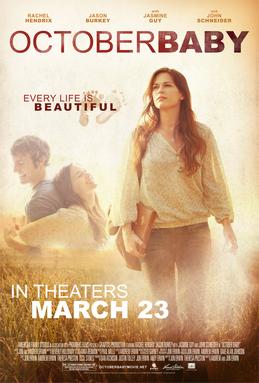
That may explain the tone of last year's October Baby, which - despite containing all the easy moralising, emotional appeals and casual misogyny that have caused even dedicated pro-lifers to turn their back on the movement - feels unexpectedly gentle, even elegiac. Unapologetically pandering to people who already agree with it, October Baby is not so much aimed at converting anyone to the cause as it is about patting activists on the back and telling them they had a good run.

After collapsing during a college play, Hannah (Rachel Hendrix) finds out why she has been sickly since infancy: she is the survivor of a failed abortion. Against the objections of her adoptive father (John Schneider), she joins her only friend and secret crush Jason (Jason Burkey) on a road trip to Mobile, Alabama, where she hopes to pick up the trail of her birth mother. With the help of a number of people who take pity on her, including not one but two police officers (Robert Amaya and Tracy Miller) and a nurse (Jasmine Guy), Hannah is finally able to find her mother and learn lessons about forgiveness, redemption and living life to the full.

In case that made it sound all right, let me state in no uncertain terms that October Baby is a bad film. It suffers first and foremost from a totally pedestrian script whose beats land all exactly where you expect them. The actors aren't particularly inspired by it, but they turn in reasonably effective performances: the real actors (John Schneider and Jasmine Guy) more so than others, but even the supporting actors essentially earn their keep, if no more. Hendrix, the nominal star, is the wobbliest of them all, genuinely nailing some of her scenes but flubbing lines in other places. She is, anyway, rather likeable, generally affecting and does not seem dead inside, which is pretty much all you can ask for in this sort of project.

That's the narrative, anyway: but o sweet Lord, the sheer artlessness of the thing! The mostly functional editing just falls apart in a few places, cutting off lines and introducing continuity errors; and the blocking is hardly any better, cutting off people's faces and producing entirely information-free frames. Flaws like that crop up only now and again, but from the look of the whole thing there is no escape.

For lo, even though I'm generally on board with the digital revolution in film October Baby offers a masterclass in how not to use the Red One and its cousins. In the hands of director Jon Erwin, acting as his own director of photography (a poor idea for those of us who are not Steven Soderbergh), high-definition video looks really damn awful, as if Erwin had heard of cinematography but wasn't quite sure what the term meant. I know the film's one-size-fits-all sheen and totally flat 'arty' aesthetic because I'm an evangelical Christian and that's what our more expensive videos look like. I'm sorry, everybody.

I may complain, but here it is: I actually kind of enjoyed October Baby. The G-rated teen shenanigans are endearing in a dorky fashion, and I honestly had fun with the budding romance between Hannah and Jason: they don't have any chemistry, I guess, but there's a certain pleasant atmosphere. The guilt-forgiveness-redemption arc several characters go through may be trite, but it can't be denied that October Baby achieves genuine poignancy and emotional release in places. You get the feeling that if the film wasn't totally in thrall to a censorious subculture, it might find something raw and real to say rather than just rattling off pro-life talking points. (Over the credits there is an interview with actress Shari Rigby, who has struggled with guilt over having an abortion. It's really quite moving.)

And yet there is quite a lot that is unpleasant and troubling in October Baby too, especially the treatment of the 'unredeemed' women who must be shown the error of their ways. At no point does the film suggest there's anything wrong with Hannah just showing up unannounced at her birth mother's office to confront her. The film wields forgiveness more as a weapon than a bridge to restoration: it's about vindication and vengeance rather than reconciliation. That's the big one, but the treatment of more marginal women is just as icky: there's Jason's girlfriend Alanna (Colleen Trusler), for example, whose unique personality trait is 'bitch' and who is shoved aside just as soon as possible.

With its unexpected endorsement of ecumenism, though, October Baby is still gentler than than the slew of anti-feminist organisations and Southern Poverty Law Center-certified hate groups endorsing it might indicate. It's not easy to create propaganda that's also good entertainment, and October Baby doesn't make the cut. Instead, it exposes the soullessness of the dying evangelical subculture. It's the cinematic equivalent of the insipid Christian pop-rock crowding the sountrack: slick, earnest and utterly empty.