Showing posts with label Italian horror. Show all posts

Wednesday, 24 July 2013

Retracing the wounds of the martyrs

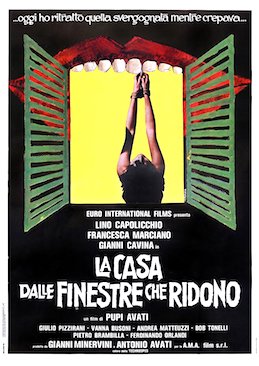
For an Italian horror film released in 1976, Pupi Avati's The House with Laughing Windows (La casa dalle finestre che ridono) is a little weird. Old-fashioned, in a sense: in the second half of the seventies, the giallo was in decline, wandering into the dustbin of obsolescence just like the Gothic horror genre it had replaced. The trend towards outré gory exploitation was already clear, even if most of the zombie and cannibal films that would exemplify this tendency hadn't been released yet.

In comes The House with Laughing Windows, and it's at once a throwback to chaster times - no series of elaborate murders here - and a weirdly experimental thing: a post-giallo, perhaps, both chronologically and thematically. It's a coincidence - Avati could hardly know that the time he finally moved from his earlier Gothic horror-comedies to the giallo would be an age of transition - but it's an interesting one. It's an exercise in deconstruction: Avati explores the spaces between the traditional beats of the giallo and discovers new loci of terror.

The film is set in a small marshland town in Emilia-Romagna. Struggling artist Stefano (Lino Capolicchio) has been commissioned by the diminutive mayor, Solmi (Bob Tonnelli), to restore a fresco of St Sebastian by an infamously morbid, long-dead artist that's recently been discovered at the parish church. Stefano also rents a room at the villa of a bed-ridden old woman, Laura (Pina Borione), begins a relationship with a young teacher, Francesca (Francesca Marciano), and is increasingly freaked out by the painting and the town's many strange residents.

That's really it. There's a death early in the film, but where in most gialli that would trigger Stefano's investigation  (with the requisite crucial bit of detail buried in his memory), it mostly sets off an hour of thickening atmosphere here. It's a broody mood piece, largely free of outrageous murders and, to the shock of every giallo aficionado, entirely bereft of trenchcoat-wearing black-gloved killers. Instead of progressive plot movement, we get foreboding galore and a sudden rush towards a final twist that doesn't win any sense-making competitions.


Not that The House with Laughing Windows is tastefully free of violence. The film opens with the dead artist Legnani's insane, bloodthirsty ramblings playing over footage of a murder, and the ending is in a similar vein. For all that the giallo is violent, it tends not to reduce the human body to meat to the extent that The House with Laughing Windows does in crucial sequences; despite being extraordinarily invested in Italian particularity in every other respect, here the film feels like the horror films coming out of the United States at the same time, or indeed the cannibal film that was about to consume the Italian horror industry. What I'm saying, I guess, is that Avati's uncredited work on the screenplay of Salò, or the 120 Days of Sodom (1975) doesn't seem entirely out of character.

The film boasts a strong cast, beginning with a compelling central performance by Capolicchio. A classic giallo protagonist in the sense of being an outsider having to navigate an alien place and community, Capolicchio nevertheless remains opaque himself instead of being an easy audience stand-in. And this is the right choice: by only allowing us a loose and tentative anchor, Avati increases the sense of unease. Marciano is similarly great; but if I had to nominate a best-in-show it would be Borione's wonderful, unsettling weirdness.

The connection between sexual transgression and murderous violence is well-established in the giallo, even if it never became codified into the rigid sex-equals-death moralism of the slasher film. Avati takes those lingering shots of lacerated flesh and pushes them further, into a film that connects, spoiler, wickedness to gender-bending. Its sexual politics is now more obviously problematic, but hasn't lost all the potency it held in the seventies. And that goes for The House with Laughing Windows as a whole: in deviating from the conventional structure of the giallo, it's perhaps the most chilling film in the genre this side of Bava or Argento.

Saturday, 1 December 2012

Gotta get that feline

Everyone agress there is a whole lot of lesser Argento: most projects the man has directed in the last three decades, say. 1971's The Cat o' Nine Tails (Il gatto a nove code) is commonly reckoned among the director's minor works, despite attempts to make it part of a poorly defined 'animal trilogy' with The Bird with the Crystal Plumage and Four Flies on Grey Velvet.

All things considered The Cat o' Nine Tails deserves its for-completists-only reputation. As an attempt to push the envelope at a time when the classic giallo of the sixties was running out of steam, the film is overshadowed by Mario Bava's violent Twitch of the Death Nerve. But it's still full of interesting ideas that Argento recycled in later masterpieces like Deep Red.

Franco Arnò (Serbian-American actor Karl Malden), a blind man, and his niece Lori (Cinzia de Carolis) are out for a walk at night when they overhear a man in a parked car talking about blackmail to an unseen companion. Arnò, disturbed by this, is up at his home later solving a crossword when he hears the sound of a guard being struck at the head at a nearby research facility. The next day, it turns out that somebody broke into the Terzi Institute, but apparently stole nothing. The police, led by Superintendent Spimi (Pier Paolo Capponi), suspect industrial espionage, especially as the institute was spearheading research into XYY syndrome.

The case turns uglier when one of the institute's researchers, Dr Calabresi (Carlo Alighiero), falls off a platform at the railway station and is crushed to death by a train. Arnò suspects foul play and teams up with the journalist working on the story, Carlo Giordani (James Franciscus). Realising that Calabresi was pushed they begin to investigate the owner of the institute, Fulvio Terzi (Tino Carraro), his scientists and Calabresi's paramour Bianca Merusi (Rada Rassimov). Nine leads in all - hence the title. But that number goes down quickly as somebody starts bumping off possible witnesses to their crimes...

It's a weak plot. And not in the 'Whee, let's have fun with crazy surreal murders!' way we're used to from Bava's films, but as if Argento ran up against a deadline, could not figure out his own mystery, and tried to cover the unconvincing reveal with a tremendously abrupt ending. And that's without the whole chromosome nonsense, inspired by sensationalistic misreporting of men with XYY syndrome at the time. It's not just silly now that public understanding of genetics has moved at least somewhat beyond 'it's magic, and also rigid biological determinism'; it's also pretty insulting to those who were vilified as likely delinquents on the basis that they had an extra chromosome. (Full disclosure: as far as I'm aware, I have just forty-six chromosomes. There's a sentence I never expected to write in a film review.)


The characters are much better, as much as Argento's screenplay attempts to make mincemeat out of any arcs. Giallo heroes tend to be foreigners, but as a blind man Arnò is an outsider of another kind. If his impairment is mostly rendered stereotypically (enhanced hearing, that sort of thing), Malden elevates the character to something much better than the script had in mind. Franciscus's Giordano is a far more milquetoast character, although he's never less than likeable and gets something of an arc through his affair with Terzi's daughter Anna (Catherine Spaak). But the film's treatment of its co-leads is wildly uneven, with early hopes of an unconventional protagonist dashed as he is increasingly upstaged by Giordano. Argento would get the balance of a journalist-and-amateur team right the second time around in Deep Red - by demoting one of the characters.

Like many of Argento's films The Cat o' Nine Tails touches on risqué themes. Here it's homosexuality, presented sensitively for its time (as would be the case in Deep Red). Then there's the police, who are more competent here than they are in a lot of gialli but are fully aware of their reputation for reactionary politics. When Giordano insults him, Spimi agrees nonchalantly: 'Cops are all bastards. We beat confessions out of people. Take bribes. Oppress minorities.'


As is standard in the giallo, plenty of people die between announcing they've solved the case and actually passing on that information. The role of the telephone is one of the strongest links between the giallo and its North American bastard child, the slasher. (It's also a neat way of separating the two distinct traditions that I've argued can be found in the American slasher: if it's obsessed with the telephone, it's a giallo-style slasher, not a descendant of the countryside-revenge film.) In both subgenres, the telephone connects and isolates at the same time, as characters are able to speak to one another but are physically alone and vulnerable. As such, conversations interrupted by the murderer can be a key event (Halloween) or even the whole concept (Scream).

Stylistically Argento begins to move beyond The Bird with the Crystal Plumage, arguably the apex of the classic giallo. That means experimenting with Bavaesque colour, an enterprise he subsequently abandoned until the later seventies. Above all, though, it's by escalating the violence. While less extreme than Twitch of the Death Nerve half a year later, Cat pushes the envelope in nastiness with unflinching death scenes. Surrounded by a better film, that might be impressive; but here it leaves a sour aftertaste, especially paired with an underwhelming, synth-heavy Ennio Morricone score. The Cat o' Nine Tails may have been a cul-de-sac, but thankfully the director learnt from it.

Saturday, 27 October 2012

Italian Horror Blogathon: Deep Red (Argento, 1975)

Part of the Italian Horror Blogathon at Hugo Stiglitz Makes Movies.

Dario Argento's fifth film is perhaps the most famous giallo of them all, but in hindsight it emerges as a transitional effort. Bridging the gap between excellent but ultimately meat-and-potatoes gialli and the surreal fever dreams Argento directed in the late seventies and eighties, Deep Red (Profondo rosso) flirts with the supernatural without ever quite losing its mind in the manner of later films.

At a 'scientific' conference in Rome, Professor Giordani (Glauco Mauri) attempts to prove the existence of telepathy with the help of German medium Helga Ulmann (Macha Méril). The presentation goes awry, however, when Helga is overwhelmed by the evil presence of a murderer somewhere in the room. Disturbed, she returns home, but not before announcing that she knows the killer's identity, unaware the scoundrel is lurking in the shadows of the red-curtained theatre.

Cue the inevitable: Helga is murdered by a figure wearing a dark raincoat in a scene that pays homage to Hitchcock's Psycho, but plays Italian cinema's permissive attitude towards gore to the hilt. From the street below, the killing is witnessed by Marc Daly (David Hemmings), an English jazz pianist. Marc struggles to remember a painting he is convinced the murderer has removed from Helga's flat, while the police devote their time to mocking him for being a penniless artist instead of solving the case. He's aided in his investigation by his depressed alcoholic friend Carlo (Gabriele Lavia), a self-proclaimed 'proletarian of the pianoforte' who performs for bored society types wearing 1920s fashions at a local bar. He also teams up with extroverted reporter Gianna Brezi (Daria Nicolodi), and the two begin an affair.

After remembering a children's song he heard during the murder, Marc is told about a book describing a past murder connected to the same piece of music. He tracks down the author, Amanda Righetti (Giuliana Calandra), but the killer gets there first, stabbing Righetti in the spine and killing her by scalding her face in the bath, because in Italy the taps apparently run boiling water. (This death was ripped off, with similarly terrific make-up effects and preposterous logic, by Halloween II.) Marc is nevertheless able to identify the haunted house pictured in Righetti's book and goes to investigate...

Deep Red has a pretty terrific plot, but it's the central conceit I like best. The murder spree is kicked off by Helga's public telepathic discovery that somebody in the room has killed before; if it were not for that single coincidence, the past would have remained buried and the killer wouldn't have had to bump people off to protect his secret. It's much better than the standard 'psycho killers kill because they are mad, and also because of sexual perversion' the giallo favours, and it grounds the film psychologically even as Argento incorporates elements of the supernatural.


Then there's the fact that Argento is a stylist of genius: not as compelling in his use of colour and contrast as Mario Bava, but his eye for space, blocking, and utilising the frame surpasses that of the father of the giallo. And Deep Red doesn't disappoint. There are plenty of creepy props (terrifying children's dolls, dead birds, etc.), but the greatest scares are derived from the Baroque stylisation in Argento's arrangements, using his actors' faces to the greatest effect while creating plenty of negative and off-camera space where threats might lurk.

Where Bava made his way from Gothic horror to inventing the giallo, Argento moved from screenwriting to directing films in a subgenre that was already fully formed at the turn of the seventies. To the giallo at its height Argento brought a keen focus on the corruption of Italy's social elite: the side-by-side of luxury, high culture and murder - blood and art, blood as art - distinguishes his work. It's unsurprising, then, that Deep Red touches on controversial or risqué subjects like homosexuality, women's liberation (Marc is a fairly chauvinist hero), and the impact of politics on the police (who seem to be on strike when they're not busy bungling the investigation).


Beyond its focus on lurid subject matter, Deep Red is also really damn gory. Bava's Twitch of the Death Nerve had opened the floodgates in that respect, but let it never be said Argento was not a keen student. With the brutal death of Righetti, mentioned above, special effects wizards Germano Natali and Carlo Rambaldi outdo themselves. Their work on other scenes - including an infamous decapitation - is less brutally realistic, but Argento more than picks up the slack with unflinching direction. When Giordani is repeatedly smashed face first into walls and sideboards we keep expecting Argento to cut away, but he never does.

It's not a perfect film: even in the Italian original there is plenty of irritating overdubbing, suggesting the director's dissatisfaction with some line readings. Then there is the soundtrack, which improbably seems to have a cult following. Argento fired composer Giorgio Gaslini half-way through the job and replaced him with musical collective Goblin. Their progressive rock score isn't bad per se, although it suggests Goblin spent too much time listening to Tubular Bells and In Search of Space. It's just not very giallo: I want screeching strings, damn it, not space rock.

But those flaws can't damage Deep Red's status as one of the best and arguably the most famous giallo. As a giallo with supernatural elements and a mid-point in Argento's oeuvre it isn't a great introduction to the subgenre: that honour belongs to the director's own Bird with the Crystal Plumage. But, importantly for a horror film, Deep Red is no less terrifying than it was in 1975. Gialli, after all, age more gracefully than slashers because of their psychological themes and the general lack of stupidity.

Wednesday, 24 October 2012

3rd Annual Italian Horror Blogathon: Torso (Martino, 1973)

Part of the Italian Horror Blogathon at Hugo Stiglitz Makes Movies.

After making his way from sexploitation 'documentaries' to feature films, Sergio Martino dedicated much of his considerable energy to the crowded space between horror and thriller. Directing gialli and other B-movies at the breakneck pace typical of the Italian film industry, the Roman churned out two or more pictures a year throughout the first half of the seventies.

By 1973 Martino was thus a veteran of the giallo despite having worked in the subgenre all of two years. It was certainly an interesting time. In 1971 Mario Bava, the godfather of the giallo, had decisively abandoned procedural elements in favour of lurid violence with Twitch of the Death Nerve (Reazione a catena), although most of his colleagues would not follow this shift for a number of years; and North American filmmakers were beginning to notice Italian horror, resulting in the first slasher, Black Christmas, in 1974.

But I'd be lying if I claimed it's just its place in history that interested me in the first of Martino's 1973 films (and the only one to be released in North America the same year). It's the title. I corpi presentano tracce di violenza carnale (The Bodies Bear Traces of Carnal Violence) distils the contemporary appeal of the giallo to its essentials: blood and sex. It's not all there is to the film: although Martino was one of the sleazier giallo directors - which is saying something -, he was no hack. The promise of I corpi presentano tracce di violenza carnale, anyway, is not quite conveyed by the English rump title Torso - although that moniker is pertinent too, as we shall see.

In the film's opening shot Martino's camera travels from a woman's face down her bare upper body to a doll, whose eyes are gouged out by the man she straddles. Then we go to a ménage à trois between a man and two women, while their partially out-of-focus sex is photographed by an automatised camera. The creepy sex and clinical focus on viewing and recording anticipate the film's themes. It's undoubtedly sleazy, but the music by Guido and Maurizio de Angelis is sufficiently urgent and creepy to drain the scene of all potential titillation.


Cut to a university in Rome, where Franz (John Richardson) lectures on Renaissance art to a mixed group of Italians and American exchange students. Jane (Suzy Kendall) and her friend Daniela (Tina Aumont) reject the unwelcome advances of creepy coursemate Stefano (Roberto Bisacco). Meanwhile, their friend Flo (Patrizia Adiutori) and her boyfriend (Fausto di Bella) are strangled by a masked assailant after making love in a car. Later Carol (Cristina Airoldi), another student, is murdered in a swamp by the same cloaked figure.

When the police seek the help of the student body, Jane is conflicted. She knows that she has spotted somebody in the piazza the previous day wearing the distinctive red-and-black scarf used to strange the victims, but there is a detail she struggles to remember, a detail that might crack the case... After she receives a threatening phone call, she is more than willing to accept Dani's invitation to come out to her uncle's country manor for a couple of days to recover from the shocking events, along with friends Katia (Angela Covello) and Ursula (Carla Brait).

Up to that point Torso is a bog-standard giallo, featuring all the expected elements: a foreigner embroiled in a murder case in an Italian city, repressed memories, a killer in a mask and dark coat. On the trip to the country, however, it becomes something altogether darker and more lurid as Martino amps up both the titillation and the gore. As a murder mystery Torso does not satisfy: Stefano is such an obvious red herring that I began to wonder if Martino might be double-bluffing, while the true identity of the killer is easy to figure out by a process of elimination well before the reveal.

But by 1973, the giallo had broken free of its procedural roots, and the latter half of Torso is a thoroughly effective blood-and-nudity shocker, though one that asks uncomfortable questions of the audience. Although he does not use the murderer's point of view excessively, Martino's lingering, often deliberately overlong shots implicate the audience in his act of watching, and he does not flinch: where you'd expect the camera to cut away, it doesn't. I shan't claim that as seasoned an exploitation director as Martino is deliberately rubbing the audience's depravity in their faces, but something is going on here. Nor is his objectification of women as straightforward as expected, with close-ups more disorienting than titillating.

As common in the giallo, the killer suffers from psychosexual hang-ups that don't necessarily make sense, but are disturbing as all hell. And that's where the English title comes in. The killer has a habit of stripping his victims half-naked, groping their naked torso and attacking their chest and eyes with a knife. Martino thankfully cuts to a flashback of a doll's eyes being gouged out to spare us those gory details, although he does not hesitate to kill off several victims at once, shockingly wrongfooting a viewer who expects them to be offed one at a time; and in a scene hinted at by the film's US poster, we watch through Jane's eyes as the murderer saws his victims to pieces. It's bloody violent stuff, but Martino works hard to offset blatant titillation with disturbing subtext.

Torso also parodies left-wing student culture, albeit in the somewhat befuddled and clueless fashion common at the time. As usual in sensationalist coverage of counterculture mockery and leering projection go hand in hand, from a student's pseudo-Marxist dismissal of Perugio as a 'common-sense bourgeois' to a comically overdrawn hippie commune, complete with drugs and free love. For me, though, the peak of the film's humour is a police officer's suggestion that after helping him solve the murders, the students 'can protest and riot when we're a bit reluctant to let you dismantle the state', a line so dated I laughed out loud. Not that rebellious students like me aren't trying to dismantle the state anymore: we are. But the uncomprehending rhetoric dismissing us as lazy troublemakers just ain't what it used to be.

Monday, 6 February 2012

Viva Bava, Part 6: In space, no-one can hear you make mediocre films

In the early sixties, American International Pictures made a ton of money by distributing Mario Bava's films stateside. They'd usually retitle and edit the original film, removing gore, re-arranging the segments of Black Sabbath and so on. For that reason we Bava aficionados prefer the Italian release versions, but let's give credit where credit is due: without AIP, Bava could never have built a fanbase in America.

Despite having passed on Blood and Black Lace, AIP still wanted to distribute Bava's films, and they decided to get closer to the source. Thus it was that the maestro's next feature was financed jointly by AIP and Francoist Spain's Castilla Cooperativa Cinematográfica, and for the first time a Bava film was released almost simultaneously in Italy and the US (in September and October 1965, respectively).

I'd dearly love to blame AIP, who released the film as a double bill with Die, Monster, Die!, for the all-out badness of Planet of the Vampires (Terrore nello spazio), but I can't. Yes, the film's English screenplay, penned by Ib Melchior and AIP producer Louis M. Heyward, is dire almost beyond belief, but it's a translation of an Italian script Bava himself cowrote. Sure, AIP gave the Italian just $100,000 to work with, but low budgets were never a problem for Bava before (see Black Sunday). And the all-round bad acting? Well, working with an international cast who didn't understand each other, Bava must take at least part of the blame for not getting better performances.

Two interplanetary spaceships, the Argos and the Galliott, approach the unexplored planet of Aura when they suddenly find themselves subjected to an enormous gravitational force. The ships lose contact, and the Argos' crew begin attacking each other under the influence of an unexplained force. Captain Mark Markary (Barry Sullivan) manages to contain his raging crew and land the Argos on Aura's barren, fog-covered surface.

Our plucky heroes go on an expedition to the Galliott, which has crashed not too far from the Argos, but find all her crew dead and conclude they killed each other in the same fit of madness. After burying the victims, however, crew member Tiona (Evi Marandi) believes she's seen the dead walking while standing watch. Eventually, they realise the planet is inhabited by a non-corporeal race who are possessing the dead humans for their own nefarious purposes.

You may have noticed the above summary doesn't include any vampires. The Aurans certainly don't count: they inhabit dead bodies, sure, but they don't drink blood, and no-one ever suggests taking a stake to them. It's much more Invasion of the Body Snatchers than Dracula, but hey, AIP had previously marketed more than one Bava film about vampires, so they must have decided that marketing the picture as 'vampires... in space!' was a great idea. (Commercially, it worked out.) Thankfully, I don't have to blame Bava for this too: the Italian title just means, more vaguely but also more accurately, 'terror in space'.

Logic isn't the script's strong suit. Well, that's putting it mildly: nothing in Planet of the Vampires makes a lick of sense. Instead of coherence, Bava and/or Melchior decide to load up the script with incessant technobabble - especially sad given the cheapness of the sets. The less said about the thespians the better: the cast of Planet of the Vampires are, despite the extenuating circumstances listed above, an exceedingly sorry lot, with Ángel Aranda plumbing the depths of unconvincing acting.

But it's still a Mario Bava film and therefore looks gorgeous. There's an absolutely terrific giallotastic pan and zoom over a roomful of corpses, for example. (Notice that our space explorers' symbol seems to be struck-out double lightning bolts, as if fighting fascism was their primary concern.)


As always in Bava's films, the lighting is vibrant to the point of garishness. The director used vast amounts of fog to obscure the cheapness of the papier-maché rocks of Aura, but at least he shot said fog and rocks exceedingly well, emphasising otherworldly reds, blues and gaudy greens:


Its visual beauty can't save Planet of the Vampires from succumbing to utter tedium. It takes a stronger reviewer than me to behold the boring, confusing story and woeful acting and not throw up one's hands, saying, 'I don't care'. The film lives on mainly thanks to critics' claim that it inspired Alien, despite Ridley Scott's insistence he hadn't seen Planet of the Vampires before making his masterpiece. If we must compare the two, it is sadly entirely to the detriment of the earlier film. It's no surprise that Bava never dabbled in science fiction again.

Saturday, 28 January 2012

Viva Bava, Part 5: Cutting-edge fashion

After pushing the boundaries of Gothic horror to new and disturbing places with Black Sabbath and The Whip and the Body, Mario Bava wasted no time in returning to the new subgenre he had created. Blood and Black Lace (Sei donne per l'assassino), though in several ways a worse film than The Girl Who Knew Too Much, distilled all the distinctive elements of the giallo into a single picture for the first time.

As so often, Bava's backers didn't expect or want the archetype of the ultra-stylish murder mysteries of the sixties and seventies: as an Italian-West German co-production, Blood and Black Lace was planned as a whodunit in the tradition of the countless German Edgar Wallace adaptations of the time. (These are still a mainstay on television in the Fatherland.) Like so much of Bava's career, the film was to be work for hire.

The director, though, was bored of that and chose to focus on lurid murders and cheap thrills at the expense of plot. Commercially, the gamble didn't quite work out: a box office bomb in Italy and a modest success in West Germany, Blood and Black Lace was passed over by AIP, who'd distributed Bava's earlier horror films in the United States. Instead, the film was picked up by the Woolner Brothers and released in a widely disliked English dub, to a cool reception.

Woolner Brothers did, however, bestow upon Blood and Black Lace its glorious English title, the first time that a Bava film title was improved by translation. Sei donne per l'assassino (Six Women for the Murderer) is serviceably lurid, making it perfectly clear we're about to watch a slice of exploitation; but Blood and Black Lace, ah! The alliteration, the structure of the vowels, the progression from relatively soft consonants to the hard /k/ and the hissed /s/ of the final words! And then there's the heady mix of high fashion, titillation and gore the words themselves promise. It is, in a word, a stunning title for an exploitation film that would not be surpassed until Twitch of the Death Nerve.

After extraordinarily stylish opening credits in which the actors are arranged like mannequins in a luridly lit fashion studio, we meet a man and a woman outside a mansion, discussing their current acute lack of cocaine; it turns out that Isabella, the man's still-girlfriend, is holding out on them, and they agree they'll ask her for the white stuff when she gets back. But when we cut to Isabella (Francesca Ungaro) walking through the woods, it isn't long before she's attacked and strangled to death by a masked killer wearing a trenchcoat and black gloves (actor and stuntman Goffredo Unger) in a pretty vicious sequence.


The next day, Inspector Silvestri (Thomas Reiner) turns up at the fashion house where Isabella worked as a model. The house is run by Massimo Morlacchi (Cameron Mitchell) and his lover, fashion designer Contessa Cristina Cuomo (Eva Bartok). The models become nervous as it is revealed that Isabella kept a diary in which the fashion house's various sins - abortion, cocaine, blackmail, you name it - are detailed. Nicole (Ariana Gorini) is murdered by the killer at the antique shop of her lover Franco Scalo (Dante Di Paolo), but the diary has already been nicked from her purse by Peggy (Mary Arden), and...

You know what? If the above sounds confusing, imagine what the film is like to watch. Blood and Black Lace has loads and loads of characters, most of whom never matter as more than cannon fodder and/or red herrings: half a dozen models, as many men employed in various capacities, and hangers-on. The narrative isn't so much flawed as downright broken: Inspector Silvestri, whose perspective we assume as he begins to unravel the house's dark secrets, all but disappears in the third act, when the screenplay's attention shifts radically to other characters. It's an illogical mess of a plot, and a thoroughly unsatisfying mystery.

But! That critique isn't just not the whole picture: it misses the point fundamentally, for Blood and Black Lace is style as substance, full of Bava's signature use of shadow, spare lighting, strong colours (a lot of red this time round) and quasi-psychotic zooms - which fit right in with the lurid subject matter, where they seemed out of place in The Whip and the Body. Carlo Rustichelli's string-heavy score is overwrought but extraordinarily atmospheric, while a shot of the killer appearing and disappearing in flickering light is so good it was ripped off as far down the ladder as Halloween: The Curse of Michael Myers.


There's no doubt that unlike Bava's somewhat more artful earlier horror thrillers Blood and Black Lace is exploitation: the film revels in serving up scantily clad young women for the slaughter, and in the grand tradition of bodycount horror it's inventive when it comes to murder. There's a loving close-up of one model being stabbed to death with a spiked glove, for example; another is killed when her face is pressed against a burning furnace, while a third is drowned in the bath and then has her wrists slashed to suggest suicide, which gives us the above image of horrid loveliness.

It's quite shockingly violent for 1964, far more so than The Girl Who Knew Too Much, and sexually suggestive to boot: one girl is suffocated wearing her nightgown, and the way the scene is filmed and acted her death throes might as well be sexual ecstasy - which puts the viewer into an uncomfortable perspective, to say the least. The acting is, all in all, mostly functional, although Bartok knocks the rest of the cast into a hat.

At one point, Inspector Silvestri and his colleagues discuss what drives the killer. They turn out to be wrong, but the question is symptomatic of something Bava's films ask time and again: why murder? Because it's beautiful, the giallo answers disconcertingly. The look of the subgenre - black gloves, trenchcoats, gleaming blades, dead bodies draped in an aesthetic, even titillating fashion: the visual vocabulary that renders the viewer complicit in the horrors depicted first blossomed in Blood and Black Lace. If the film isn't perfect - not even, perhaps, good - it nonetheless proved sufficiently compelling to inspire legions of imitators.

Thursday, 19 January 2012

Viva Bava, Part 4: With his stripes

Italian horror developed at an astonishing pace in the early 1960s. I've previously referred to just how many films across a range of genres Mario Bava made during those years. But it's worth remembering that Bava and his collaborators barely had time to wait and see if Black Sabbath would be a success, for the maestro's next film was released on 29 August 1963, just twelve days after its predecessor. Put that in your pipe and smoke it, Terence Malick.*

That The Whip and the Body (La frusta e il corpo) was a Mario Bava film may not have been obvious to audiences at the time, though (nor, I think, would they have cared very much: the age of the auteur was not yet at hand, excepting superstar directors like Alfred Hitchcock). For it was in The Whip and the Body that Bava first used the nom de plume John M. Old, and pretty much everyone else involved in the production also adopted Anglo-Saxon pseudonyms: having managed to hire Christopher Lee at the height of his stardom, they were trying to seem as non-Italian as they could. It's a pity, but at least we know who the very capable folks behind the scenes really were.

The Whip and the Body is set at a castle in the nineteenth century. Kurt (Christopher Lee), the violent, sadistic son of the elderly, invalid count (Gustavo de Nardo, sporting the ingenious nom de plume Dean Ardow), returns to claim his patrimony, having been exiled years before after driving the daughter of housekeeper Giorgia (Harriet Medin) to suicide. In the meantime, his former lover Nevenka (Israeli actress Daliah Lavi) has married his spineless brother Christian (Tony Kendall), frustrating his cousin Katia (Ida Galli), who'd had her sights set on Christian. Reluctantly, the count allows Kurt to stay.

It soon turns out, however, that the prodigal son hasn't changed. While Nevenka is at the beach alone, she is surprised by Kurt, who flogs her with a horsewhip before raping her, claiming that she is really enjoying the violence. Before long, Kurt is killed when he's stabbed in the neck by an unseen assailant. He's buried in the family crypt, but the family's relief soon turns to terror. A ghostly Kurt, apparently risen from the grave, appears to Nevenka during the night and brutally whips her again. Christian at first assumes his sister is hallucinating, but when the count is found murdered by being stabbed in the neck, he too accepts that his brother must be a revenant.

Besides its subject matter - which would be heavily censored when the film was released in the United States, under the title What! - it's the contrast, perhaps even conflict between Bava as director and as cinematographer that makes The Whip and the Body so fascinating. Bava's visual vocabulary was developing at a rapid pace, and in this, his fourth horror film, he's using a whole lot of sudden, violent zooms that seem to prefigure his later work (and the erratic direction of American horror directors like Tobe Hooper). Frankly, it doesn't work: Gothic horror calls for steadier camerawork than Bava was interested in at this point, and the film's most effective sequences are among the most conservatively staged.

As a cinematographer, though, Bava does extraordinary work here: together with longtime collaborator Ubaldo Terzano, he makes The Whip and the Body hands down his most gorgeous film so far. Italian cinema was fonder of vivid colours than Hollywood, and Bava doesn't disappoint with luscious blue, green and red lighting: a sequence of Kurt walking down a corridor is downright breathtakingly beautiful. If The Girl Who Knew Too Much proved anything, it's that nobody put ol' Mario in a corner when it came to lighting his leading ladies' faces, making the most of the interplay of light and shadow on pale skin. The shots of Lavi's frightened face are nothing short of brilliant.


The Whip and the Body is, of course, about sadomasochism. Villains with psychosexual hangups were nothing new at the time: the most famous was Norman Bates of Psycho, who had inspired countless knock-offs. Kurt is a more disturbing character even than Norman, though. Where the latter kills because he must destroy the objects of his desire, finding himself unable to mortify the desire within, Kurt inflicts pain to establish and maintain his dominance. He is totally egocentric, quite incapable of pangs of conscience.

What makes this more stomach-turning, of course, is that Kurt's insistence that deep down Nevenka enjoys and loves him for his violence is true. It doesn't take long for Nevenka's pain to turn into sexual ecstasy: Kurt's aggression provides something she misses with the weak-seeming Christian. She has internalised her patriarchal subjection to such an extent that she begins to crave it, and in several scenes she fetishises the welts Kurt has dealt her, and obviously enjoys being beaten:


Eventually, Nevenka accepts Kurt's 'love', sucking the thumb he extends to her in a scene straight out of L'âge d'or, and it seems inevitable that the sex act alluded to in a shockingly bald way is one so expressive of gender dominance. Lavi, whose attempt to base a career on her very considerable sex appeal eventually floundered despite her appearance in Casino Royale, isn't all that good. I'm suspecting Bava must have been unpleasant to his leading ladies: Michèle Mercier, in Black Sabbath, is the only actress in his films so far who really seems at ease. Christopher Lee, though, is a wonder to behold: his natural stage presence would hold the film together if Bava couldn't.

It will hopefully have become obvious by now - and if not, just wait for Blood and Black Lace, but please ignore the horror IMDB have chosen as the page image - that Bava's films usually have extraordinarily vivid, beautiful posters. I mention this because The Whip and the Body is the first Bava film whose poster is, as we say in the Fatherland, a little nullachtfünfzehn (08/15 - the serial number of a Great War machine gun, naturally): bog-standard, in other words. It wasn't in all markets: the demented French poster continues to delight. This was the first time, though, that I regretted being tied to the Italian poster. Enough said.

All in all, The Whip and the Body may be the most fully rounded and satisfying film of Bava's I've seen so far. As with most Italian genre films, story logic clearly ranked far below style in the director's list of priorities: but with a motion picture as gorgeous as this one, I shan't complain. The Whip and the Body perhaps marks Bava's peak as a master of Gothic horror, and clearly the man was in a roll. For the next film on our list is what is often called the greatest of the gialli, 1964's Blood and Black Lace. 

*This depends somewhat on what release date you accept for Black Sabbath, but the most widely reported is 17 August 1963.

Monday, 16 January 2012

Viva Bava, Part 3: Figure in black which points at me

This series has repeatedly discussed the profound influence Mario Bava and his imitators would have on the American horror film of the 1970s and 1980s, but the flow of ideas went both ways. I've already referred to the importance of Psycho, but it is to the series of Edgar Allan Poe adaptations by American International Pictures and Roger Corman, beginning with 1960's House of Usher, that Bava's next feature is most obviously a homage.

By 'homage', I only partly mean 'rip-off'. I tre volti della paura, released in August 1963, is not one of Bava's best films, but though not a masterpiece it's much more interesting than it appears on the surface. It's conducting a cinematic dialogue between Gothic horror and the emerging giallo, and points both to Bava's roots and to his future; not to mention that its importance in the development of exploitation horror is vastly underrated.

Oh, and when AIP released it in the English-speaking world they decided to give it a title reminding audiences of Bava's previous hit, Black Sunday; and thus a film whose original title means The Three Faces of Fear (translated literally for most European markets) became Black Sabbath, and as such a couple of Birmingham lads, members of a band called Earth, spotted the film's poster at a cinema across the street from band practice. They realised the occult theme attracted crowds, renamed themselves, and the world was given a great many awesome guitar riffs.

Black Sabbath is an anthology film composed of three horror stories unrelated by plot. They were put in a different order for release in America, and 'The Telephone' was butchered to remove a lesbian subplot, but thankfully it's the Italian original that has survived. In that version, the film opens with an absolutely delightful soliloquy by Boris Karloff - yes, that Boris Karloff - obviously having an amount of fun one can't usually obtain legally, standing in front of a vaguely scary-looking background while discussing whether creepy-crawlies attend cinemas (they do, apparently) and introducing the horrid tales we're about to see unfold.

We begin with 'The Telephone', the first Italian thriller film shot in colour, which is set entirely in the Paris apartment of Rosy (Michèle Mercier), a callgirl who receives phone calls in which a man threatens to kill her. Rosy realises the anonymous caller is likely to be Frank (an uncredited Milo Quesada), a recently escaped convict her testimony condemned to prison. Terrified, she asks her former lesbian lover Mary (Lydia Alfonsi) to come over so she'll feel safer, but unbeknownst to her it was Mary, masking her voice, who was making the calls all along just to be able to spend some time with Rosy. Unfortunately for both of them, the real Frank is out on the prowl too.


In the second segment, 'The Wurdalak', Vladimir, an aristocratic fop (Mark Damon, of House of Usher), rides through the wilderness of an unspecified region of eastern Europe (portrayed, as it was in Black Sunday, by Italy) when he discovers a headless body with a precious dagger in its back. He comes up to a house where Giorgio (Glauco Onorato) informs him that the dagger belongs to his father Gorca, meaning that the dead body must be the wurdalak, an undead monster Gorca had set out to hunt.

The household otherwise consists of Pietro (Massimo Righi), Giorgio's kid son Ivan (the actor's name isn't listed), as well as his wife Maria (Rica Dialina) and his sister Sdenka (Susy Andersen, the name adopted by Maria Antonietta Golgi - it was the sixties, remember, and Bava himself assumed an English nom de plume on occasion). These last two seem to cast a lot of longing glances at each other, or maybe I just want that to be true because, with due respect, they're both extraordinarily fit.

Anyway, Gorca (Boris Karloff) soon returns, but he seems changed, harsh and cruel while refusing food. His sons' suspicions that he has himself been turned into a wurdalak are confirmed when Gorca kills Pietro and drags off Ivan because, in the best idea the film takes from the Aleksey Tolstoy story this segment is based on, the wurdalak attacks those he loved in life. Vladimir, revealing himself as the hateful scumbag he seemed from the first, persuades Sdenka to run away with him because, he claims, he loves her, but will they manage to escape the growing wurdalak clan? (No.)


In 'The Drop of Water', set in Victorian London, a nurse (Jacqueline Pierreux) is called late at night to the home of an elderly medium who has just died. While preparing the dead body, she is tempted by the precious ring on the dead woman's finger and nicks it, when a glass of water tips over and drops of water fall to the floor; she's also annoyed by a fly. While at home, she is haunted by dripping water and supernatural occurrences all over her flat.

'The Drop of Water' is the weakest of the three segments by far, brought down by a boring, derivative story. The other two are excellent, but before we get to that we need to appreciate the glorious ending, in which the fourth wall is not so much broken as smashed down and danced upon. The closing soliloquy is delivered by Boris Karloff atop a horse; and before we know it Bava zooms out, the horse is revealed to be mechanical, and Karloff laughs maniacally while PAs run past him with branches on what we can now very clearly see is a film set. It is one of the most surreal, delirious, incredible scenes I've ever seen in a film, and I can't believe they cut it from the American release.

There's thus a lot of tongue-in-cheek self-referentiality to Black Sabbath that I like very much - and so did Karloff, who declared his segments the most fun he'd ever had in a film. The horror veteran's presence is one of Black Sabbath's greatest assets, not just in his demented soliloquies but also in his more serious turn as a blood-sucking grandfather (the only time Karloff played a vampire, incidentally).

The episodes pretty much stand or fall with the actors: 'The Telephone' is anchored by Mercier (alone for half the running time) and Alfonsi, 'The Wurdalak' can rely on Karloff, Onorato and Dialina even as Damon is an annoying, bland disappointment, while Pierreux's weak performance dooms 'The Drop of Water'.

'The Telephone' is the most obviously proto-giallo of the three segments. There's a shot of Rosy's stalker peering through the curtains that is very reminiscent of Norman Bates, with an attending focus on the eye that also marks Black Christmas a decade later and countless horror films since. It's also here that the fetishism of the gleaming knife, absent from The Girl Who Knew Too Much but characteristic of the later giallo, is developed, and a later stylish murder in which a character is strangled with a stocking is a sign of things to come.

The superficially less proto-anything 'Wurdalak' really points both to Italian Gothic horror and the gialli of the future. The scene in which Vladimir is introduced to Gorca's entire family is, let's face it, a 'meet the meat' scene. It's basically a bodycount picture in Gothic trappings: the killer does not have an aim in the pursuit of which he may kill people (as in Black Sunday, where Asa is trying to resurrect herself by draining Katia's life force) but the killing is itself the aim; and the way in which individuals are isolated and picked off one by one is distinctly slasherish. The idea of Boris Karloff as the original slasher villain, though inexact, is too tempting to just be dropped, even as the final scene is not at all in that later tradition but rather cribbed from Dracula:
And then insensibly there came the strange change which I had noticed in the night. Her breathing grew stertorous, the mouth opened, and the pale gums, drawn back, made the teeth look longer and sharper than ever. In a sort of sleep-waking, vague, unconscious way she opened her eyes, which were now dull and hard at once, and said in a soft, voluptuous voice, such as I had never heard from her lips, 'Arthur! Oh, my love, I am so glad you have come! Kiss me!'

Arthur bent eagerly over to kiss her, but at that instant Van Helsing, who, like me, had been startled by her voice, swooped upon him, and catching him by the neck with both hands, dragged him back with a fury of strength which I never thought he could have possessed, and actually hurled him almost across the room.

'Not on your life!' he said, 'not for your living soul and hers!' And he stood between them like a lion at bay...

I kept my eyes fixed on Lucy, as did Van Helsing, and we saw a spasm as of rage flit like a shadow over her face. The sharp teeth clamped together. Then her eyes closed, and she breathed heavily. (p. 116)

Even with such literary references, it's encouraging to see that Bava's exploitation instincts were being honed. There's a head prop, crafted once again by his father Eugenio, that is far better than anything they managed to create for Halloween: Resurrection almost forty years later, and in general the gore (of which there is little) is of the excellent quality one has come to expect. 'Exploitation' means something else too, though, and indeed Black Sabbath is quite desperate to emphasise its actresses' heaving bosoms; 'The Telephone', being a half-hour segment of the lovely Mercier in a nightgown, is pretty much just a delivery system for titillation.

It's a beautiful film, shot by Ubaldo Terzano and Bava himself to emphasise otherworldly indigoes and dark blues. I praised Bava's black-and-white cinematography in The Girl Who Knew Too Much, and I'm sad to see there'll be no more of the exquisite contrasts of that film; but his mastery of colour here almost makes up for it. It's an important film: transitional, certainly, 'lesser' Bava, perhaps, but no less entertaining for that.
Thursday, 12 January 2012

Viva Bava, Part 2: Women in refrigerators

After Mario Bava first gained fame outside his native Italy with 1960's Black Sunday/The Mask of Satan, three years passed before his return to the horror genre. Not, mind you, that Bava was idle in those years. On the contrary, he directed, shot, co-directed and salvaged no fewer than five pepla in 1960 and 1961 (Esther and the King, The Last of the Vikings, The Wonders of Aladdin, Hercules in the Haunted World and Erik the Conqueror, since you ask).

This breakneck pace was not unheard of in the rough-and-ready boom days of the Italian film industry, but it could only be achieved by rushing production and releasing films in short intervals (the last three on the list above all hit cinemas in a timespan of just five weeks). Thus we have no Bava films from 1962, but he hit the ground running, and February 1963 saw the release of The Girl Who Knew Too Much (La ragazza che sapeva troppo).

By that time, cinema at the intersection between horror and murder mystery wasn't what it had been just three short years previously. Psycho had changed the rules of the game forever, introducing a focus on the lurid, female victims and disturbed psycho-killers that was immediately copied across the pond.

Granted, Hitchcock's tour de force had actually come out six weeks before The Mask of Satan, but if you expect copycats to appear that quickly I think you're overestimating even the great Italian rip-off machine. A few years on, though, Psycho's mark on Italian cinema was indelible. The Girl Who Knew Too Much is, therefore, above all a homage to the master of suspense (some have called it a spoof), referring to his work in its title (a play on Hitchcock's The Man Who Knew Too Much) and its camerawork. But it's also already something else: the prototype of a new subgenre, the first of the gialli.*

Nora Davis (Letícia Román) is an American visiting her sickly aunt Ethel (Chana Coubert) in Rome. During the night Ethel dies, and Nora is walking to the hospital to notify them of the death when she is mugged and knocked out on Piazza di Spagna. When she regains consciousness, she sees a woman staggering towards her before falling over dead, a knife in her back, and being dragged away by a bearded man. Nora faints again and is revived with brandy by a stranger, but the good Samaritan flees at the approach of the police - who, of course, will not listen to Nora's ravings, believing her to have been drunk, grief-stricken and delusional, especially since no body has been found.

Our heroine is still unsure if she's imagined the whole scene but gladly accepts when the late Ethel's neighbour, Laura (Valentina Cortese) offers her her house while she leaves the city for a few days. Nora explores Rome with the late Ethel's doctor, Marcello Bassi (John Saxon), but soon discovers that what she saw fits the profile of a murderer who killed three young women whose names began with consecutive letters of the alphabet ten years previously. Since her surname begins with a 'D' and she Knows Too Much, Nora fears she may be next.

It's almost as if Bava knew he was making the first cinematic giallo: The Girl Who Knew Too Much is positively awash in explicit references to that post-war Italian genre of cheap paperbacks that blended crime, horror and titillation. One of the very first things the voiceover narration (which would not become a trope of the genre) tells us about Nora is that she is an avid reader of libri gialli, 'yellow books', the full meaning of which is not quite conveyed by the 'murder mysteries' as which the subtitles translate the phrase. Later, our heroine uses skills gleaned from her reading to ward off the killer.

The Girl Who Knew Too Much is the first time the giallo made the jump to the big screen, but it's also Bava's last feature filmed in black and white. As such, it marks his highest mastery of monochrome both as a director and as a cinematographer. Bava may not have thought much of his lead actress ('it could have worked with James Stewart and Kim Novak, whereas I had...oh, well, I can't even remember their names'), but he sure made the most of Román's skin and blonde hair by throwing shadows on it, for delightful and spooky contrasts:


So even if Román's performance isn't all it could be (while John Saxon seems a bit lost, she looks uncomfortable, as if the on-set experience wasn't altogether pleasant), she certainly has the face to carry off a giallo. I don't subscribe to blanket condemnation of exploitation films as misogynistic: while they do have ingrained and often actively nasty patriarchal structures, they can also perform gender in surprisingly transgressive ways, as Carol Clover and others have shown.

But Ramón's character pioneers the 'type' of woman gialli would keep going for - young, beautiful, blonde - and the fact that the victims are women at all. Unlike the American slasher, which killed both sexes, though in heavily gendered and stereotyped ways, gialli almost always preferred female victims. The film's Italian poster says it all: if slashers are Dead Teenager Films, gialli have to strain not to be Dead Woman Films - hence the post title.

Bava's direction consciously borrow from Hitchcock - witness his use of signature zooms and pans - but in speaking its own visual dialect it sets up the giallo's most distinctive characteristic: in contrast to their sometimes brutally artless brethren across the pond, gialli are stylish. As such, you pretty much trip over moments of extraordinary visual flair like this shot in which Nora, lying in bed, finds herself menaced by a dark silhouette on the other side of the window:


The dramatic musical cues (lots of strings, à la the screeching climax of Psycho) and the editing by Mario Serandrei both betray Hitchcock's influence and mark the new subgenre (a cutaway on a crescendo is particularly effective). The outsider, often a foreigner, who's in the city where he witnesses a crime only for a limited period of time - another giallo distinctive - is also introduced here. (It survives in fossilised form in Black Christmas and subsequently disappears in North America.)

All in all, The Girl Who Knew Too Much seems like a sign of things to come. An emphasis on style (not, as yet gore) rather than plot; a list of female victims to be stalked and killed; crimes that (mild spoiler) are ultimately senseless and not rationally motivated; a knife-wielding murderer, though not yet masked; the presence of John Saxon, he of Black Christmas and A Nightmare on Elm Street: why yes, I think we're in proto-slasher territory.

At the same time, that teleological perspective is massively problematic. Reducing the giallo to the precursor of the slasher - even viewing The Girl Who Knew Too Much as nothing more than the first giallo - risks engaging in presentism and papering over the very real differences between genres and films.

The humour, for example: The Girl Who Knew Too Much is funny in quite a few scenes, and terror sometimes resolves into comic relief - something that is unheard of in at least the first wave of North American slashers, which seem to come from a darker, more brutal place. Even the film's outrageous final twist - which reveals either the protagonist's or the writers' ignorance of the psychoactive properties of marijuana - is ambiguous. We can't switch off hindsight, but The Girl Who Knew Too Much really does feel like Bava had discovered a potent formula - and there was more where that came from.

*The Girl Who Knew Too Much was released in a truncated cut in the US, as Evil Eye. This review is based on the original Italian version.

Monday, 9 January 2012

Viva Bava, Part 1: A riot is an ugly thing, and it's just about time we had one

This is the first post in a series exploring the films of Italian horror maestro Mario Bava. Not, I should clarify, a proper retrospective. Italian genre cinema of the post-war period being what it is, Bava's filmography is an extraordinarily ragged mess. As a workhorse, Bava did shedloads of second-unit direction, uncredited work and films that have nothing to do with the origins of the modern horror film I'm interested in tracing here.

Bava's father was a cinematographer, and the young Mario earned his spurs shooting other people's films in the late forties and fifties, when pepla, Italian sword-and-sandal pictures in which strongmen like Hercules and Maciste performed deeds of heroic valour, were ripping off  American epics like The Ten Commandments. Bava himself directed his share of pepla, from Hercules in the Haunted World (Ercole al centro della terra) to the Viking-themed Erik the Conqueror (Gli invasori).

I shan't consider those films here, nor will I discuss his forays into Spaghetti Western (Roy Colt and Winchester Jack/Roy Colt e Winchester Jack) and crowd-pleasing comic-book adaptations (Danger: Diabolik). I'll restrict myself instead to the horror films credited to Bava, although I may come back later for The Devil's Commandment (I vampiri) and Caltiki - The Immortal Monster (Caltiki - il monstro immortale), both of which Bava salvaged when the temperamental director Riccardo Freda walked off set.

That means that the first film for our consideration is Bava's official directorial debut, 1960's La maschera del demonio. Titled Black Sunday and The Mask of Satan in the United States and Britain respectively, the film was an international box office smash, although it barely made back its production costs in Italy itself. The Mask of Satan (which I keep misspelling 'The Mask of Stan') fell foul of the British Board of Film Censors, who refused to grant the film a rating; it was thus not seen in the UK until 1968. Despite concern over its outré gore effects, Bava's debut immediately found a devoted fanbase including many critics.

We open with an execution: in seventeenth-century Moldavia, a vampire witch, Princess Asa Vajda (Barbara Steele in her star-making turn, even though the opening credits misspell her name as 'Steel'), is about to be burnt at the stake together with her accomplice Javuto (Arturo Dominici) by her brother. She places a curse on his descendants before a heavy mask bristling with spikes on the inside - the titular mask of Satan - is hammered on her face, killing her in a scene that's no less harrowing fifty years on.* A heavy downpour, however, prevents the customary destruction of the body.

Two hundred years later, we meet Dr Thomas Kruvajan (Andrea Checchi) and his assistant Dr Andre Gorobec (John Richardson), who are crossing the Moldavian landscape by coach on their way to an academic conference. They bribe Nikita the coachman (Mario Passante) to take a shortcut through the woods the locals fear is haunted. The carriage breaks down, and while Nikita fixes the damage the scientists explore nearby ruins, where they discover the tomb of the long-dead witch, who's prevented from rising again by a cross fixed to her sarcophagus.

After Gorobec has gone outside again, Kruvajan is attacked by a 'bat' that's obviously a rag waved into shot by a PA. In the process of subduing the beast, the clumsy professor manages to smash the cross into pieces and injure himself a minute later, dripping blood onto the witch's face when he attempts to remove the satanic mask (which, as we know, is just bad archaeological practice). I mean, seriously. What is with these people? Having both fed the vampire and destroyed the safeguard holding her in place, our idiot scientists travel on to a nearby village, not before meeting Katia (also portrayed by Steele), the beautiful daughter of Prince Vajda, with whom Gorobec is instantly smitten.


Asa, reanimated but too weak to leave her coffin, commands Javuto to rise and do her work for her, which he does by attacking Prince Vajda (Ivo Garrani). He's warded off with a cross and flees, but when Katia and her brother Constantine (Enrico Olivieri) call Dr Kruvajan to help their delirious father, the scientist is abducted by Javuto and turned into a vampire by Asa. Now Gorobec must figure out what's going on before Asa is able to consume Katia's life-force and rise to resume her satanic service.

The Mask of Satan is elevated to classic status by Bava's stylish direction. It's difficult to single out moments, but an absolutely terrific pan after the carriage drives off near the beginning of the film that feeds into Bava's use of branches as a visual theme is among the most impressive. Bava, acting as his own cinematographer, uses the monochrome colour scheme to highlight contrast and emphasise shadows: when a door Kruvajan has passed through falls shut revealing Asa's griffin symbol, it's one of the most beautiful black-and-white scenes I've ever seen, confirming the sinister undertones we already suspected in a single striking image.

The film's stunning special effects, courtesy of Bava himself and his father (one wonders what Eugenio Bava, a deeply religious man who also created sacral art, would have made of his son's later splatterfests), make it worth watching even now. For a film from 1960, The Mask of Satan is quite extraordinarily gory: a vampire is staked through the eye, another is burnt to death, and bugs and scorpions crawl over the undead witch's face before she is reanimated in a really terrific sequence, to become the iconic spike-scarred face below.

Unfortunately The Mask of Satan is bedevilled (ho ho) by cheapness. A portrait referred to as 'canvas' in dialogue is obviously goddamn paper glued on wood, and they would have done well to omit animals: supposedly frightened Dobermans are cheerfully wagging their tails at the actors, while an allegedly panicked cow is peacefully masticating, suggesting the set was a less terrifying experience than the final product. (And look, I'm the descendant of a long line of farmers, and no-one milks their cows late at night.)

Nor are the performances all that great, and they're butchered by absolutely dire English dubbing, complete with wildly inconsistent accents. The exception is Steele who - despite being, as she says, 'drunk, barely over eighteen, embarrassed... not very easy to be around' and annoyed with Bava's very exploitative insistence on emphasising her body - makes a good Katia and an outstanding bloodsucking sorceress. (The film seems to think 'witch' and 'vampire' are synonyms, and presents a decidedly heterodox spin on both.)

There's a moment in The Mask of Satan in which the inglorious future of horror cinema is suddenly glimpsed. In the film's third act, Prince Vajda's servant Ivan (Tino Bianchi) is killed by being strangled from behind with a piece of rope. The way this murder is filmed is very giallo, slasherish even: it could be straight out of Twitch of the Death Nerve or Friday the 13th, and just for a second, the road that led from the shores of Italy to America's grindhouses is laid bare. 

*Tim Burton cites the influence of The Mask of Satan on his work. I'm no Burton fan, but it helps that Sleepy Hollow, my favourite Burton feature, is the one that bears the mark of Bava most clearly.