
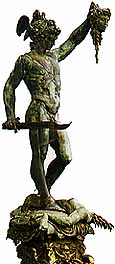
Look at that poster: it’s the reason I went to see this. The trailer didn’t seem all that inspiring, and all the other posters were hackwork at best, but that one seemed promising. A screaming man holding up the severed head of Medusa: well, that suggested rip-roaring action, a bit of horror, and plenty of fun with Greek mythology. Alas, there’s a reason that poster is so good: the image is ripped off from Benvenuto Cellini’s sculpture Perseus
with the Head of Medusa (1554). Left to their own devices, it would appear the advertisers couldn’t come up with anything half as good.
The rest of
Clash of the Titans is just as tired – it’s a remake, after all. As in 1981, the story follows Perseus (Sam Worthington, starring in the third action blockbuster within a year after
Terminator Salvation and
Avatar), a son of Zeus (Liam Neeson, wearing obvious eye-shadow and a lot of tinfoil). When the city-state of Argos, ruled by King Kepheus (Vincent Regan, who’s apparently the go-to guy to play ancient Greeks – witness
Troy and
300) decides to rebel against the Olympians, Hades (Ralph Fiennes in full Voldemort mode) sets the Argives an ultimatum: within ten days, they must sacrifice Princess Andromeda (Alexa Davalos), or the Kraken (evidently on loan from Norway and played by quite a lot of CGI) will be unleashed on them. Not if Perseus has anything to do with it, though: the demigod decides to save Andromeda and sets out on a journey to find a way to defeat the Kraken. He and his plucky band of companions, including gruff Draco (Mads Mikkelsen) and the mysterious Io (Gemma Arterton) encounter an enormous number of people/creatures, including giant scorpions, Djinns (yes, really), Charon, and Medusa (who,
pace the film, is not a Titan) before the time comes to face the Kraken. It’s really a series of quests, like playing Dungeons & Dragons, held together by the flimsiest of plots.
The production design is thoroughly goofy. Witness Mads Mikkelsen and Liam Cunningham with braided hair; behold Liam Neeson wearing… that; marvel at Sam Worthington’s possibly not historically accurate crew-cut; cower in awe at the abundant over-acting across the board. But this silliness clashes most violently with the intended tone of the movie, which is thoroughly serious. ‘Perseus must succeed in his quest to destroy the Kraken!
They’re going to kill that poor woman! Run, lest
Laser Zeus wipe us off the face of the earth!’ The film’s attempts at comic relief, meanwhile, feel stale and contrived. It’s evident the actors didn’t know what to make of the material. Liam Neeson and Ralph Fiennes overact like there’s no tomorrow, but Neeson looks miserable, as if his calculation of being paid
and getting to shout, “Release the Kraken!” turned seriously sour. Sam Worthington’s acting, of course, consists mostly of scowls, although I must admit I’m starting to like him (but perhaps it’s just over-exposure). Some, like Alexa Davalos and Mads Mikkelsen, are game but ought to have got more screen-time (one of my favourite lines is Mikkelsen’s: asked why he never smiles, he answers that ‘When I spit in the eyes of the gods, then I’ll smile’.) The highlight of the film is Gemma Arterton, who is not merely stunningly beautiful in an ethereal, pre-Raphaelite way, but also creates a fascinating character that’s far above the material.
Leterrier is obviously aiming for a fun, but serious blockbuster rather than high camp, but can't achieve either.
Clash of the Titans ought to have created an immersive world. For suspension of disbelief to work, a film must be not realistic but plausible. It isn’t: it never once succeeds in convincing us that it takes place in a real world. All its locations betray their nature: they’re movie sets, and nought else. Nor does Louis Leterrier care one wit for the geography of his imaginary world. The director has apparently not the slightest sense of space: we are never sure where any part of the world is in relation to the rest, and this profoundly undermines the epic journey. Sometimes the geography goes from confused to simply
wrong: in one scene, for instance, our heroes are in a lush forest, then run for a few hundred yards and end up in a barren rock desert. If the filmmakers cannot treat their setting seriously, then why should we?
Few of the film’s sequences really work. This is mostly because there is no proper build-up - the heroes simply encounter a monster at some point, but we have not been prepared to be awed by it. This is most egregious in the case of the Kraken, where anticipation would have been useful, but it also ruins the party's encounter with the Stygian witches, who, having no eyes themselves carry around an eyeball to see (something done to far more terrifying effect in
Pan’s Labyrinth). The one fight in which the film does use build-up properly unfortunately ends up working against it anyway. This is the battle against Medusa, which I had looked forward to, and Leterrier nicely builds the tension before the encounter. But the fight in the Gorgon’s temple is a dreadful let-down because Leterrier fails to build a good stalking sequence (compare
Clash of the Titans’ lame foray into the lair of a lurking beast with, for instance,
Alien and its sequel). Medusa’s lair is too well-lit, no good use is made of the possibilities afforded by surround sound, and the monster is visible too often. The makers should have gone for horror here.
There’s another problem with having too much light: it exposes the poor quality of the special effects. Medusa is a particularly unconvincing CGI creature, and she is not helped by the fact that Hollywood has evidently still not figured out how to make petrification frightening. Generally, the creature design should have abided by the principle that less is more. There is a certain archetypal simplicity to the creatures of Greek myth. Everyone can imagine what a woman with snakes for hair might look like (dreadful, that is). Similarly, I would have preferred for Charon to simply be a human-looking ferryman (albeit particularly unkempt, as myth would have it) with an ordinary boat; the over-the-top design actually represents wasted opportunities galore. On the better side, the Kraken looks good; my favourite effect is the Pegasus, which, I expect, is helped by mostly being a real horse.
Speaking of visuals: in contrast to some reviewers I did not find the 3D irritating or even nauseating, but profoundly unnecessary. Since
Clash of the Titans was filmed in 2D, the three-dimensional effects by the grace of post-production simply don't add anything. The film’s colour palette is too dark and drab to work well in 3D (compare this to the lush, bright
Avatar). Worse, Leterrier’s work isn't truly three-dimensional: it’s actually layered 2D. Imagine cardboard cut-outs moving in front of a canvas, and you get a pretty good idea of what the characters look like.
Clash of the Titans belongs in the tradition of the new wave of sword-and-sandal films following in the wake of
Gladiator (2000). Traditional movies about the ancient world were made in the spirit of a sanctifying classicism that insisted that Greco-Roman antiquity was the Birthplace of Civilisation, Democracy, Philosophy and many other concepts worthy of capitalisation (and in consequence this classicism censored all that was illicit, erotic and transgressive). Symbolised by white-washed marble statues and bearded scholars, this mindset created films like the sedate
The 300 Spartans (1962). This changed in the new millennium, when ancient carnage became marked by extreme violence and suffused with the ultra-machismo most radically expressed in
300 (2007), a hyper-kinetic retelling of the Battle of Thermopylae with a pounding techno sountrack. If
300 was effectively fascist art, it was also an uncomfortable reminder of the real nature of ancient Greek warfare, the warrior ethos, and the brutal ideology that subjected ‘barbarians’.
Clash of the Titans follows this tradition (before they enter Medusa’s lair, Perseus reminds his men: ‘Don’t look this bitch in the eye’), but it is ultimately too timid to go all the way. It might have been a better film if it had: dark and violent can work quite well (indeed it arguably does in
300), and almost in spite of myself I would have welcomed more gore, especially in the battle with Medusa, instead of the squeaky-clean kiddie fare Leterrier offers. For, while it offers intermittent thrills,
Clash of the Titans can never quite decide what it wants to be - which leaves it a regrettable failure.


