Showing posts with label empire. Show all posts

Sunday, 21 April 2013

To serve and give his life as a ransom for many

By 1964 the historical epic was on its way out. In the United States Cleopatra, doomed by its stupendous cost and the scandal surrounding its leads, had hastened the demise of the genre. In Italy pepla could always be cheaply made, but audiences were beginning to desert sword-and-sandal adventures in favour of the new kids on the block, the giallo and the spaghetti western. With the ancient epic as a whole went the colossal Bible adaptations of the fifties and early sixties, like The Ten Commandments (1956) and King of Kings (1961).

Curiously, though, the dying years of the biblical epic were in fact well suited to serious public explorations of religion. The papacy of John XXIII, culminating in the Second Vatican Council, marked an opening of the Catholic Church towards the world, a qualified departure from its previous defensive stance vis-à-vis modernity and possibly an ecclesiological revolution. As part of that, the Church became more willing to engage art produced by non-Catholics.

The non-Catholic that interests us here is Pier Paolo Pasolini, Italian novelist, director, poet, intellectual and pretty much every other cultural profession under the sun. An open atheist and communist, Pasolini was also followed by (well-founded) rumours of homosexuality in the tabloid press. He was, in short, precisely the sort of person the Syllabus of Errors of a more combative papacy was directed against. And yet Pasolini's The Gospel According to St. Matthew (Il vangelo secondo Matteo) - dedicated to the memory of John XXIII - is a stunning success, a far more interesting religious work than the often musty epics Hollywood had churned out. Armed with an unimpressive budget, Pasolini succeeds in making the most ubiquitous story in Western culture strange again.

He does this, first, by adapting only the Gospel of Matthew, shunning the usual approach of harmonising the gospels or filling in gaps in one with bits from the other. That approach often leads to ridiculousness in adaptation (witness talkative crucified Jesus in The Passion of the Christ) as well as cognitive dissonance, since we're taught not to realise that Matthew and Luke tell different and incompatible nativity stories. By sticking solely to Matthew, the film does not feature the birth of John the Baptist, the census and journey to Bethlehem (like Matthew's gospel, Pasolini implies Joseph and Mary are from Bethlehem), the birth of Jesus in a stable, the shepherds - and that's the nativity alone; later, we're not given the 'I am' statements, the woman caught in adultery, the wedding at Cana, Jesus and Zacchaeus, the parable of the Good Samaritan, doubting Thomas, and so on. By missing all these familiar elements, the narrative feels startling and strange; we see its shape, but it is not the shape of the gospel we think we know.


Instead, Pasolini - faithful to Matthew, I think - presents the story mostly as an escalating conflict between Jesus and the Jewish civil and religious authorities. He emphasises Herod's massacre of the innocent at Bethlehem, repeatedly stressing the violence of the authorities. We see Jesus react tearfully to the murder of John the Baptist, but determined to continue his mission. Under pressure in Jerusalem, he retreats into the company of the Twelve, with whom he eats a final supper at a safe house before being betrayed, arrested and executed, and rising again on Sunday.

At the heart of Pasolini's gospel story is Jesus (and, before him, John the Baptist) challenging the institutions and representatives of Israel to accept him as Messiah. Rejected, he begins forming an alternative Israel consisting of the poor, the disreputable and the sick - an upside-down kingdom that pointedly confronts the authorities. The victory of established Israel - capturing, convicting and executing Jesus - proves an illusion, as he rises and commissions his followers to extend his kingdom to the whole earth. Because the old Israel rejected Jesus, it has now been rejected by God.

That storyline, of course, is why Matthew's gospel is often accused of antisemitism - a charge that seems basically accurate, although anti-Jewish rhetoric from a precarious first-century Messianic sect is undoubtedly different from the modern-day scourge. Pasolini avoids that problem by de-contextualising Matthew's Jesus-against-the-Jews story through the deliberate use of anachronism. Herod's soldiers are dressed like medieval warriors and Spanish conquistadors, and the film uses the Romanesque and Gothic churches of Basilicata and Apulia for sets. The soundtrack features well-known pieces of religious music from Händel to Blind Willie Johnson's "Dark Was the Night". By mixing symbols from two thousand years of Christian history, Pasolini's film is at once about first-century Palestine and the hope of a whole crushed humanity in Jesus. First-century events are thus imbued with an eschatological dimension.

At the same time, Pasolini undercuts folk orthodoxy at several points. Salome, whose dance before Herod II leads to the execution of John the Baptist, is portrayed as a nervous teenage girl under the thrall of her mother, not the lascivious temptress of tradition. Jesus, meanwhile, is not the serenely smiling figure of religious art; Spanish student Enrique Irazoqui portrays him as angry, driven, and ultimately inscrutable. The other actors, local amateurs all, predictably give flat, affectless performances - which, given Pasolini's copious use of the Brechtian Verfremdungseffekt, is as it should be.

The Gospel According to St. Matthew is not the plain Marxist allegory Pasolini was expected to produce. Pasolini's Jesus is, instead, the Christ of liberation theology: in his ministry God's kingdom - inaugurated by his death at empire's hands - and the embrace of the oppressed are inextricably bound up. The audience, though, is not put in a comfortable position of solidarity. Pasolini films the trial of Jesus over the shoulders of the jeering crowd, implicating the viewer in the rejection of Jesus. His Jesus is not reducible to a single lesson or pat truth. The suffering of mankind bound up in him, he remains mysterious - but endlessly fascinating.

Sunday, 13 January 2013

Surviving empire's wars

Poster at coproductionoffice.eu.
Reviews of Rome, Open City (Roma, città aperta) tend to start with the circumstances of the film's creation. I won't break with that tradition, for rarely is a film so clearly and intentionally a reflection of its own making. Roberto Rosselini experienced the fear, frustration and desperate hope of life in Rome before liberation himself. For that reason the film, shot while the frontline was just a few hundred kilometres north of Rome and released in 1945 some fifteen months after the Allied capture of the city, provides a startlingly immediate look at life under Nazi occupation.

Conceived by Rossellini with co-writers Federico Fellini and Sergio Amidei during the months of occupation in 1944, Rome, Open City is a feature-length amalgamation of what was originally to be two documentaries: one on Roman children sabotaging the German forces, another on a Catholic priest executed for aiding the resistance. The seams definitely show: it is, indeed, a bit of a rickety creation, plagued by uncertain financing and the lack of decent working studios, processing facilities or, well, anything.

Against the odds, though, Rome, Open City emerged as a work of genius, and the first great success of Italian neo-realism: though 'success' means foreign critics, really, as Italian audiences were not particularly receptive to a recreation of horrors they had experienced barely a year previously. Which I get: if you're struggling every day to find enough food and fuel to keep you going, a film that opens and ends on a tracking shot of your wartorn capital probably won't be your idea of escapist entertainment.

In the winter of 1943-44, resistance officer Giorgio Manfredi (Marcello Pagliero) narrowly escapes capture by the Gestapo and goes to hide out at the flat of his friend Francesco (Francesco Grandjacquet), a communist engaged to a widow, Pina (Anna Magnani), who is first seen orchestrating the looting of a bakery. Meanwhile the parish priest, Don Pietro Pellegrini (Aldo Fabrizi), works for the resistance by passing messages and money. But the local Gestapo commander, SS Sturmbannführer Bergmann (Harry Feist), is on their trail with the help of his Fascist counterpart, the police president of Rome (Carlo Sindici).

Now, about those seams: the script's looseness is generally a strength, but at times plot holes open. It's certainly the case that a band of Don Pietro's students, led by Pina's son Marcello and his friend Romoletto (I've not been able to ascertain the actors' names, so please do comment if you know them), are in there somewhere committing acts of petty sabotage against the Germans. But Romoletto's outsized heroism is shown as foolish in a scene in which Don Pietro has to take a makeshift bomb from him, and the boys disappear from the film at the half-way mark only to reappear right at the end. It is quite generally a film in which characters seem to appear and drop off the face of the earth with little rhyme or reason: Francesco, too, vanishes at a certain point, after which the focus narrows to Don Pietro, Manfredi, and their Axis pursuers.

What's more, Rome, Open City was shot silent, presumably for lack of sound stages, and sound dubbed in later. This is effective, with the possible exception only of some of the voice acting. Praise where it is due, though: many of the actors dubbing the Germans' lines are clearly native speakers (Joop van Hulzen speaks perfect German, like most Dutchmen seem to), and the German dialogue is generally not only flawless but pleasingly idiomatic (if you can bear the horrid military-inflected jargon the Nazis created, that is). There's one glaring exception, though: for unless Austrian-born Harry Feist grew up in some seriously weird linguistic enclave, his dialogue was overdubbed by a non-native speaker - who, to add insult to injury, was asked to intone minor errors like intransitive 'fortzusetzen' ('fortzufahren' would be correct). Ah, but I'm nitpicking.

Despite being largely a chamber piece, Rome, Open City contains impressive shots: one, of Pina running after a German truck, is rightly famous. Even so, the look of the film is - well, not slapdash, but it certainly looks like several kinds of film stock were used, that being pretty low on everyone's list of priorities at the time. Surprisingly, though, most of the variety in the film's aesthetic (which one imagines caused cinematographer Ubaldo Arata no shortness of headache) is caused not by stock but by inconsistent and difficult post-processing. Suffice it to say that more than once in the course of 102 minutes, it suddenly feels like we've stepped into a different film.

Those open seams might be considered flaws, but their effect is the opposite: they make the film feel fresh, startling and immediate even after decades. And that certainly contributes to the feeling of realism - which should not be misunderstood: much of Rome, Open City is thoroughly melodramatic, full of fiendish stereotypical villains (dancers sleeping with German officers for money and comforts, evil lesbians, camp SS commanders) and pure-hearted heroes (a hard-working widow, a fussy yet selfless priest). But there is as much surprising nuance as there is cliché: the atheist who prefers being married by a priest to having to step in front of Fascist officials, say, or the timid Austrian deserter (Ákos Tolnay).

More importantly, though, the realism of Rome, Open City lies in its unvarnished examination of a people under occupation. Not without humour, of course: I've come to accept that, in the same way every Bollywood film seems to have song-and-dance numbers irrespective of the subject matter, every Italian film of the first three post-war decades will contain silly humour, although what is offered here is grimmer than usual (Bergmann's conversations being disturbed by the screams of tortured men, for example). Realism, I said: Rossellini deals frankly with hunger and ration books, as well as controversial social issues like pregnancy outside wedlock, which British films like Saturday Night and Sunday Morning would not get around to doing for another fifteen years - contemporary social dramas like The Stars Look Down (1940) still have considerably stuffier morals.

Above all, though, the film tastes of fear: fear of speaking over the phone lest the secret police listen in, fear of being caught outside after curfew. And, everpresent, fear of being dragged out and roughly handled when the occupier chooses to raid your house. I'd say I don't want to preach at y'all, but that's precisely what I'm going to do: the picture Rossellini paints of life under foreign occupation is startlingly similar to the war in Iraq, complete with civilians murdered during house raids. The German regime in Italy is portrayed not so much as fascist as simply technocratic: it serves no end except to perpetuate itself. And barely even that: for as Bergmann cheerfully acknowledges, the Nazis will have to withdraw from Rome sooner or later.

Not that, in foregrounding counter-insurgency, Rossellini neglects the role Italian Fascist collaborators play in enabling Nazi rule. Indeed, the film appears downright prescient when Bergmann prophesies trouble after an Allied victory: for considering the 1948 election, the Years of Lead and Operation Gladio, what European country besides Greece had such a fractious, violent postwar history as Italy? When challenged as to why he's working with atheists, Don Pietro says: 'I believe that anyone who fights for justice and freedom walks in the ways of the Lord.' For a film so invested in the grubby details of ordinary life, Rome, Open City relies on religious imagery to an extraordinary degree. Unless, perhaps, the greatest sacred value lies in thoroughly earthly acts of earthly kindness. That is at the heart of Don Pietro's character - and at the centre of the film.

Wednesday, 18 July 2012

The patriarchal imagination of Doug Wilson


Trigger warning: this post discusses rape, slavery and genocide apologia.

Last night over at The Gospel Coalition, Jared Wilson posted an excerpt from Doug Wilson's Fidelity: What It Means To Be A One-Woman Man. 'Outrage' is often used to describe the sort of reaction the post provoked, but 'hurt' is just as apt. The Wilsons wounded their brothers and sisters, and when people expressed their hurt they belittled them and told them to 'retake their ESL class'. It's worth quoting that Doug Wilson excerpt in full:
A final aspect of rape that should be briefly mentioned is perhaps closer to home. Because we have forgotten the biblical concepts of true authority and submission, or more accurately, have rebelled against them, we have created a climate in which caricatures of authority and submission intrude upon our lives with violence.
When we quarrel with the way the world is, we find that the world has ways of getting back at us. In other words, however we try, the sexual act cannot be made into an egalitarian pleasuring party. A man penetrates, conquers, colonizes, plants. A woman receives, surrenders, accepts. This is of course offensive to all egalitarians, and so our culture has rebelled against the concept of authority and submission in marriage. This means that we have sought to suppress the concepts of authority and submission as they relate to the marriage bed.
But we cannot make gravity disappear just because we dislike it, and in the same way we find that our banished authority and submission comes back to us in pathological forms. This is what lies behind sexual “bondage and submission games,” along with very common rape fantasies. Men dream of being rapists, and women find themselves wistfully reading novels in which someone ravishes the “soon to be made willing” heroine. Those who deny they have any need for water at all will soon find themselves lusting after polluted water, but water nonetheless.
True authority and true submission are therefore an erotic necessity. When authority is honored according to the word of God it serves and protects — and gives enormous pleasure. When it is denied, the result is not “no authority,” but an authority which devours.
– Douglas Wilson, Fidelity: What it Means to be a One-Woman Man (Moscow, Idaho: Canon Press, 1999), 86-87.
Rachel Held Evans has done a beautiful job of unpacking why this is vile, overt misogyny that does not even bother to hide behind standard complementarian weasel words. J.R. Daniel Kirk, too, gets straight to the point:
[W]hen you sexually conquer someone, this is rape. The connection Wilson draws is too much on target: he has, in fact, described all sex as an act of rape. It is therefore not surprising that he sees such a connection between rape outside of marriage and not finding the sort of satisfaction that he suggests is coming to men in their exploits of power.
Wilson's argument is this: sex ought to consist of men penetrating, planting, conquering and colonising (i.e. rape) and women receiving, surrendering and accepting. When it does not - when it becomes an 'egalitarian pleasuring party' - then men will act out their God-given manhood in unacceptable forms of rape, and women will partake of perverted varieties of sexual submission. This is somewhat at odds with reality, of course. One of the major victories of the women's movement, after all, was the outlawing of marital rape.

The Wilsons' response to their critics is generally not worth the blog space it's written on. They insist that they've been misunderstood, but fail to explain what they mean. They accuse their critics, in the passive-aggressive 'Why do they hate us?' fashion of the faux martyr, of trying to twist their words. Jared, in fact, withdraws to affirming 'marital sex that is mutually submissive' while pretending not to have retreated.* Doug's 'explanation' of his choice of words takes the cake, though:
“Penetrates.” Is anyone maintaining that this is not a feature of intercourse? “Plants.” Is the biblical concept of seed misogynistic? “Conquer.” Her neck is like the tower of David, and her necklace is like a thousand bucklers. “Colonize.” A garden locked is my sister, my bride. C’mon, people, work with me here.
Here we have a response that ignores the existence of non-penetrative sex because it would throw Wilson's argument that sex is necessarily about domination into disarray; that attempts to shame critics by wielding the Bible as a sledgehammer; that makes two references to the Song of Songs which significantly distort the actual trajectory of mutual pursuit found in that wonderful erotic poem. And by feigning incomprehension, Wilson continues men's long and ignoble history of insisting that women who criticise them are irrational or 'emotional'.

It's not just women, however, that Wilson thinks are uppity. In the video at the top of this post, Wilson identifies with the values of the Confederacy, such as states' rights - as if those were more than an expedient to prevent the federal government from interfering with slavery; and he holds that slavery should have been abolished by parliamentary processes rather than war - as it might well have been had the Southern states not seceded and attacked the North precisely to preclude that possibility. Wilson reveals a blindness to really existing institutions of power and privilege, be they patriarchy or slavery, that is born of being a white Christian man and not listening to people who aren't.

What connects Wilson's neo-Confederate tendencies to his rabid pro-patriarchalism isn't just his evident desire to return to the good ol' days of c. 1850. As Grace at Are Women Human? points out, Wilson's apologia for both rape and slavery is linked by his vision of a society in which white men benevolently rule over everyone else. White male domination is thus at the heart of Wilson's belief system. This is not, I hardly need to stress, an orthodox view of Christianity - although some people who think like Wilson use the cross too, usually by setting it on fire.

Wilson's choice of words - penetration, planting, conquest, colonisation - is the naked language of imperialism. He projects the seizure of physical space from indigenous people onto female bodies. Here as there, violence is glorified as the expression of true manliness and justified by 'planting', which has excused occupation and genocide from the Americas to the West Bank. By casting women as a dark continent that must be subdued and made to flourish by white Christian men, Wilson doesn't just other women: he reveals his fear of them. If left unconquered, uncolonised and unpenetrated, they might run amok and threaten his privilege.

It works the other way round, too, for 'penetration' is a metaphor drawn from patriarchal sex that imperialism projects onto the places it wishes to consume and the people who live there. That actual, physical rape occurs in this context is hardly surprising. The language of 'penetration' that robs women of agency and humanity does the job just as well when dusted off and applied to indigenous people and their lands. In gendering to-be-conquered people feminine, imperialist discourse reveals its roots in patriarchal society.

This has, I fear, been something of a long, rambling post. It has not been temperate. It's hugely encouraging to see how many Christians have stood up to Wilson's rape fantasies. We can be confident, I think, that increasingly those who grant the views of Wilson and his ilk shelter - those like The Gospel Coalition - aren't just wrong. They're also in the minority.

*Jared Wilson mostly quoted Doug Wilson approvingly without adding much, and now he is out of this saga.

Saturday, 30 June 2012

Jesus was a colonised person


In 'Song of the Magi', Anaïs Mitchell links Jesus' Bethlehem to today's West Bank town:
...a child is born
born in Bethlehem
born in a cattle pen
a child is born on the killing floor...
welcome home, my child
your home is a checkpoint now
your home is a border town
welcome to the brawl
life ain't fair, my child
put your hands in the air, my child
slowly now, single file, now
up against the wall
Jesus was a colonised person living under Roman occupation in first-century Palestine. Imperial rule shaped Jewish society. Tax collectors were ostracised as collaborators, revival preachers proclaimed the coming kingdom of heaven,  and zealots organised armed resistance. Occupation loomed large over Jesus' ministry too, from the discussion on paying taxes to the Romans to the expectation that Jesus would overthrow the occupiers by force and install himself as Israel's anointed king. Instead, he triumphed over Caesar by quietly submitting to the most gruesome public death the Empire could devise.

That matters.

Jesus came to lift up the poor, the hungry, the broken-hearted and the despised. He ushered in an upside-down kingdom in which the last was to be first. In his body he experienced the brutality and violence of Empire. His promise to oppressed, beaten, frightened, occupied people everywhere - a pledge whispered but never drowned out by Empire's heavy boots - is that things will not always be this way.
... wear we now our warmest coats
wear we now our walking shoes
open wide the gates of hope
and let us through
There was little love lost between Jesus and the wielders of power, especially if they used God's name to justify their violence. That hasn't changed in two thousand years.

It means that, far from propping up the empires supposedly built on 'Judaeo-Christian foundations', Jesus is with their victims, whispering with them sweet songs of freedom.

Saturday, 31 December 2011

Class and class struggle in early Rome


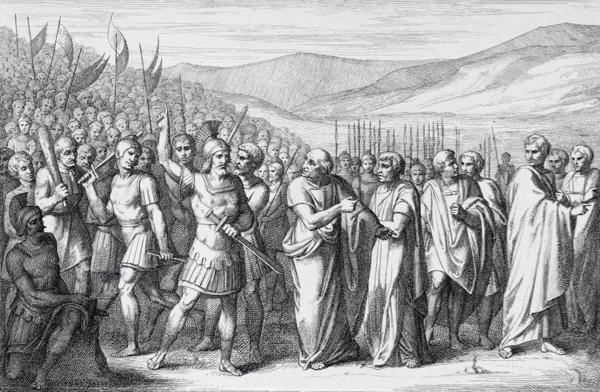
Despite its grandiose title, this post - long delayed by being away from my copy of Livy's Ab urbe condita - does not offer an outline of class struggle in the early Roman Republic as a whole. It is intended, instead, to provide a brief introduction to how Livy frames conflict between the orders. (This is based on The Early History of Rome, the Penguin translation of the first five books of Ab urbe condita, which ends with the sack of Rome by the Gauls.)

The early Republic was a Beutegemeinschaft, a society based on capturing and distributing loot through annual warfare. Success in war kept the gold flowing and was thus integral to the survival of the state, which exported its tensions. For this, the patricians - Rome's ancient aristocracy, the political and religious elite - required the consent of the far larger plebeian class, who did most of the fighting.

This was exploited by the plebeians in the first secessio plebis in 494 BC - a general strike in which the plebeians, rather than respond to military summons, left the city, gathered on the Mons Sacer and threatened to found a new town. Grievances included disadvantages in the allocation of land in colonies, armed Roman settlements built to subdue captured enemy territory, and the patricians' exclusive privileges. The patricians made significant concessions, including the institution of plebeian tribunes, representatives of the plebs who could influence the legislative process. The ongoing tug-of-war between the tribunes and the Senate occupies much of Livy's account.

Most of what we learnt in school, though, was about Rome's foreign wars, not her internal struggles. This is hardly surprising, since the conflict of the orders offers none of the dramatic bloodletting of Porsena's siege of Rome or the wars against Veii; but in truth the social conflict, mostly confined to forums and laws though it is, provides thrills aplenty. It also has the advantage of being less overgrown with fictions and the rigid narrative framework all accounts of foreign wars had to follow.

Livy includes a beautiful vignette that encapsulates the patricians' fears at the opening of his fourth book. Faced with the prospect of a bill brought by the plebeians that would legalise intermarriage between the orders - an unthinkable travesty to the aristocracy - the consuls M. Genucius and C. Curtius respond (4.1):
In all communities the qualities or tendencies which carry the highest reward are bound to be most in evidence and to be most industriously cultivated - indeed it is precisely that which produces good statesmen and good soldiers; unhappily here in Rome the greatest rewards come from political upheavals and revolt against the government, which have always, in consequence, won applause from all and sundry. Only recall the aura of majesty which surrounded the Senate in our father's day, and then think what it will be like when we bequeath it to our children! Think how the labouring class will be able to brag of the increase in its power and influence! There can never be an end to this unhappy process so long as the promoters of sedition against the government are honoured in proportion to their success. Do you realise, gentlemen, the appalling consequences of what Canuleius is trying to do? If he succeeds, bent, as he is, upon leaving nothing in its original soundness and purity, he will contaminate the blood of the ancient and noble families and make chaos of the hereditary patrician privilege od 'taking the auspices' to determine, in the public or private interest, what Heaven may will - and with what result? that, when all distinctions are obliterated, no one will know who he is or where he came from! Mixed marriages forsooth! What do they mean but that men and women from all ranks of society will be permitted to start copulating like animals? A child of such intercourse will never know what blood runs in his veins or what form of worship he is entitled to practise; he will be nothing - or six of one and half a dozen of the other, a very monster!
We're not supposed to like these consuls (whose speech, of course, is fabricated wholecloth by Livy). The points made, though, are familiar: the belief that rampant disobedience to authority is crippling the commonwealth, as the Tories affirm; the notion that society, politically correct as it is, rewards the lazy and insubordinate; and lastly, a fear of what, in a different day and age, the Americans called miscegenation, which will lead to human beings becoming as beasts. There's nothing more heartening than reading millennia-old rants warning of the imminent collapse of human civilisation - it puts the Daily Heil in perspective.

We might call Livy's stance on all this broadly call patriotic: he firmly disapproves of internal strife that weakens Rome against her enemies. To this end, he demands justice for the plebeians and repeatedly censures the more arrogant of the patricians: but he also wishes the plebeians would cease to cause trouble. That Livy's narrative should be dominated by his desire for internal peace is hardly surprising. He was writing towards the end of the first century BC, when the period of vicious and hugely destructive civil wars - still within living memory - had ended with the dominance of Augustus, who is praised for restoring concord (even as Livy holds modern morals to be depraved).

Even as the plebeians fought for increased rights, they nonetheless had a stake in Roman society. In consequence they should not be reckoned the wretched of the earth but, perhaps, something of a labour aristocracy, set above the landless and the unfree. 'We propose that a man of the people may have the right to be elected to the consulship', argued Canuleius (4.1): 'Is that the same as saying some rogue who was, or is, a slave?'Social stratification eventually lead to the absorption of the richer plebeians into a broader Roman aristocracy, the nobilitas. It wasn't until the Social Wars and the slave risings of the first century BC that the dispossessed again threatened the integrity of Roman class society.

Friday, 30 December 2011

Where do oppressors go when they die?


Me in Ceasefire, on Christianity and social justice:
As a result of historic defeats the language of the Left is often focused on outcomes, 'equality' and 'social justice' The Bible, on the other hand, is more forthright: it talks of freedom, loosing the yoke, setting the prisoners free. Its vision of another world is not one that is more equal, but one in which the Downpresser Man has been vanquished, and revolutionary discourses heavily influenced by the Bible – reggae, for example – reflect this...

If he is 'the least of these', then Jesus is a Palestinian woman giving birth at a checkpoint in the West Bank, a fourteen-year-old jailed for rioting in Tottenham, a peasant starving in Somalia, a factory worker losing her home to foreclosure in Michigan, an Iraqi street orphan, a black man on death row in Texas, a raped woman who’s told she 'wanted it', a Foxconn employee who kills himself out of despair in China.
He is all the people we have been told to fear and despise, the whole suffering mass of humanity, the wretched of the earth. It’s not Christian to defend mansions and missiles just so long as the government will keep gay marriage illegal. Christian life is to unmask the discourses of power and to end oppression. The promise of Christmas is that injustice will not last forever.

Monday, 12 September 2011

I, for one, welcome our Tory overlords


Lord Mandelson famously said that Labour was relaxed about people 'getting filthy rich'. Ed Miliband went further, declaring that 'I'm not just relaxed about you getting rich, I applaud you' and excising that nasty world 'filthy'. That's all very well, but there's one problem: it doesn't go far enough. So here's my humble attempt at an ode that does justice to the glory of the rich.

Miliband praised those who 'generate wealth [and] create jobs'. Indeed. Where would we be without the rich? How would we procure the basic necessities of life? I daresay there would be no wealth, no food, no resources: I fear we should starve to death. Society would fall into ruins. Anarchy would reign. Think of Africa, for example. As the admired British historian Hugh Trevor-Roper put it, Africa had no history, only 'the unedifying gyrations of barbarous tribes in picturesque but irrelevant corners of the globe'. It was the rich that brought Africa into world history and sacrificed much to civilise the natives. But did they show proper gratitude? Far from it. It is no wonder Africa has fallen back into barbarity.

For delivering us from this fate we owe a debt of gratitude to the wealthy. They labour day and night doing God's work, and that for very little reward: for what are the baubles the rich are content with compared to the dignity of spirit, that inner light possessed by the poor? What's more, when they have worked hard as entrepreneurs, many go on to sacrifice their twilight years selflessly serving the community as politicians and lobbyists, while the rest of us enjoy our gold-plated pensions.

But that's not all. The Good Book says that the meek will inherit the earth, that a man may lose his soul yet gain the whole world, and that it is easier for a camel to go through the eye of a needle than for a rich man to enter the kingdom of God. That means that the rich are freely forfeiting their salvation and giving up their place in the Kingdom for you, willing that none that believe in them should perish but have flat screen TVs. Greater love hath no-one than this, that he lay down his life for his friends.

 Yes, it's true. Our Tory overlords love us. David Cameron loves you. George Osborne loves you. Nick Clegg loves you most of all, and his heart bleeds when he sees you weary and heavy laden under national debt. That's why they're removing benefits: they love you too much to let you waste your life watching daytime television. We have relied on their generosity too much, and their cross has become too heavy to bear. The financial crisis is nothing but the wealthy stumbling under the weight of their work for us. They only ask that we help them a little, take some of their heavy load, as Simon of Cyrene did for Our Lord. Is that too much to ask?

Think about this the next time you wrongfully covet the goods of the rich. David Cameron was raised for this moment. Since childhood he was prepared to see his life poured out for us. When you grumble, when you kick against the pricks, you are only hurting yourself. Not for me wanton rebellion and lawlessness. I love our government.

Thursday, 14 July 2011

Love is best

In one year they sent a million fighters forth
           South and North,
And they built their gods a brazen pillar high
           As the sky,
Yet reserved a thousand chariots in full force -
           Gold, of course.
Oh heart! oh blood that freezes, blood that burns!
           Earth's returns
For whole centuries of folly, noise and sin!
           Shut them in,
With their triumphs and their glories and the rest!
           Love is best.
-Robert Browning, 'Love Among the Ruins'