If Google Trends is any indication, abortion as a hot-button issue is in decline in America. Searches still cluster faithfully around presidential elections, but each peak is less impressive than the one before it. 'Pro-life' and 'pro-choice' have suffered similar and closely aligned, albeit steadier declines. Despite the best effort of Republican lawmakers and Catholic bishops, attempts to curb reproductive rights have largely been defeated, and much like the larger Christian Right electoral coalition the pro-life movement seems unlikely to regain its place as a decisive force in American politics.
That may explain the tone of last year's October Baby, which - despite containing all the easy moralising, emotional appeals and casual misogyny that have caused even dedicated pro-lifers to turn their back on the movement - feels unexpectedly gentle, even elegiac. Unapologetically pandering to people who already agree with it, October Baby is not so much aimed at converting anyone to the cause as it is about patting activists on the back and telling them they had a good run.
After collapsing during a college play, Hannah (Rachel Hendrix) finds out why she has been sickly since infancy: she is the survivor of a failed abortion. Against the objections of her adoptive father (John Schneider), she joins her only friend and secret crush Jason (Jason Burkey) on a road trip to Mobile, Alabama, where she hopes to pick up the trail of her birth mother. With the help of a number of people who take pity on her, including not one but two police officers (Robert Amaya and Tracy Miller) and a nurse (Jasmine Guy), Hannah is finally able to find her mother and learn lessons about forgiveness, redemption and living life to the full.
In case that made it sound all right, let me state in no uncertain terms that October Baby is a bad film. It suffers first and foremost from a totally pedestrian script whose beats land all exactly where you expect them. The actors aren't particularly inspired by it, but they turn in reasonably effective performances: the real actors (John Schneider and Jasmine Guy) more so than others, but even the supporting actors essentially earn their keep, if no more. Hendrix, the nominal star, is the wobbliest of them all, genuinely nailing some of her scenes but flubbing lines in other places. She is, anyway, rather likeable, generally affecting and does not seem dead inside, which is pretty much all you can ask for in this sort of project.
That's the narrative, anyway: but o sweet Lord, the sheer artlessness of the thing! The mostly functional editing just falls apart in a few places, cutting off lines and introducing continuity errors; and the blocking is hardly any better, cutting off people's faces and producing entirely information-free frames. Flaws like that crop up only now and again, but from the look of the whole thing there is no escape.
For lo, even though I'm generally on board with the digital revolution in film October Baby offers a masterclass in how not to use the Red One and its cousins. In the hands of director Jon Erwin, acting as his own director of photography (a poor idea for those of us who are not Steven Soderbergh), high-definition video looks really damn awful, as if Erwin had heard of cinematography but wasn't quite sure what the term meant. I know the film's one-size-fits-all sheen and totally flat 'arty' aesthetic because I'm an evangelical Christian and that's what our more expensive videos look like. I'm sorry, everybody.
I may complain, but here it is: I actually kind of enjoyed October Baby. The G-rated teen shenanigans are endearing in a dorky fashion, and I honestly had fun with the budding romance between Hannah and Jason: they don't have any chemistry, I guess, but there's a certain pleasant atmosphere. The guilt-forgiveness-redemption arc several characters go through may be trite, but it can't be denied that October Baby achieves genuine poignancy and emotional release in places. You get the feeling that if the film wasn't totally in thrall to a censorious subculture, it might find something raw and real to say rather than just rattling off pro-life talking points. (Over the credits there is an interview with actress Shari Rigby, who has struggled with guilt over having an abortion. It's really quite moving.)
And yet there is quite a lot that is unpleasant and troubling in October Baby too, especially the treatment of the 'unredeemed' women who must be shown the error of their ways. At no point does the film suggest there's anything wrong with Hannah just showing up unannounced at her birth mother's office to confront her. The film wields forgiveness more as a weapon than a bridge to restoration: it's about vindication and vengeance rather than reconciliation. That's the big one, but the treatment of more marginal women is just as icky: there's Jason's girlfriend Alanna (Colleen Trusler), for example, whose unique personality trait is 'bitch' and who is shoved aside just as soon as possible.
With its unexpected endorsement of ecumenism, though, October Baby is still gentler than than the slew of anti-feminist organisations and Southern Poverty Law Center-certified hate groups endorsing it might indicate. It's not easy to create propaganda that's also good entertainment, and October Baby doesn't make the cut. Instead, it exposes the soullessness of the dying evangelical subculture. It's the cinematic equivalent of the insipid Christian pop-rock crowding the sountrack: slick, earnest and utterly empty.
Showing posts with label conservatism. Show all posts
Wednesday, 26 December 2012
Sunday, 23 December 2012
Some soundbites from the Coalition for Marriage
Having recently come across the homepage of the Coalition for Marriage - a pressure group composed of representatives from conservative Christian institutions - I thought I'd dissect some of their soundbites. 'Soundbites', aye: I'll just tackle the stuff on the front page, the barely connected bits that are intended to sway casual visitors the campaigners' way. I'll take them in turn.
'Marriage is unique'
Throughout history and in virtually all human societies marriage has always been the union of a man and a woman.Unless you count polygamy in all sorts of societies, including the elite of ancient Israel. Or same-sex unions of various kinds. Or concubinage. Or the profound changes marriage underwent in the sixties and seventies, from a system in which (very broadly) a woman was passed from her father's control to her husband's, to one of egalitarian partnership - arguably a more profound revolution than marriage equality. (This is a general problem for advocates of marriage discrimination: if marriage is about partnership not property, patriarchy and legitimate procreation, an essential argument against same-sex marriage falls.) Above all, though, it's an appeal to tradition: lots of institutions (slavery, absolute monarchy, religious intolerance, human sacrifice...) have been traditional without being good.
Marriage reflects the complementary natures of men and women.Guys, you're not doing a great job of hiding the fact that your arguments come from Christian complementarianism, the hot & sexy new version of patriarchy that conservative churchmen cobbled together from the corpse of the old thing back in the seventies. In that view, men and women
Although death and divorce may prevent it, the evidence shows that children do best with a married mother and a father.Sleight of hand, our old friend! Why, of course if you eliminate single parents and precarious family situations from the equation, you'll find that 'children do best with a married mother and father'. But comparing like with like, there is in fact no difference between opposite-sex and same-sex couples.
'No need to redefine'
Civil partnerships already provide all the legal benefits of marriage so there's no need to redefine marriage.The right to be married and recognised as such is a legal benefit of opposite-sex marriage, although UK law is otherwise better than some countries'. But: if civil partnerships are equal to marriage in everything but name, why would anyone still push for marriage? Inventing a separate but equal institution for gay people is unfair and frankly mean-spirited, and viewing their state as somehow not marriage has real consequences. Making sure the separate school for black people is just as nice as that for white people does not remove white supremacy.
It's not discriminatory to support traditional marriage.Another non sequitur, and palpable nonsense too. Declaring that only certain couples should be permitted to marry and others should be excluded is the very nature of discrimination. The C4M's website does nothing but ineffectually make the case for discrimination. If they're scared of being called discriminatory because it sounds nasty, well - doesn't that tell you something?
Same-sex couples may choose to have a civil partnership but no one has the right to redefine marriage for the rest of us.This feeds into the next section and will be dealt with there. For now, I'll refer you to the dire consequences gay marriage will have on your freedom.
'Profound consequences'
If marriage is redefined, those who believe in traditional marriage will be sidelined. People's careers could be harmed, couples seeking to adopt or foster could be excluded, and schools would inevitably have to teach the new definition to children.Yes, indeed: this paragraph is nought but the guilty conscience of folks who realise that they've destroyed gay people's careers, stopped them from adopting and fostering children, and forced them to listen to offensive views. But, like the racist worried about white people becoming a minority, that guilty conscience turns to aggression: we must hold the gays down lest they do to us what we did to them.
If marriage is redefined once, what is to stop it being redefined to allow polygamy?Sorry, but I'm all non-sequitured out.
'Speak up'
People should not feel pressurised [sic] to go along with same-sex marriage just because of political correctness. They should be free to express their views.That doesn't actually mean anything. By 'political correctness', these respectable people mean the consensus that being a bigot is a bad thing. And people are free to express their views. Isn't that why C4M is able to broadcast their vitriol freely, rather than having to smuggle anti-gay tracts into the country in potato crates?
That's that, for now. It's a rancid mess of illogical soundbites indeed: the consequence of taking what is preached from conservative Christian pulpits and picking out all the Bible bits to make it more palatable to a religiously plural audience. Turns out that leaves only the flimsiest of non-arguments.
Let me close with the immortal words of Rev. W.A. Criswell, admittedly on the other side of the pond, on our inalienable right to not have to rub shoulders with gay people:
Don’t force me by law, by statute, by Supreme Court decision... to cross over in those intimate things where I don’t want to go. Let me build my life. Let me have my church. Let me have my school. Let me have my friends. Let me have my home. Let me have my family. And what you give to me, give to every man in America and keep it like our glorious forefathers made it—a land of the free and the home of the brave.Oh, hang on. Turns out he was talking about racial segregation. Oh well.
Tuesday, 14 February 2012
If your neighbour worships twenty gods: a note on biblical law and religious toleration
Christians are used to seeing secular society - whose institutions favour no particular faith - as a dire threat. To John Piper, for example, '[t]he modern secular world... tries to remove God from his all-creating, all- sustaining, all-defining, all-governing place [and] has no choice but to make itself god'. In other words, a secular society is blasphemous by definition. Against this conservative appraisal, I'll suggest secularism is most fruitfully understood not as a menace destroying western civilisation from within, but as a blessing longed for by those who did not enjoy it, made possible by Jesus' death on the cross.
At the same time, I'll argue that the liberal understanding of secularism is ahistorical and impossible to square with biblical evidence. Here, for example, is the excellent blogger Fred Clark, arguing against the US Catholic bishops' attempt to stop contraceptive services for women:
'It does me no injury,' Thomas Jefferson wrote, 'for my neighbour to say there are 20 gods or no God. It neither picks my pocket nor breaks my leg.' The advocates of burka-logic [sic] disagree. They insist that the very presence of such irreligious neighbors does them an injury - the injury of constraining their freedom to live unperturbed by the constant reminder of such blasphemies.This quintessentially liberal argument - my neighbour's religious predilections do me no harm, so I have no business constraining him - cannot survive an encounter with the God of the Old Testament. At Sinai God makes a covenant is with Israel as a community to ensure correct religious observance and moral behaviour in the land (Deuteronomy 1:1-14). The Mosaic Law does not offer any room for religious toleration. Indeed the Israelites are explicitly commanded to destroy all traces of Canaanite paganism if they wish to enjoy the land (Deuteronomy 12:1-4).
Contrary to Jefferson, under Old Testament law my neighbour's heterodox religious observance does pick my pocket and break my leg. The Religious Right's notion of 'individual responsibility' is quite absent in the Bible. God repeatedly threatens to punish people for sins they have not themselves committed, 'visiting the iniquity of the fathers on the children and the children's children, to the third and fourth generation' (Exodus 20:5, Exodus 34:7, Numbers 14:18, Deuteronomy 5:9, and many more). Positively, God considers whole communities more kindly on account of a few righteous people (Genesis 18:22-32, Romans 11:28).
The insistence that Israel is judged as a whole for the actions committed in its midst rather than as individuals is perhaps best encapsulated by Deuteronomy 21:1-9:
If in the land that the LORD your God is giving you to possess someone is found slain, lying in the open country, and it is not known who killed him, then your elders and your judges shall come out, and they shall measure the distance to the surrounding cities. And the elders of the city that is nearest to the slain man shall take a heifer that has never been worked and that has not pulled in a yoke. And the elders of that city shall bring the heifer down to a valley with running water, which is neither ploughed nor sown, and shall break the heifer's neck there in the valley. Then the priests, the sons of Levi, shall come forward... And all the elders of that city nearest to the slain man shall wash their hands over the heifer whose neck was broken in the valley, and they shall testify, 'Our hands did not shed this blood, nor did our eyes see it shed. Accept atonement, o LORD, for your people Israel, whom you have redeemed, and do not set the guilt of innocent blood in the midst of your people Israel, so that their blood guilt be atoned for.' So you shall purge the guilt of innocent blood from your midst, when you do what is right in the sight of the LORD.Here the murderer is unknown and unidentifiable, but the nearest settlement is required to offer a sacrifice in atonement for the sin committed lest it be visited upon their heads. The action, not the acting subject, is the primary term. Nor does the Bible consider the motives of offenders. Distinguishing murder from accidental killings, for example, is an innovation of the ninth century, when earnest scholars attempted to settle matters humanius (more humanely) than the often harsh Church Fathers. (So much, incidentally, for the notion that a concern for human welfare reveals a 'man-centred' world-view.)
We tend to take a modern legal understanding of individual responsibility for granted, but it can seriously distort our reading of the Bible. The concept of bloodguilt - that sin, if unatoned, will return to haunt even those who have not themselves committed it - is accepted by New Testament writers (Luke 11:50-51, Revelation 6:10). Augustine's notion that original sin is passed on through biological parenthood - logically consigning those who die in the womb to damnation - would also be impossible without bloodguilt.
But that isn't the whole story. In the New Testament, God's people are not told to enforce obedience among their nonbelieving neighbours. Indeed the New Testament is marked by disinterest in secular power at best, and outright hostility at worst (Revelation 17:1-6). The death of Jesus at the cross changes everything. From that point onwards, it is not biological descent from Abraham but faith that determines membership in the people of God (Romans 9:30). The ethno-religious boundaries of ancient Israel have been shattered. God's people are now of every nation and tongue, no longer identifiable with individual peoples or states.
Secularism - a society no longer compelled to enforce religious obedience among its subjects, on pain of judgment - is thus made possible by the death of Jesus. When an individual puts her faith in Christ she cannot become his without also becoming part of the people of God; God's covenant is made with his people as a whole. There is no salvation for the individual outside the collective salvation of God's people (which is why I continue to find Calvinism's emphasis on Christ's successful purchase of a definite people compelling). It is because of this ingrafting into the people of God that baptism - a public symbol of membership in God's family - is important. But it no longer coincides with membership in an earthly nation or obedience to a set of temporal laws.
If the potential for secularism was present from Jesus' death onwards, that potential had to remain unrealised in pre-modern societies, which functioned through personal relationships and localised hierarchies sealed and enforced through oaths. Public declarations of political and religious loyalty - which are quite superfluous in modern states - were vital to rulers who lacked the centralised bureaucracy necessary to enforce obedience among their subjects. (For example, a modern state knows who all its subjects are and where they live, something the ancients could not have imagined in their wildest dreams.)
Even the Roman state, often praised for its tolerance, could not solve the problem of religious diversity by becoming secular - atheist as a state - but only by being radically inclusivist, declaring all faiths valid and adding foreign deities to its pantheon. Still, it required that its subjects subordinate their loyalties to the imperial cult, and those who could not comply - Christians, most famously - had to suffer its wrath. Pre-modern societies that did not compel everyone's conversion (the political entities of the Islamic world, for example) nonetheless had to privilege one faith.
It was only with the vastly increased capacity of the state from the French Revolution onwards, and its sweeping aside of motley feudal ties and privileges, that overwhelmingly Christian societies could provide freedom of religion for their subjects without breaking down. Our nonconformist forebears - the very people from whom modern evangelicalism is descended - ardently campaigned and prayed for a secular state that would not exclude them on the basis of religion, and eventually obtained that sweet freedom.
Labels:
antiquity,
Christianity,
conservatism,
early modern age,
evangelicalism,
historical materialism,
Jesus,
liberalism,
the middle ages
Monday, 23 January 2012
Let the little children come unto me
When I was seventeen, I spent three weeks serving as a 'senior camper' at a Christian summer camp. The purpose of Iwerne Holidays was to present the gospel to teenagers from independent schools in a fun environment including sports, excursions, and all sorts of activities. It was just like being a 'camp counselor' across the pond, except we weren't hacked to pieces by machete-wielding madmen.*
It was, however, nothing at all like Jesus Camp. Therein lies much of what makes the film so fascinating and irritating.
Jesus Camp, released in 2006, is an artifact of the culture wars of the 2000s, that appalling time in history when 'religion' (whatever that means) was at the forefront of public debate in the Anglo-Saxon world. The days of Richard Dawkins, Christopher Hitchens, James Dobson and Pat Robertson, all of them thankfully increasingly irrelevant in an age where culture war has dissolved into the naked class struggle whose halo it was from the beginning.
Anyway! The film follows evangelical culture around a Pentecostal children's camp called 'Kids on Fire' in North Dakota. There, pastor Becky Fischer 'equips' children to be 'warriors for Christ' to 'take America back' by evangelism as well as fighting abortion and other forms of ungodliness in the public sphere. Directors Heidi Ewing and Rachel Grady focus on three of the children: twelve-year-old Levi, homeschooled by his mother, who teaches him that evolution is a hoax; nine-year-old Rachael, who regularly engages in evangelism towards strangers; and ten-year-old Tory, who breakdances to Christian metal.
At Kids on Fire, these and other children are taught to be wary because 'the devil goes after the young' and to distrust secular entertainment ('Had it been in the Old Testament, Harry Potter would've been put to death!'). Among themselves, the children discuss their feelings about films and books, revealing their struggles with what they're being taught. In a service that can in good conscience only be described as mass hysteria, the children break down weeping and pledge to end abortion by political activism and asking God for 'righteous judges'.
We meet Levi again at New Life Church in Colorado Springs. In an interview, Pastor Ted Haggard expresses his delight at evangelical Christians forming a decisive voting bloc against homosexuality, abortion and the teaching of evolution. This scene, of course, now has a potency the filmmakers couldn't be aware of at the time: just a few months later, Haggard fell from grace when it was revealed he'd indulged in adulterous gay sex and illegal drugs for years.
As you'll have guessed by now, Jesus Camp is a liberal message picture. Despite the lack of a narrator, Ewing and Grady clearly think the formation of a political evangelicalism focused on anti-abortion, anti-homosexual 'family values' is a very bad thing, and I agree with them. Even so, I didn't really need the constant scare music they lather on every scene of Pentecostal worship. The snippets of Mike Papantonio's radio show, in which he criticises the Religious Right, are editorialising I welcome: it's good to see a Christian offer an alternative view to the one pushed by the film's subjects.
Even while Jesus Camp sternly disapproves of its subject matter, it's a respectful, humane film. When Becky Fischer says, offhand, 'I get exhausted doing this' while preparing for another session, it's the rawest, truest moment in the film. While I don't think we learn enough about them (which isn't really excusable, given the film's short running time), the children are never treated as less than full human beings with dreams and ambitions. Levi's worldview may be a mess of cruel lies - if global warming is true, ye are yet in your sins - but we learn to rejoice and mourn with him.
As such, the film's ostensibly simple message constantly rebels against the much more complex response the film actually induces in the viewer - especially if that viewer, like me, is himself an evangelical Christian. Becky Fischer's ministry is horrifying: she's convinced children need to be indoctrinated because most people's Weltanschauung is fixed from a young age, so better get in early; and she's worried because 'the enemy' - Islam - is supposedly training young children to blow themselves up, an amount of dedication she seems to view with envy rather than horror. (It was 2006, remember.)
In Fischer's call that children should be 'warriors' the Christian concept of spiritual warfare thus comes worryingly close to real, physical warfare. The 'Christian pledge of allegiance' one of the families recites at home has nothing to do with the gospel but a lot with a brand of Christian nationalism - something I can't imagine Jesus approving of. Faith in radical, counter-cultural grace - following an executed criminal - does not sit comfortably with colonising the public sphere because 'our nation was founded on Judaeo-Christian values' (Fischer).
Although the film is unmistakeably a product of its time - witness the scene in which the children are invited to bless a cardboard cutout of George Bush by stretching out their hands towards it - it seems prescient in other ways. The language of 'taking back America', now secularised in the Republican Right's crusade against ostensible Marxists, socialists, and liberals, is used here in religious garb. This rhetoric of national rebirth in the face of an ungodly, totalitarian government - a narrative that is a pack of lies, remember, no matter what we might feel about Obama otherwise - has given rise to the uniquely American permutations of fascism that are now flourishing at the even-loonier end of the Tea Party.
Jesus Camp runs into problems in failing to notice that Fischer and her ilk are engaged in intra-evangelical point-scoring, too: Rachael believes that churches with ordered, sedate services are 'dead'. The raucous Pentecostal manifestations of Kids on Fire - dancing, weeping, speaking in tongues, the whole vocabulary of the charismatic movement - would be regarded with bemusement if not outright horror by many evangelicals; fundamentalists, who trace their tradition back to the Puritans and disapprove of both dancing and what Jonathan Edwards called 'enthusiasm', would be especially appalled.**
The filmmakers don't seem to realise that the Religious Right is less a terrifying monolith than a collection of increasingly disparate forces provisionally united around certain political issues: opposing homosexuality, abortion and secularism, championing the military and the death penalty. Just like Fischer herself, Ewing and Grady never investigate the loci of structural power and privilege among their subjects: the power of leaders over followers, adults over children, men over women. Jesus Camp would be a richer film for it, but it remains an eye-opening portrait of the Religious Right.
*What did you expect? Being a Christian summer camp, the experience lacked the weed-smoking and fornication necessary to enrage Norfolk's homicidal maniac population.
**Perhaps more embarrassingly, many evangelicals would not be comfortable with a female pastor.
It was, however, nothing at all like Jesus Camp. Therein lies much of what makes the film so fascinating and irritating.
Jesus Camp, released in 2006, is an artifact of the culture wars of the 2000s, that appalling time in history when 'religion' (whatever that means) was at the forefront of public debate in the Anglo-Saxon world. The days of Richard Dawkins, Christopher Hitchens, James Dobson and Pat Robertson, all of them thankfully increasingly irrelevant in an age where culture war has dissolved into the naked class struggle whose halo it was from the beginning.
Anyway! The film follows evangelical culture around a Pentecostal children's camp called 'Kids on Fire' in North Dakota. There, pastor Becky Fischer 'equips' children to be 'warriors for Christ' to 'take America back' by evangelism as well as fighting abortion and other forms of ungodliness in the public sphere. Directors Heidi Ewing and Rachel Grady focus on three of the children: twelve-year-old Levi, homeschooled by his mother, who teaches him that evolution is a hoax; nine-year-old Rachael, who regularly engages in evangelism towards strangers; and ten-year-old Tory, who breakdances to Christian metal.
At Kids on Fire, these and other children are taught to be wary because 'the devil goes after the young' and to distrust secular entertainment ('Had it been in the Old Testament, Harry Potter would've been put to death!'). Among themselves, the children discuss their feelings about films and books, revealing their struggles with what they're being taught. In a service that can in good conscience only be described as mass hysteria, the children break down weeping and pledge to end abortion by political activism and asking God for 'righteous judges'.
We meet Levi again at New Life Church in Colorado Springs. In an interview, Pastor Ted Haggard expresses his delight at evangelical Christians forming a decisive voting bloc against homosexuality, abortion and the teaching of evolution. This scene, of course, now has a potency the filmmakers couldn't be aware of at the time: just a few months later, Haggard fell from grace when it was revealed he'd indulged in adulterous gay sex and illegal drugs for years.
As you'll have guessed by now, Jesus Camp is a liberal message picture. Despite the lack of a narrator, Ewing and Grady clearly think the formation of a political evangelicalism focused on anti-abortion, anti-homosexual 'family values' is a very bad thing, and I agree with them. Even so, I didn't really need the constant scare music they lather on every scene of Pentecostal worship. The snippets of Mike Papantonio's radio show, in which he criticises the Religious Right, are editorialising I welcome: it's good to see a Christian offer an alternative view to the one pushed by the film's subjects.
Even while Jesus Camp sternly disapproves of its subject matter, it's a respectful, humane film. When Becky Fischer says, offhand, 'I get exhausted doing this' while preparing for another session, it's the rawest, truest moment in the film. While I don't think we learn enough about them (which isn't really excusable, given the film's short running time), the children are never treated as less than full human beings with dreams and ambitions. Levi's worldview may be a mess of cruel lies - if global warming is true, ye are yet in your sins - but we learn to rejoice and mourn with him.
As such, the film's ostensibly simple message constantly rebels against the much more complex response the film actually induces in the viewer - especially if that viewer, like me, is himself an evangelical Christian. Becky Fischer's ministry is horrifying: she's convinced children need to be indoctrinated because most people's Weltanschauung is fixed from a young age, so better get in early; and she's worried because 'the enemy' - Islam - is supposedly training young children to blow themselves up, an amount of dedication she seems to view with envy rather than horror. (It was 2006, remember.)In Fischer's call that children should be 'warriors' the Christian concept of spiritual warfare thus comes worryingly close to real, physical warfare. The 'Christian pledge of allegiance' one of the families recites at home has nothing to do with the gospel but a lot with a brand of Christian nationalism - something I can't imagine Jesus approving of. Faith in radical, counter-cultural grace - following an executed criminal - does not sit comfortably with colonising the public sphere because 'our nation was founded on Judaeo-Christian values' (Fischer).
Although the film is unmistakeably a product of its time - witness the scene in which the children are invited to bless a cardboard cutout of George Bush by stretching out their hands towards it - it seems prescient in other ways. The language of 'taking back America', now secularised in the Republican Right's crusade against ostensible Marxists, socialists, and liberals, is used here in religious garb. This rhetoric of national rebirth in the face of an ungodly, totalitarian government - a narrative that is a pack of lies, remember, no matter what we might feel about Obama otherwise - has given rise to the uniquely American permutations of fascism that are now flourishing at the even-loonier end of the Tea Party.
Jesus Camp runs into problems in failing to notice that Fischer and her ilk are engaged in intra-evangelical point-scoring, too: Rachael believes that churches with ordered, sedate services are 'dead'. The raucous Pentecostal manifestations of Kids on Fire - dancing, weeping, speaking in tongues, the whole vocabulary of the charismatic movement - would be regarded with bemusement if not outright horror by many evangelicals; fundamentalists, who trace their tradition back to the Puritans and disapprove of both dancing and what Jonathan Edwards called 'enthusiasm', would be especially appalled.**
The filmmakers don't seem to realise that the Religious Right is less a terrifying monolith than a collection of increasingly disparate forces provisionally united around certain political issues: opposing homosexuality, abortion and secularism, championing the military and the death penalty. Just like Fischer herself, Ewing and Grady never investigate the loci of structural power and privilege among their subjects: the power of leaders over followers, adults over children, men over women. Jesus Camp would be a richer film for it, but it remains an eye-opening portrait of the Religious Right.
*What did you expect? Being a Christian summer camp, the experience lacked the weed-smoking and fornication necessary to enrage Norfolk's homicidal maniac population.
**Perhaps more embarrassingly, many evangelicals would not be comfortable with a female pastor.
Labels:
charismata,
Christianity,
conservatism,
documentary,
evangelicalism,
fascism,
Jesus,
liberalism,
Marxism
Saturday, 31 December 2011
Class and class struggle in early Rome
Despite its grandiose title, this post - long delayed by being away from my copy of Livy's Ab urbe condita - does not offer an outline of class struggle in the early Roman Republic as a whole. It is intended, instead, to provide a brief introduction to how Livy frames conflict between the orders. (This is based on The Early History of Rome, the Penguin translation of the first five books of Ab urbe condita, which ends with the sack of Rome by the Gauls.)
The early Republic was a Beutegemeinschaft, a society based on capturing and distributing loot through annual warfare. Success in war kept the gold flowing and was thus integral to the survival of the state, which exported its tensions. For this, the patricians - Rome's ancient aristocracy, the political and religious elite - required the consent of the far larger plebeian class, who did most of the fighting.
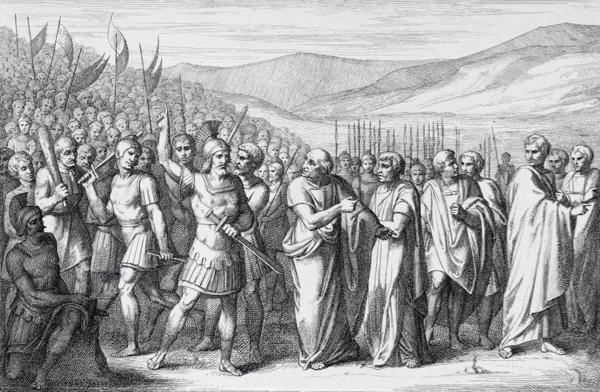
This was exploited by the plebeians in the first secessio plebis in 494 BC - a general strike in which the plebeians, rather than respond to military summons, left the city, gathered on the Mons Sacer and threatened to found a new town. Grievances included disadvantages in the allocation of land in colonies, armed Roman settlements built to subdue captured enemy territory, and the patricians' exclusive privileges. The patricians made significant concessions, including the institution of plebeian tribunes, representatives of the plebs who could influence the legislative process. The ongoing tug-of-war between the tribunes and the Senate occupies much of Livy's account.
Most of what we learnt in school, though, was about Rome's foreign wars, not her internal struggles. This is hardly surprising, since the conflict of the orders offers none of the dramatic bloodletting of Porsena's siege of Rome or the wars against Veii; but in truth the social conflict, mostly confined to forums and laws though it is, provides thrills aplenty. It also has the advantage of being less overgrown with fictions and the rigid narrative framework all accounts of foreign wars had to follow.
Livy includes a beautiful vignette that encapsulates the patricians' fears at the opening of his fourth book. Faced with the prospect of a bill brought by the plebeians that would legalise intermarriage between the orders - an unthinkable travesty to the aristocracy - the consuls M. Genucius and C. Curtius respond (4.1):
In all communities the qualities or tendencies which carry the highest reward are bound to be most in evidence and to be most industriously cultivated - indeed it is precisely that which produces good statesmen and good soldiers; unhappily here in Rome the greatest rewards come from political upheavals and revolt against the government, which have always, in consequence, won applause from all and sundry. Only recall the aura of majesty which surrounded the Senate in our father's day, and then think what it will be like when we bequeath it to our children! Think how the labouring class will be able to brag of the increase in its power and influence! There can never be an end to this unhappy process so long as the promoters of sedition against the government are honoured in proportion to their success. Do you realise, gentlemen, the appalling consequences of what Canuleius is trying to do? If he succeeds, bent, as he is, upon leaving nothing in its original soundness and purity, he will contaminate the blood of the ancient and noble families and make chaos of the hereditary patrician privilege od 'taking the auspices' to determine, in the public or private interest, what Heaven may will - and with what result? that, when all distinctions are obliterated, no one will know who he is or where he came from! Mixed marriages forsooth! What do they mean but that men and women from all ranks of society will be permitted to start copulating like animals? A child of such intercourse will never know what blood runs in his veins or what form of worship he is entitled to practise; he will be nothing - or six of one and half a dozen of the other, a very monster!We're not supposed to like these consuls (whose speech, of course, is fabricated wholecloth by Livy). The points made, though, are familiar: the belief that rampant disobedience to authority is crippling the commonwealth, as the Tories affirm; the notion that society, politically correct as it is, rewards the lazy and insubordinate; and lastly, a fear of what, in a different day and age, the Americans called miscegenation, which will lead to human beings becoming as beasts. There's nothing more heartening than reading millennia-old rants warning of the imminent collapse of human civilisation - it puts the Daily Heil in perspective.
We might call Livy's stance on all this broadly call patriotic: he firmly disapproves of internal strife that weakens Rome against her enemies. To this end, he demands justice for the plebeians and repeatedly censures the more arrogant of the patricians: but he also wishes the plebeians would cease to cause trouble. That Livy's narrative should be dominated by his desire for internal peace is hardly surprising. He was writing towards the end of the first century BC, when the period of vicious and hugely destructive civil wars - still within living memory - had ended with the dominance of Augustus, who is praised for restoring concord (even as Livy holds modern morals to be depraved).
Even as the plebeians fought for increased rights, they nonetheless had a stake in Roman society. In consequence they should not be reckoned the wretched of the earth but, perhaps, something of a labour aristocracy, set above the landless and the unfree. 'We propose that a man of the people may have the right to be elected to the consulship', argued Canuleius (4.1): 'Is that the same as saying some rogue who was, or is, a slave?'Social stratification eventually lead to the absorption of the richer plebeians into a broader Roman aristocracy, the nobilitas. It wasn't until the Social Wars and the slave risings of the first century BC that the dispossessed again threatened the integrity of Roman class society.
Labels:
antiquity,
conservatism,
empire,
historical materialism,
history,
war
Thursday, 15 December 2011
The trouble with pre-tribbers
I didn't expect it after the dire Left Behind, but Left Behind II: Tribulation Force (2002) is one of those things you hear so much about but never encounter: an improved sequel. To be sure, it's still cheaply made, poorly written and outrageously idiotic; but it is all these things to a lesser extent than the first film was, and it even adds a couple of legitimately watchable scenes.
You may recall that Left Behind gave us the Rapture as foretold by premillennial dispensationalists. In the blink of an eye, God snatched away every single child as well as every born-again Christian on earth. The remnant of the still-corporeal seemed to take this in their stride and soon had bigger things on their minds: the rise of obviously evil Nicolae Carpathia (Gordon Currie) to power at the United Nations.
At a UN meeting behind closed doors, Carpathia appointed ten lackeys to run the world for him. He also murdered two men in front of witnesses he then brainwashed - all except for Buck Williams, who was shielded from his mind control by 'accepting Christ' - and proclaimed the dawn of a single global government and the disarmament of the nations. This, it seems, was accepted by the international community without a single complaint - surprising, you might say, since Carpathia has no military force at his disposal to threaten anyone into compliance. This isn't your run-of-the-mill idiot plot: the very premise of Tribulation Force requires not just its protagonists, but pretty much everyone in the whole world to be a wretched moron.
Everyone, that is, but the ragtag bunch of American Christians who call themselves the Tribulation Force. As the film begins, we're told that in Israel, Tsion Ben-Judah (Lubomir Mykytiuk), the world's foremost religious scholar, is about to announce 'the single biggest piece of news in history'. (What, bigger than Jesus' crucifixion and resurrection? The filmmakers think so.) It seems that after careful study of the scriptures, Ben-Judah has determined the identity of the Messiah, and Nicolae Carpathia, who's just proclaimed a one-world religion, wants to make sure it's him.
Through personal connections - his ex-pseudo-mistress Hattie Durham (Chelsea Noble) is Carpathia's personal assistant - Rayford Steele (Brad Johnson) becomes the pilot of the Antichrist's personal plane. Buck Williams (Kirk Cameron), meanwhile, is sent to cover Ben-Judah's proclamation in Jerusalem for the Global News Network, and decides to take the scholar to meet the two extraordinarily shaggy witnesses (Les Carlsen and Louis Negin) who are preaching Christ at the Western Wall. The problem: Carpathia's UN soldiers have sealed off the area and have been ordered to shoot any trespassers.
This plot point is mind-bogglingly stupid. Recall, perhaps, that the United Nations don't have a standing army; recall further that Israel, which controls Jerusalem and is the only sovereign nation that has not been integrated into Antichrist's empire, isn't exactly known for its cooperation with international institutions, especially when said institutions are inflaming religious tensions by gunning down pilgrims. Even so, this is the plot we get. My recap in fact skips most of the film: for two thirds of its running time, Tribulation Force is treading water.
That wheel-spinning at least gives us the series' first gospel talk. For a Christian film, Left Behind was curiously devoid of Jesus, befitting the authors' reading of the Bible as a mass of coded prophecies. In Tribulation Force, though, we get the new character of Chris (David MacNiven), who's lost his family to the Rapture. He shares a pretty nifty scene with Rayford, which feels almost raw and human, and although the gospel as preached by Tribulation Force is all about sin and judgment and not about Jesus' attractive qualities, as well as being curiously free of reference to the world-shattering events of Left Behind, this alone makes Tribulation Force better than its predecessor.
There's also a contrived romantic subplot between Buck and Chloe Steele (Janaya Stephens), involving one of those misunderstandings we all love so much when Chloe mistakes Buck's sister Ivy (Krista Bridges) for his fiancée. (This trope is virtually never gender-flipped.) Because women are irrational, it's perfectly all right for Rayford and Buck to join forces in patronising and manipulating Chloe in amusing and heartwarming ways until the misunderstanding is resolved. Although I do love some sanitised, subtext-heavy romance, it's still a bit much to take, especially when Buck and Rayford go off to Israel and leave Chloe behind. (This, however, gives us several hilarious scenes of unmistakeable sexual tension between Chloe and Ivy. I don't think that was intentional.)
That sort of relief makes Tribulation Force rather more enjoyable than its dour predecessor. Directed by the hack Bill Corcoran, the film trumps the books by considering what would actually happen to the world in the wake of the Rapture - although it still does so much less successfully than, for example, Jim Munroe's terrific comic book Therefore Repent!, which wisely focuses on the human element. The film also ends in the wrong place, going for a limp warm glow where a shock setback at the close would have worked much better.
Then there's the questionable theology. 'We can't stop [Carpathia], we can't change the events of the Bible', Bruce Barnes (Clarence Gilyard) suggests. Well, that's all dramatic tension gone; but despite Bruce's claim, the Tribulation Force does manage to foil Carpathia in this film. It throws up a much larger question, though: in the rigid end-times chronology of premillennial dispensationalism, what space is there for human beings to act and affect events? What exactly is the TF to do? Ultimately, dispensationalism has a flawed understanding of the relationship between God's sovereignty and human free will, and that's a millstone around the neck of a series that already has a considerable number of strikes against it.
In this series: Left Behind: The Movie (2000) | Left Behind II: Tribulation Force (2002) | Left Behind: World at War (2005)
You may recall that Left Behind gave us the Rapture as foretold by premillennial dispensationalists. In the blink of an eye, God snatched away every single child as well as every born-again Christian on earth. The remnant of the still-corporeal seemed to take this in their stride and soon had bigger things on their minds: the rise of obviously evil Nicolae Carpathia (Gordon Currie) to power at the United Nations.
At a UN meeting behind closed doors, Carpathia appointed ten lackeys to run the world for him. He also murdered two men in front of witnesses he then brainwashed - all except for Buck Williams, who was shielded from his mind control by 'accepting Christ' - and proclaimed the dawn of a single global government and the disarmament of the nations. This, it seems, was accepted by the international community without a single complaint - surprising, you might say, since Carpathia has no military force at his disposal to threaten anyone into compliance. This isn't your run-of-the-mill idiot plot: the very premise of Tribulation Force requires not just its protagonists, but pretty much everyone in the whole world to be a wretched moron.
Everyone, that is, but the ragtag bunch of American Christians who call themselves the Tribulation Force. As the film begins, we're told that in Israel, Tsion Ben-Judah (Lubomir Mykytiuk), the world's foremost religious scholar, is about to announce 'the single biggest piece of news in history'. (What, bigger than Jesus' crucifixion and resurrection? The filmmakers think so.) It seems that after careful study of the scriptures, Ben-Judah has determined the identity of the Messiah, and Nicolae Carpathia, who's just proclaimed a one-world religion, wants to make sure it's him.
Through personal connections - his ex-pseudo-mistress Hattie Durham (Chelsea Noble) is Carpathia's personal assistant - Rayford Steele (Brad Johnson) becomes the pilot of the Antichrist's personal plane. Buck Williams (Kirk Cameron), meanwhile, is sent to cover Ben-Judah's proclamation in Jerusalem for the Global News Network, and decides to take the scholar to meet the two extraordinarily shaggy witnesses (Les Carlsen and Louis Negin) who are preaching Christ at the Western Wall. The problem: Carpathia's UN soldiers have sealed off the area and have been ordered to shoot any trespassers.
This plot point is mind-bogglingly stupid. Recall, perhaps, that the United Nations don't have a standing army; recall further that Israel, which controls Jerusalem and is the only sovereign nation that has not been integrated into Antichrist's empire, isn't exactly known for its cooperation with international institutions, especially when said institutions are inflaming religious tensions by gunning down pilgrims. Even so, this is the plot we get. My recap in fact skips most of the film: for two thirds of its running time, Tribulation Force is treading water.
That wheel-spinning at least gives us the series' first gospel talk. For a Christian film, Left Behind was curiously devoid of Jesus, befitting the authors' reading of the Bible as a mass of coded prophecies. In Tribulation Force, though, we get the new character of Chris (David MacNiven), who's lost his family to the Rapture. He shares a pretty nifty scene with Rayford, which feels almost raw and human, and although the gospel as preached by Tribulation Force is all about sin and judgment and not about Jesus' attractive qualities, as well as being curiously free of reference to the world-shattering events of Left Behind, this alone makes Tribulation Force better than its predecessor.
There's also a contrived romantic subplot between Buck and Chloe Steele (Janaya Stephens), involving one of those misunderstandings we all love so much when Chloe mistakes Buck's sister Ivy (Krista Bridges) for his fiancée. (This trope is virtually never gender-flipped.) Because women are irrational, it's perfectly all right for Rayford and Buck to join forces in patronising and manipulating Chloe in amusing and heartwarming ways until the misunderstanding is resolved. Although I do love some sanitised, subtext-heavy romance, it's still a bit much to take, especially when Buck and Rayford go off to Israel and leave Chloe behind. (This, however, gives us several hilarious scenes of unmistakeable sexual tension between Chloe and Ivy. I don't think that was intentional.)
That sort of relief makes Tribulation Force rather more enjoyable than its dour predecessor. Directed by the hack Bill Corcoran, the film trumps the books by considering what would actually happen to the world in the wake of the Rapture - although it still does so much less successfully than, for example, Jim Munroe's terrific comic book Therefore Repent!, which wisely focuses on the human element. The film also ends in the wrong place, going for a limp warm glow where a shock setback at the close would have worked much better.
Then there's the questionable theology. 'We can't stop [Carpathia], we can't change the events of the Bible', Bruce Barnes (Clarence Gilyard) suggests. Well, that's all dramatic tension gone; but despite Bruce's claim, the Tribulation Force does manage to foil Carpathia in this film. It throws up a much larger question, though: in the rigid end-times chronology of premillennial dispensationalism, what space is there for human beings to act and affect events? What exactly is the TF to do? Ultimately, dispensationalism has a flawed understanding of the relationship between God's sovereignty and human free will, and that's a millstone around the neck of a series that already has a considerable number of strikes against it.
In this series: Left Behind: The Movie (2000) | Left Behind II: Tribulation Force (2002) | Left Behind: World at War (2005)
Labels:
Christianity,
conservatism,
direct to video,
end times mania,
gender,
Jesus,
Middle East
Monday, 12 December 2011
What hath God wrought?
There's something oddly fascinating about end times mania. You may remember that the Rapture was supposed to happen earlier this year, as predicted by Christian radio host Harold Camping. Virtually nobody believed Camping's arcane numerology, but the media lavished undeserved attention on him, and Facebook was awash in mockery.
When the apocalypse failed to occur, Camping retired. The real story, though, wasn't that somebody claiming to have deciphered a secret message in the Bible had once again been wrong: it was that people cared, if only to ridicule. In 2011, billboards announcing the imminent fiery destruction of all life seemed to be a visible sign of the extraordinary times of economic and political crisis we're living through.
And where there's a cultural obsession there's a market. Enter Tim LaHaye and Jerry B. Jenkins with their Left Behind series of novels. Left Behind deals with the end of the world, all according to the teachings of premillennial dispensationalism. The books became a publishing phenomenon and would have turned their authors into millionaires if they hadn't been already. They mostly sold in the States, though: I've certainly seen Left Behind volumes prominently displayed in English Christian bookshops, but they remained largely unknown on this side of the pond.
It was inevitable there should be a film; and what a film! Left Behind promised to be the biggest, most ambitious Christian production of all time. Cloud Ten Pictures threw $17.4 million at the film despite realising it would go straight to video, as indeed it did: but strong sales led to Left Behind being thrown into cinemas after video release. Even so, it lost money and led Tim LaHaye to sue the producers, claiming they'd promised him a $40 million film. (Two direct-to-video sequels were produced, and there's supposedly a reboot in the offing.)
We open with a ludicrous fauxlosophic narration by Buck Williams (noted banana expert Kirk Cameron), followed by credits over stock footage of Jerusalem. Then we see something ominous: CGI warplanes approaching Israel both from the east and the west - and, for some reason, disgustingly fake-looking CGI tanks driving east across the Syrian border. Now it's time to meet Buck Williams, Greatest Investigative Reporter of All Time, standing in the Israeli desert (played by a quarry in Ontario) where, thanks to a miracle formula by Dr Chaim Rosenzweig (Colin Fox), corn is being grown. Dr Rosenzweig refuses to sell his formula, but he'll exchange it for peace for Israel, yada yada yada -
- and then Israel is attacked by planes from all directions. A great deal of silliness ensues, but the gist of it is that the massive, overwhelming attack is defeated by the hand of God pretty much swatting the planes out of the sky. (The identity of the attackers is never clarified, by the way: in the book it's Russia and Ethiopia, thus supposedly fulfilling Ezekiel's prophecy about Gog and Magog. Miracle!)
The film's special effects budget thus blown in the first five minutes, it's time to meet the Steeles. They're Rayford (Brad Johnson), a pilot; Irene (Christie MacFayden), his devoted born-again wife; and their children, twenty-year-old Chloe (Janaya Stephens - Lacey Chabert was originally attached to play this part) and pre-teen Raymie (Jack Manchester). Chloe has a nose ring, and dialogue establishes this means she's rebellious & unsaved. Blah blah, Rayford is emotionally unavailable and misses his son's birthday, Chloe is displeased, Irene is saintly, and Raymie is annoying. Then Rayford goes off to work.
Now, about half an hour in, we've finally reached the first page of the novel this is based on: we're on a flight out of Chicago. In the middle of the night, people begin to notice some of the adults and all the children seem to be missing. There's much panicking, and Rayford has to turn the plane around; there's chaos on the ground, too, as the disappearances, apparently global, have led to panic and accidents. (Chloe, for example, has to hit the brakes to avoid a pile-up caused by a disappeared lorry driver. This suggests Christians should not be issued driving licences.) Anyway, the cast realise that the disappearances are the supposedly foretold Rapture: God has whisked away his church, and a seven-year tribulation is about to begin on earth. At the same time, there's a charismatic young man, Nicolae Carpathia (Gordon Currie), rising to power at the UN with promises of world peace.
I don't believe in the Rapture. It's a nineteenth-century invention based on incredibly weak scriptural evidence. (Fred Clark has done excellent in-depth dissections of the books, by the way. His criticism is intelligent, Bible-based and, best of all, hilarious.) I find LaHaye and Jenkins's approach - cobble together bits of 'prophecy' from Revelation, Daniel, Ezekiel and wherever else you can find it into a maddeningly elaborate, fragile whole - both silly and deeply misguided. I've always been told not to waste my time with end-times prophecy since 'concerning that day and hour no one knows, not even the angels of heaven' (Matthew 24:36).
But even if I didn't have deep reservations about the film's happy-clappy attitude to the rivers turning into blood, it would still be a bad film. As directed by Vic Sarin and shot by George Tirl, Left Behind looks totally anonymous. (The 4:3 TV aspect ratio doesn't help.) It reeks of cheapness: apart from the initital all-out attack on Israel the rest of the film is talking, and the dialogue is very bad.So's the acting, by and large. Chelsea Noble, Kirk Cameron's real-life wife, is dispiritingly awful, acting mostly by blinking a lot.
But it's very rare for a film to achieve total worthlessness: the laws of probability dictate that something will almost always work out right. And so it is with Left Behind.
Imagine you're Brad Johnson. You may have been a Marlboro Man in the eighties, but for a brief time you were hot stuff after your roles in Spielberg's Always and Milius' Flight of the Intruder. It didn't work out, though: instead of becoming a star, you turned into the poor man's Tom Berenger. Now you're approaching middle age, you've got a mortgage to pay, and there's this part in a Christian film about the apocalypse. It's silly, it's low-budget, and it will go straight to video. How do you approach that role?
You and I would probably be phoning it in. But clearly, we're not Brad Johnson, because he takes one look at the dismal material and creates a believable, relatable character using nothing but good old-fashioned acting skills acquired over long, moderately unsuccessful years in the business. He turns Rayford Steele, obnoxious and vapid on the page, into an actual living, breathing human being. He could anchor the film, if only they hadn't decided to demote him to supporting cast.
This is worth mentioning because of the baffling contrast between Johnson and our nominal lead, Kirk Cameron in the role of Buck Williams. After his conversion to Christianity and the end of Growing Pains, Cameron became increasingly evangelistic and didn't do much acting in mainstream films anymore. As a fervent believer in 'prophecy' he wanted to do Left Behind and create the greatest/only evangelistic blockbuster of all time. They even rebalanced the material to make Buck the main character rather than part of an ensemble. But here's the thing: Cameron is terrible. He can't convincingly present things he actually passionately believes in. He is a very bad actor, and his presence is the equivalent of cement shoes to Left Behind.
It was a tremendously misguided enterprise from the start. Many of the scenes are laughable when they're meant to be sincere, and for some reason the filmmakers decided to shoehorn in contemporary Christian music whenever anyone shuts their mouth for more than a couple of seconds. Ultimately, though, Left Behind is tripped up by its theology as much as by the incompetence of most of those involved.
When Rayford Steele tells Hattie that '[i]t's not about us. It's about something bigger and something better', Left Behind's failure as a Christian work is laid open for all to see. Actually, it is about us; God does what he does because he loves human beings. We're not just ants to be slaughtered from heaven. It's no wonder LaHaye and Jenkins don't understand that, though. There is no Jesus in Left Behind, no cross and no forgiveness, only death and judgment; and I'm glad that's not the world we live in.
In this series: Left Behind: The Movie (2000) | Left Behind II: Tribulation Force (2002) | Left Behind: World at War (2005)
When the apocalypse failed to occur, Camping retired. The real story, though, wasn't that somebody claiming to have deciphered a secret message in the Bible had once again been wrong: it was that people cared, if only to ridicule. In 2011, billboards announcing the imminent fiery destruction of all life seemed to be a visible sign of the extraordinary times of economic and political crisis we're living through.
And where there's a cultural obsession there's a market. Enter Tim LaHaye and Jerry B. Jenkins with their Left Behind series of novels. Left Behind deals with the end of the world, all according to the teachings of premillennial dispensationalism. The books became a publishing phenomenon and would have turned their authors into millionaires if they hadn't been already. They mostly sold in the States, though: I've certainly seen Left Behind volumes prominently displayed in English Christian bookshops, but they remained largely unknown on this side of the pond.
It was inevitable there should be a film; and what a film! Left Behind promised to be the biggest, most ambitious Christian production of all time. Cloud Ten Pictures threw $17.4 million at the film despite realising it would go straight to video, as indeed it did: but strong sales led to Left Behind being thrown into cinemas after video release. Even so, it lost money and led Tim LaHaye to sue the producers, claiming they'd promised him a $40 million film. (Two direct-to-video sequels were produced, and there's supposedly a reboot in the offing.)
We open with a ludicrous fauxlosophic narration by Buck Williams (noted banana expert Kirk Cameron), followed by credits over stock footage of Jerusalem. Then we see something ominous: CGI warplanes approaching Israel both from the east and the west - and, for some reason, disgustingly fake-looking CGI tanks driving east across the Syrian border. Now it's time to meet Buck Williams, Greatest Investigative Reporter of All Time, standing in the Israeli desert (played by a quarry in Ontario) where, thanks to a miracle formula by Dr Chaim Rosenzweig (Colin Fox), corn is being grown. Dr Rosenzweig refuses to sell his formula, but he'll exchange it for peace for Israel, yada yada yada -
- and then Israel is attacked by planes from all directions. A great deal of silliness ensues, but the gist of it is that the massive, overwhelming attack is defeated by the hand of God pretty much swatting the planes out of the sky. (The identity of the attackers is never clarified, by the way: in the book it's Russia and Ethiopia, thus supposedly fulfilling Ezekiel's prophecy about Gog and Magog. Miracle!)
The film's special effects budget thus blown in the first five minutes, it's time to meet the Steeles. They're Rayford (Brad Johnson), a pilot; Irene (Christie MacFayden), his devoted born-again wife; and their children, twenty-year-old Chloe (Janaya Stephens - Lacey Chabert was originally attached to play this part) and pre-teen Raymie (Jack Manchester). Chloe has a nose ring, and dialogue establishes this means she's rebellious & unsaved. Blah blah, Rayford is emotionally unavailable and misses his son's birthday, Chloe is displeased, Irene is saintly, and Raymie is annoying. Then Rayford goes off to work.
Now, about half an hour in, we've finally reached the first page of the novel this is based on: we're on a flight out of Chicago. In the middle of the night, people begin to notice some of the adults and all the children seem to be missing. There's much panicking, and Rayford has to turn the plane around; there's chaos on the ground, too, as the disappearances, apparently global, have led to panic and accidents. (Chloe, for example, has to hit the brakes to avoid a pile-up caused by a disappeared lorry driver. This suggests Christians should not be issued driving licences.) Anyway, the cast realise that the disappearances are the supposedly foretold Rapture: God has whisked away his church, and a seven-year tribulation is about to begin on earth. At the same time, there's a charismatic young man, Nicolae Carpathia (Gordon Currie), rising to power at the UN with promises of world peace.
I don't believe in the Rapture. It's a nineteenth-century invention based on incredibly weak scriptural evidence. (Fred Clark has done excellent in-depth dissections of the books, by the way. His criticism is intelligent, Bible-based and, best of all, hilarious.) I find LaHaye and Jenkins's approach - cobble together bits of 'prophecy' from Revelation, Daniel, Ezekiel and wherever else you can find it into a maddeningly elaborate, fragile whole - both silly and deeply misguided. I've always been told not to waste my time with end-times prophecy since 'concerning that day and hour no one knows, not even the angels of heaven' (Matthew 24:36).
But even if I didn't have deep reservations about the film's happy-clappy attitude to the rivers turning into blood, it would still be a bad film. As directed by Vic Sarin and shot by George Tirl, Left Behind looks totally anonymous. (The 4:3 TV aspect ratio doesn't help.) It reeks of cheapness: apart from the initital all-out attack on Israel the rest of the film is talking, and the dialogue is very bad.So's the acting, by and large. Chelsea Noble, Kirk Cameron's real-life wife, is dispiritingly awful, acting mostly by blinking a lot.
But it's very rare for a film to achieve total worthlessness: the laws of probability dictate that something will almost always work out right. And so it is with Left Behind.
Imagine you're Brad Johnson. You may have been a Marlboro Man in the eighties, but for a brief time you were hot stuff after your roles in Spielberg's Always and Milius' Flight of the Intruder. It didn't work out, though: instead of becoming a star, you turned into the poor man's Tom Berenger. Now you're approaching middle age, you've got a mortgage to pay, and there's this part in a Christian film about the apocalypse. It's silly, it's low-budget, and it will go straight to video. How do you approach that role?
You and I would probably be phoning it in. But clearly, we're not Brad Johnson, because he takes one look at the dismal material and creates a believable, relatable character using nothing but good old-fashioned acting skills acquired over long, moderately unsuccessful years in the business. He turns Rayford Steele, obnoxious and vapid on the page, into an actual living, breathing human being. He could anchor the film, if only they hadn't decided to demote him to supporting cast.
This is worth mentioning because of the baffling contrast between Johnson and our nominal lead, Kirk Cameron in the role of Buck Williams. After his conversion to Christianity and the end of Growing Pains, Cameron became increasingly evangelistic and didn't do much acting in mainstream films anymore. As a fervent believer in 'prophecy' he wanted to do Left Behind and create the greatest/only evangelistic blockbuster of all time. They even rebalanced the material to make Buck the main character rather than part of an ensemble. But here's the thing: Cameron is terrible. He can't convincingly present things he actually passionately believes in. He is a very bad actor, and his presence is the equivalent of cement shoes to Left Behind.
It was a tremendously misguided enterprise from the start. Many of the scenes are laughable when they're meant to be sincere, and for some reason the filmmakers decided to shoehorn in contemporary Christian music whenever anyone shuts their mouth for more than a couple of seconds. Ultimately, though, Left Behind is tripped up by its theology as much as by the incompetence of most of those involved.
When Rayford Steele tells Hattie that '[i]t's not about us. It's about something bigger and something better', Left Behind's failure as a Christian work is laid open for all to see. Actually, it is about us; God does what he does because he loves human beings. We're not just ants to be slaughtered from heaven. It's no wonder LaHaye and Jenkins don't understand that, though. There is no Jesus in Left Behind, no cross and no forgiveness, only death and judgment; and I'm glad that's not the world we live in.
In this series: Left Behind: The Movie (2000) | Left Behind II: Tribulation Force (2002) | Left Behind: World at War (2005)
Labels:
Christianity,
conservatism,
direct to video,
end times mania,
Jesus,
Middle East
Friday, 23 September 2011
Jan Fleischhauers Kampf gegen das Böse
An dieser Stelle eine Fußnote zu meiner längeren Polemik gegen Jan Fleischhauer, die konservative Ein-Mann-Sturmabteilung des Spiegels. Fleischhauer hat sich diesmal linke Verschwörungstheorien vorgeknöpft, vor allem zur Griechenlandkrise, eigentlich aber zu diesem und jenem, wie das in seiner Kolumne oft der Fall ist.
Fleischhauers rhetorische Taktik ist barbarisch einfach. Zunächst einmal wird sarkastisch der "unbedarfte Zeitgenosse" vorausgesetzt, der nicht in der seltsamen Welt der Linken lebt: Volkes Stimme, deren simple Vernunft der linken Meinungselite nicht gut genug ist - so sei "der Niedergang Griechenlands Folge einer Politik, die auf übermäßige Schulden statt auf Wachstum setzte, und für die nun, mit Verspätung, die Rechnung präsentiert wird". Daß dieser common sense stets mit der Meinung von Kanzlerin und Konservatismus übereinstimmt, muß Zufall sein.
Der offenkundigen Wahrheit wird nun ein Strohmann gegenübergestellt, der ausschließlich glaubt, was dumm, verrückt und außerdem dem gemeinen Volke schädlich ist: "die Linken" als solche. Ob Fleischhauer dabei im Einzelfall recht hat (was allgemein nicht der Fall ist), ist nicht wichtig, da er sich mit seiner fehlerhaften Argumentationsweise schon selbst aushebelt und des konkreten Gegenbeweises gar nicht bedarf.
Am schönsten aber ist Fleischhauers Zusammenstellung der verabscheuten Verschwörungstheoretiker:
Ist denn nun die griechische Katastrophe den Machenschaften der Banken zuzuschreiben? Natürlich nicht. Ebenso wie die Finanzkrise hat niemand die Eurokrise beabsichtigt. Aber dieses Beben, das niemand wollte und mit dem zunächst niemand umzugehen wußte, hat sich doch als Geschenk für gewisse Interessen erwiesen. In Großbritannien ergab sich daraus die Chance, aus einer mutmaßlichen Schuldenkrise die schon lange gewünschte Abwicklung des Sozialstaates zu postulieren; in Griechenland wird der öffentliche Dienst des Landes an internationale Firmen verscherbelt. Naomi Klein, die Fleischhauer wohl nicht gelesen hat, behauptet eben nicht, daß Weltkrisen von bestimmten Gruppen absichtlich ausgelöst werden, sondern daß die Ideologie der Chicago School ihre Jünger dazu befähigt, unabhängig entstehende Krisen in eine neoliberale Richtung zu lenken.
Fleischhauer ist auch darum ein Ritter von der traurigen Gestalt, weil er alle jene Züge, die er auf die Linke projiziert, selber aufweist. Ein Mensch, der sich dem Kreuzzug gegen alles Linke verschrieben hat, dürfte wohl als paranoid beschrieben werden; und wer sich als publizistischer Guerillero versteht, der zieht wohl gegen böse Machenschaften ins Feld. Die verschwörerische Deutung der Griechenlandkrise, die Fleischhauer übrigens gar nicht belegt - es muß sie geben! - ist mir dabei völlig unbekannt, obwohl ich unter Linken ein- und ausgehe. Fleischhauers Spiegelfechtereien ärgern mich nicht wegen ihres Gehalts, denn sie haben keinen. Mich wurmt das Spöttisch-Herablassende von jemandem, der zu Überlegenheitsgefühlen reichlich wenig Anlaß hat.
Fleischhauers rhetorische Taktik ist barbarisch einfach. Zunächst einmal wird sarkastisch der "unbedarfte Zeitgenosse" vorausgesetzt, der nicht in der seltsamen Welt der Linken lebt: Volkes Stimme, deren simple Vernunft der linken Meinungselite nicht gut genug ist - so sei "der Niedergang Griechenlands Folge einer Politik, die auf übermäßige Schulden statt auf Wachstum setzte, und für die nun, mit Verspätung, die Rechnung präsentiert wird". Daß dieser common sense stets mit der Meinung von Kanzlerin und Konservatismus übereinstimmt, muß Zufall sein.
Der offenkundigen Wahrheit wird nun ein Strohmann gegenübergestellt, der ausschließlich glaubt, was dumm, verrückt und außerdem dem gemeinen Volke schädlich ist: "die Linken" als solche. Ob Fleischhauer dabei im Einzelfall recht hat (was allgemein nicht der Fall ist), ist nicht wichtig, da er sich mit seiner fehlerhaften Argumentationsweise schon selbst aushebelt und des konkreten Gegenbeweises gar nicht bedarf.
Am schönsten aber ist Fleischhauers Zusammenstellung der verabscheuten Verschwörungstheoretiker:
Es ist kein Zufall, dass sich das paranoide Denken vor allem in den kritischen Kreisen hält. Wer laufend gegen das Böse kämpft, gegen übermächtige Feinde und böse Machenschaften, dessen Gemütszustand ist naturgemäß etwas angespannt. Der Kampf gegen drohendes Unheil, sei es der Atomtod oder die Diktatur der Finanzmärkte, gibt dem Leben Richtung und Sinn, was sich bei der Nachwuchsgewinnung durchaus bezahlt macht. Nur führt die nervöse Weltsicht eben auch dazu, dass sich die Perspektiven verschieben und der Realitätssinn leidet. Von der Rede über das "System" bis zur Annahme, dass SIE im Hintergrund die Fäden ziehen, ist es nur ein kleiner Schritt.Ein treffenderes Selbstportrait hätte Fleischhauer kaum gelingen können, hat er sich doch dem Kampfe gegen das durchaus als böse empfundene linke Meinungsmonopol verschrieben. "Die Linke" ist für ihn eine Masse, die mit einem Willen alles unterminiert, was ihm lieb und teuer ist - wobei seine Monomanie die zur Schau getragene spöttische Überlegenheit Lügen straft. Eben weil er die Linke als geschlossene Feindesmacht begreift, kann er Naomi Klein, 9/11-Verschwörungstheoretiker und erfundene Positionen vermengen, ohne mit der Wimper zu zucken. Es ist letztlich doch alles eins.
Ist denn nun die griechische Katastrophe den Machenschaften der Banken zuzuschreiben? Natürlich nicht. Ebenso wie die Finanzkrise hat niemand die Eurokrise beabsichtigt. Aber dieses Beben, das niemand wollte und mit dem zunächst niemand umzugehen wußte, hat sich doch als Geschenk für gewisse Interessen erwiesen. In Großbritannien ergab sich daraus die Chance, aus einer mutmaßlichen Schuldenkrise die schon lange gewünschte Abwicklung des Sozialstaates zu postulieren; in Griechenland wird der öffentliche Dienst des Landes an internationale Firmen verscherbelt. Naomi Klein, die Fleischhauer wohl nicht gelesen hat, behauptet eben nicht, daß Weltkrisen von bestimmten Gruppen absichtlich ausgelöst werden, sondern daß die Ideologie der Chicago School ihre Jünger dazu befähigt, unabhängig entstehende Krisen in eine neoliberale Richtung zu lenken.
Fleischhauer ist auch darum ein Ritter von der traurigen Gestalt, weil er alle jene Züge, die er auf die Linke projiziert, selber aufweist. Ein Mensch, der sich dem Kreuzzug gegen alles Linke verschrieben hat, dürfte wohl als paranoid beschrieben werden; und wer sich als publizistischer Guerillero versteht, der zieht wohl gegen böse Machenschaften ins Feld. Die verschwörerische Deutung der Griechenlandkrise, die Fleischhauer übrigens gar nicht belegt - es muß sie geben! - ist mir dabei völlig unbekannt, obwohl ich unter Linken ein- und ausgehe. Fleischhauers Spiegelfechtereien ärgern mich nicht wegen ihres Gehalts, denn sie haben keinen. Mich wurmt das Spöttisch-Herablassende von jemandem, der zu Überlegenheitsgefühlen reichlich wenig Anlaß hat.
Subscribe to:
Comments (Atom)